
You need reliable part precision to make your project work. Subtractive CNC machining delivers great accuracy and easy-to-grow production output. However, high starting equipment costs and leftover material waste create real financial limits.
As buying experts, engineering managers, or business owners, you must check your returns carefully. You can balance technical strengths against money drawbacks to keep your project doable. Checking single-item costs helps you weigh major pros and cons before making parts. This guide helps you handle key shop choices. You can get the best advantages of CNC machining while reducing daily waste. Knowing these trade-offs unlocks full CNC machining benefits for your business using top-tier CNC gear and dependable CNC systems.
CNC machining provides top precision for making tricky metal and plastic parts.
Automated CNC tools run non-stop to increase factory output and speed.
Because the machines and initial prep work are so costly, making a small number of items is pricey.
Subtractive cutting makes extra leftover material that raises the overall cost of the part.
Big orders over 250 units lower the price for each part a lot when compared to 3D printing.
Multi-axis CNC tools craft tricky parts faster because they need fewer hand adjustments.
Smart factory software and quality rules make sure that parts work reliably well.
First, you make a digital CAD model of your part. Computer-aided manufacturing software turns this design into clear G-code directions. This digital code guides your machinery to trim material away from a solid block of metal or plastic.
Your machine bed firmly clamps the solid workpiece while cutting. Drive motors glide the cutting tool along set paths to form the final piece. Strict quality rules like ISO 9001:2015 and AS9100D guide these steps to keep the build safe.
Simple equipment moves tools across three straight X, Y, and Z axes. Advanced systems use rotating axes to shape hard parts. Cutting settings like spindle speed and feed rate directly affect your surface smoothness and tool pushing force.
Picking the right tools matches your workpiece material to keep chip loads steady. Normal shop work hits accuracy levels between ±0.127 mm and ±0.254 mm. Precision machining tightens these measures down to ±0.0254 mm, while top precision reaches ±0.0025 mm.
A CNC lathe spins a round workpiece against a still cutting blade. This simple tool quickly shapes round metal pins, long shafts, and bushings. Basic two-axis gear handles light turning jobs with fast results.
A modern turning center adds spinning blades to mill, drill, and tap parts at once. These top machines run automatically with bar feeders and extra holding spindles. They create ultra-smooth surfaces under Ra 0.4 μm for critical car and hospital tools.
Vertical CNC milling tools point cutting blades straight down onto the flat workpiece. Operators can easily watch the cutting area, load clamping gear, and check part shapes. These setups work best for flat plates, forming dies, and basic frame items.
Horizontal CNC milling centers mount their spinning tools sideways using tall holding blocks. Metal chips drop off the part naturally so tools do not cut old waste. This clean setup saves tool teeth and boosts overall factory output during big jobs.
Modern 5-axis CNC machines mix two turning movements with three straight path axes. You can tilt and flip parts to shape five sides using one clamp setup. This quick method cuts extra holding steps by 70 to 80 percent.
These smart CNC tools shape curved plane turbine blades and artificial bone parts effortlessly. Choosing 5-axis CNC setups lowers part build times by 40 to 60 percent. Smart tool angles preserve sharp cutting edges much longer, while automated setups keep high product flows going.
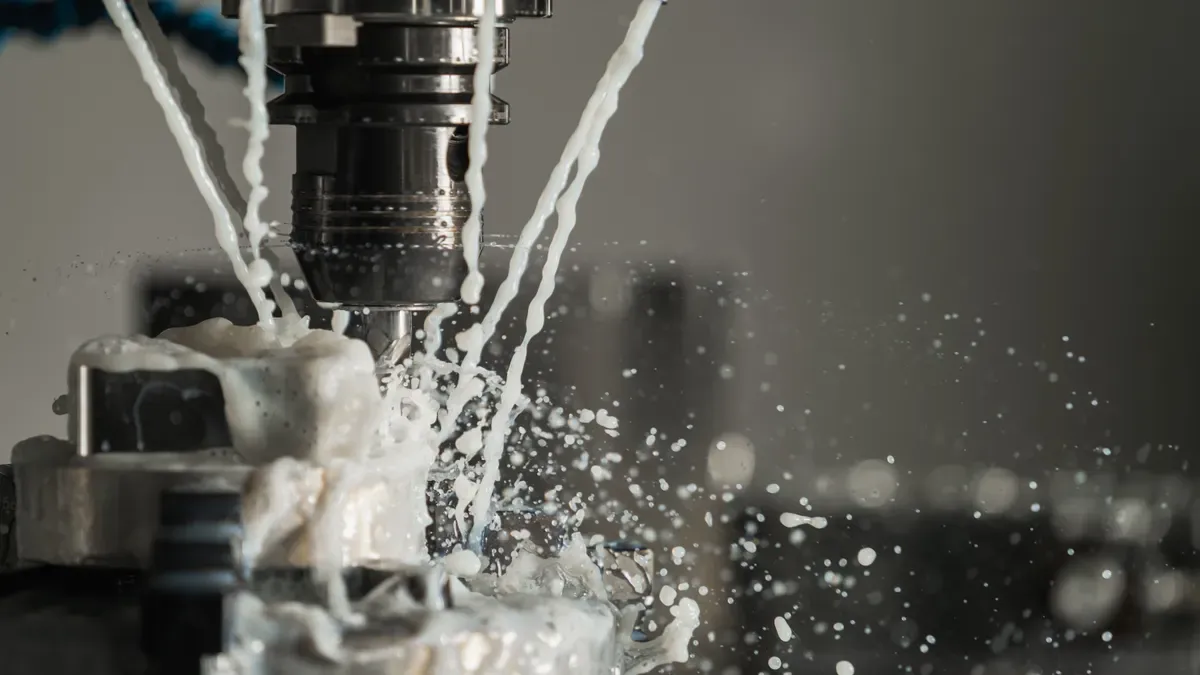
Image Source: pexels
Modern factories rely on subtractive systems to deliver superior accuracy on critical workpieces. High precision and accuracy allow computer-guided cutting tools to hold tolerances as tight as 0.0001 inches. These tight specs help aerospace, defense, and medical equipment builders complete demanding builds without standard design errors. Specialized equipment, like the TAIZHENG TMU-400 5-Axis CNC Machining Center, maintains micron-level positioning control to yield fine surface quality across delicate contours.
Consistent product quality stays reliable across every single cycle. The digital program executes identical cutting movements each time, so the 500th unit perfectly matches the first unit. This reliability lowers total scrap rates by 15 to 30 percent compared to manual shop cutting methods. You achieve high precision and accuracy across your entire run, which keeps quality control high while streamlining part inspection procedures.
Digital automation removes manual operator mistakes during critical cutting steps. Enclosed work zones keep workers safe while automated systems guide sharp tools along programmed paths. You upload the CAD file once, and the automated machine executes the code without human physical fatigue.
The TAIZHENG RA-550MY Turn-Mill Lathe combines turning and milling operations in one setup to limit human handling. Fewer part relocations minimize positioning errors across complex runs. Operators simply supervise automated operations, which helps lower shop labor costs by 40 to 60 percent during large production schedules.
Unattended running capability dramatically boosts factory efficiency. Automated CNC machines run continuously overnight with minimal manual supervision. Fast automatic tool changers switch cutters within seconds, which keeps high production and scalability steady throughout long runs.
Continuous running boosts overall increased production efficiency while speeding delivery schedules. Stored code allows easy repeatability of designs whenever you start new batches later. This steady processing ensures faster production speed for urgent orders, driving real technical advantages of CNC machining across modern manufacturing networks.
Digital manufacturing connects early design models directly to final factory output. Software converts CAD designs into G-code rapidly to generate functional prototypes for early testing. You check physical part fit and performance before launching big manufacturing runs.
Transitioning from early testing to full production requires zero physical tooling rebuilds. You run the same stored digital program to achieve increased production efficiency across larger batches. This seamless transition speeds market entry while maintaining high quality standards.
Advanced multi-axis CNC milling machines turn raw parts to cut many sides in a single setup. Moving on multiple axes lets you build complex shapes with deep spaces, tight cuts, and detailed 3D curves.
CNC Advantage Category | Primary Operational Benefit
Setup Reduction | Limits repositioning errors and saves bench time
Complex Geometries | Enables intricate multi-surface contours and angles
Continuous Automated Machining | Drives 24/7 capacity with automatic tool changes
Cutting out extra setups cuts down human handling mistakes and saves precious shop time. Big advantages of CNC milling include forming complex geometry with sharp precision on all sides. These main advantages of CNC machines give engineers full freedom to craft tricky hardware.
Material versatility lets shops work on tough structural metals, plastic blocks, and hard superalloys using the same gear. Modern CNC machines slice aluminum, stainless steel, titanium, PEEK, and brass while keeping precise cuts. Choosing the best feed rates and spindle speeds extends tool life across soft and hard metals.
Using multi-axis equipment offers great advantages of CNC machining when carving tough metal alloys. The main advantages of CNC milling help factories produce strong, top-quality parts for tough real-world uses. Buying modern CNC equipment gives your company great manufacturing flexibility, smooth shop output, and strong overall CNC machining benefits.
Starting costs are a top issue among the disadvantages of cnc machining for growing shops. Normal 3-axis cnc mills start around $50,000, but high-end 5-axis systems cost over $200,000. Big price tags make real limits for small firms that need modern gear.
Good cnc machines need big money for tools, programs, and setup. Extra building work, like power lines, can add $5,000 to $30,000 to shop costs. You must review these disadvantages of cnc machines carefully before spending cash on big jobs.
Every new job needs careful setup before cutting begins. Making code and setting up parts takes 2 to 8 hours for a medium part. Simple setups cost $50 to $150, but hard setups run from $500 to over $1,000.
These fixed costs lower profits on small jobs. Setup and code take 30% to 50% of the total budget for test parts. Thus, short runs show clear disadvantages in unit price compared to big factory runs.
Cutting parts away creates lots of metal trash. Hard shapes can hit high cnc waste rates reaching 60% to 80%. Materials make up 40% to 60% of job costs, so wasted trash drives up unit prices.
You can cut scrap with better layout paths to minimize material waste. Yet, lost material stays a major issue among disadvantages of cnc milling next to casting or molding.
Tool reach creates physical limits when carving parts. Round blades cannot cut square 90-degree inside corners, so you need a curved radius. You must also watch size limitations of cnc tooling to stop tool bend in deep holes.
Keeping hole depth under four times the tool size stops vibration and part bending. Thin walls also cause problems. You need a minimum wall thickness of 0.8 mm for metal to keep parts strong during milling. These facts show main disadvantages of cnc milling when designing parts.
Running smart cnc machines needs trained shop workers. Operators must know G-code lines, CAD/CAM design programs, and machine tuning. A lack of skilled workers can stall shop work and raise training costs for staff.
Complex mechanical parts like spindle drives and control boxes need regular care. Sudden breakdowns raise repair bills and cause unwanted shop delays. Skilled workers must handle these complex repairs to keep reliable cnc precision.
Buying teams must compare item costs across shop methods to pick the right choice. 3D printing builds parts layer by layer without special tools. Yet, cutting methods run faster as batch sizes grow bigger.
Production volume | Cost-effective process | Typical per-part cost | Key economic driver |
|---|---|---|---|
1–50 units | Additive manufacturing | $100–$500 | No tooling costs; AM can be about $140 less per part than CNC for aerospace components |
50–250 units | Either method | $80–$250 | Break-even zone; simple parts may switch to CNC around 100 units, while complex parts can remain cost-effective with AM up to about 200 units |
250+ units | Subtractive/CNC | $30–$100 | Tooling amortizes and CNC production speed lowers unit cost, often below $50 above 500 units |
Small orders favor 3D printing because startup charges stay low. Big factory jobs give the lead to cnc machining. Automatic machines cut item costs quickly when orders grow past 250 pieces. You get clear money savings through faster job times on big runs.
How strong your finished part stays depends mostly on the chosen method. Hard metal blocks give safe part strength during cnc machining.
Criterion | CNC machining | Additive manufacturing |
|---|---|---|
Structural integrity | Machined from solid billet; isotropic material properties with intact grain structure; mechanical behavior matches published material data. | Layer-by-layer build can create anisotropic strength; build-direction strength differs; porosity may occur if process parameters are not tightly controlled. |
Surface finish | Typically production-ready off the machine; can be further improved with grinding or finishing passes. | Generally requires post-processing on functional/mating surfaces, adding time, cost, and dimensional uncertainty. |
Normal cutting methods keep full material strength. You get steady results straight off the tool without extra smoothing steps. Solid internal strength makes cnc standard parts safer for heavy work.
Buying shop tools means paying extra costs past the price tag. A basic 3-axis mill costs $50,000 to $150,000. Workers make $55,000 to $75,000 every year. CAM software costs $2,000 to $10,000 yearly, and repairs take 3% to 5% of tool value each year. Floor room adds $5 to $15 per square foot every year.
Hiring outside shops avoids set overhead costs by moving expenses into changing unit prices. You check inside shop work using this simple formula: Breakeven Volume = Annual In-House Fixed Costs / (Outsourced Per-Unit Price – In-House Per-Unit Variable Cost). A firm with $85,000 in set costs, a $150 outside price, and a $50 inside unit cost breaks even at 850 parts a year. Under that amount, outside shops help you skip tough budget limits.
Growing inside output needs trusted gear to boost overall shop output. New TAIZHENG cnc machines lower hand work using smart automatic features. High precision cnc equipment keeps part accuracy safe across long automated jobs.
Setting up automatic TAIZHENG cnc tools helps shops balance worker pay and job amounts. Connected systems send G-code steps straight to multi-axis setups. These top cnc machines raise general output on tricky parts, changing shop limits into steady gains.
You must evaluate part geometry and batch size early to control manufacturing spend. Modern subtractive manufacturing cuts unit pricing when order volumes grow, but small batch production requires careful initial planning. Setting clear batch parameters allows automated equipment to run smoothly and keeps unit costs balanced across every stage of production.
Designing parts according to established design for manufacturability rules simplifies shop floor execution and lowers overall scrap risk. Specifying loose tolerances reduces required machine steps, while unnecessarily tight specs add setup time and increase total job costs.
DFM Criterion | Suitability Signal | Design Rule |
|---|---|---|
Internal corner radii | Sharp internal corners stop cylindrical end mills. | Specify a minimum internal radius of at least 0.030". |
Feature orientation | Five-axis cuts raise production expense and lead time. | Orient holes and slots along standard axes whenever possible. |
Tolerance specification | Tolerances tighter than ±0.002" require strict climate controls. | Treat ±0.005" as your baseline tolerance standard. |
Surface finish | Extremely fine surface finishes add extra machining passes. | Use a standard machined finish between 63-125 Ra. |
Evaluating potential supplier capabilities requires a thorough review of quality systems and formal certifications. You must verify that your chosen manufacturing partner maintains verified standards to ensure consistent part accuracy across large jobs.
General manufacturing environments require ISO 9001:2015 quality management systems.
Medical device hardware demands certified ISO 13485:2016 compliance.
Aerospace parts require AS9100D controls for full material lot traceability.
High-volume automated production jobs require process capability reaching Cpk >= 1.33.
Calibrated coordinate measuring machines and documented first-article reports give you verifiable proof of quality. Reviewing real inspection reports helps you confirm actual shop precision and performance before placing critical orders.
Partnering with a single integrated manufacturer eliminates supply chain delays and improves overall production efficiency. Advanced CNC machine units connect directly to smart factory software to schedule cutting operations, update job tracking, and speed delivery times.
Modern CNC equipment delivers greater reliability than older shop tools because connected machines experience fewer sudden breakdowns. You should choose vendors that utilize automated CNC setups, offer transparent order tracking, and communicate potential production delays proactively.
Criterion | What to Evaluate |
|---|---|
Machine capabilities | Confirm total count of 3-axis, 4-axis, and 5-axis CNC machines. |
Quality control | Verify CMM equipment and digital QC inspection reports. |
Sourcing transparency | Ask suppliers for their actual in-house vs outsourced production ratio. |
Selecting reliable CNC partners ensures smooth operations, consistent quality, and lower total expenses for all your complex part builds.
Making factory choices means weighing good points and bad points. Cutting parts away brings great part quality, quick build speeds, and big gains for tough jobs. High starting tool costs are clear downsides for tiny batches. But automated machine work splits setup costs over larger orders to boost unit savings. You unlock clear benefits by checking your technical plans early using a full DFM check.
Choose cnc machining systems over alternative processes when your design demands tight tolerance specifications near ±0.025 mm, versatile metal alloys, and scalable mid-volume outputs.
Using smart cnc steps ensures top cnc machining benefits while keeping your total project costs easy to guess.
CNC machining gives super fine precision and exact matching parts. You get very tight cuts down to ±0.0025 mm on strong metal blocks. This process removes human mistakes and keeps quality high on every item you make.
3D printing saves money on small orders of less than 50 parts. But subtractive cnc machines drop part prices a lot when you make over 250 pieces. You get faster work and stronger materials on big orders.
Workers need two to eight hours to write G-code and set up parts for new jobs. Small orders share these fixed costs over just a few pieces. Bigger orders split setup fees over many items to drop unit prices.
Yes, modern automated cnc tools run all day and night with very little help. Automatic tool changers swap cutting bits in a few seconds. You can load metal blocks, run code overnight, and raise total shop output.
You can cut strong metals, tough plastics, and heavy high-performance alloys. CNC machining cuts aluminum, stainless steel, titanium, PEEK, and brass. You just change turning speeds and push rates to save cutting bits.
Advanced 5-axis gear spins parts to cut many sides in just one clamp setup. This trick cuts manual part flipping by 70 to 80 percent. Moving parts less cuts placement mistakes and keeps your product measures exact.
Pick cnc machining when your design needs super tight measures near ±0.025 mm and immediate part strength. Cutting machines skip costly custom molds while keeping full, solid strength from raw metal blocks.


