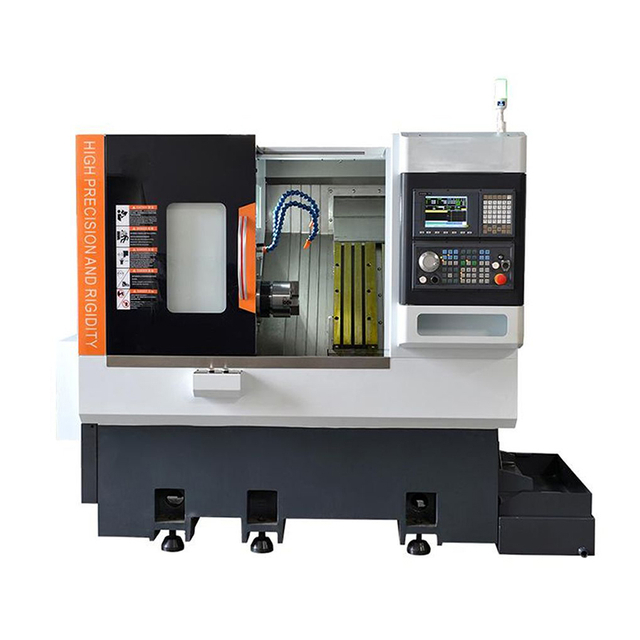
A Gang Tool Lathe is a CNC lathe specifically designed for high-speed turning of small, repetitive parts. Instead of using a rotating turret, multiple cutting tools are mounted side-by-side on a fixed tool plate, allowing rapid tool changes through simple linear movement.
Gang tool lathes are optimized for short cycle times, high rigidity, and consistent accuracy, making them ideal for high-volume small-part production.
A gang tool lathe is a CNC turning machine that uses a fixed gang tooling arrangement rather than a traditional turret. All tools are mounted in advance and remain in position throughout the machining cycle.
Key characteristics include:
No turret indexing or rotation
Extremely short tool-change distance
Simple, rigid tool mounting
Stable performance in repetitive operations
This design prioritizes speed and stability over tool quantity or complexity.
Cycle time reduction is the primary reason manufacturers choose gang tool lathes.
Unlike turret lathes, which require time to rotate and index tools, gang tool lathes:
Eliminate turret rotation delays
Switch tools using fast linear axis movement
Maintain continuous machining flow
For small parts, even fractions of a second saved per operation can result in significant productivity gains over large production volumes.
The difference between gang tool and turret lathes lies in machine structure and motion, not just tooling preference.
Gang Tool Lathe
Tools are fixed and aligned
Tool changes are linear and immediate
Optimized for speed and repeatability
Turret Lathe
Tools are mounted on a rotating turret
Tool changes require indexing and positioning
Better suited for complex, multi-operation parts
Gang tool lathes excel when simplicity and speed are more important than flexibility.
| Comparison Aspect | Gang Tool Lathe | Turret Lathe |
|---|---|---|
| Tooling Structure | Fixed tools mounted side-by-side on a rigid gang plate | Tools mounted on a rotating turret |
| Tool Change Method | Linear axis movement | Turret indexing and rotation |
| Tool Change Time | Extremely short, no indexing delay | Longer due to turret rotation and positioning |
| Mechanical Complexity | Simple, fewer moving parts | More complex rotating mechanism |
| Rigidity | High rigidity due to fixed tooling | Lower rigidity due to rotating turret mass |
| Best-Fit Production Style | High-volume, repetitive small parts | Medium complexity, mixed operations |
| Cycle Time Stability | Very consistent across long runs | Slight variation due to indexing |
| Typical Tool Quantity | Limited, pre-arranged tools | Higher tool capacity |
| Machine Footprint | Compact | Larger due to turret assembly |
Gang tool lathes prioritize speed and rigidity
Turret lathes prioritize tool flexibility
For small, repetitive parts, eliminating turret indexing can significantly improve throughput and consistency.
Gang tool lathes are most effective for parts with the following characteristics:
Small-diameter shafts or pins
Threaded components
Bushings and connectors
Simple profiles with repeated operations
High-volume, low-variation production
These machines are commonly used where consistency and throughput matter more than machining complexity.
Gang tool lathes offer excellent rigidity due to:
Short tool overhang
Fixed tool mounting
Reduced mechanical movement
This rigidity improves:
Dimensional stability
Surface finish consistency
Accuracy on small and slender parts
For small-diameter components, stable cutting conditions are critical to avoid vibration and deflection.
Gang tool lathes are well suited for machining materials that benefit from fast, stable turning:
Aluminum alloys
Brass and copper
Mild and low-carbon steels
Engineering plastics
These materials are commonly used in small precision components and are ideal for high-speed production environments.
A conventional CNC lathe offers greater flexibility for varied operations and tooling configurations. However, when production focuses on small, repetitive parts, a gang tool lathe often delivers better efficiency.
Choose a gang tool lathe when:
Parts are small and simple
Production volume is high
Cycle time is a critical factor
Tool changes dominate machining time
Choose a conventional CNC lathe when:
Parts require many tools
Machining operations are complex
Flexibility is more important than speed
| Comparison Aspect | Gang Tool Lathe | Conventional CNC Lathe |
|---|---|---|
| Primary Design Goal | Maximum speed for small parts | Versatile turning capability |
| Tool Mounting | Fixed gang tooling | Turret or flexible tool holders |
| Tool Change Efficiency | Very high | Moderate |
| Setup Strategy | Pre-configured for repetitive jobs | Adaptable to varied part types |
| Production Volume | High volume, low variation | Low to medium volume, high variation |
| Programming Complexity | Simple, repetitive programs | More complex, multi-operation programs |
| Machine Utilization | Continuous, long-run production | Frequent job changes |
| ROI Focus | Cycle time reduction | Operational flexibility |
Choose a Gang Tool Lathe when:
Parts are small and repetitive
Cycle time is critical
Tool paths are simple and repeatable
Choose a Conventional CNC Lathe when:
Parts vary frequently
Tooling requirements are complex
Flexibility is more important than speed
Gang tool lathes are not low-end machines
They are specialized tools optimized for efficiency.
They are not suitable for every part
Complex geometries may require turret or turn-mill machines.
Speed does not compromise accuracy
Proper rigidity and fixed tooling improve consistency in small-part machining.
Understanding these points helps manufacturers select the right machine for the right job.
Ultra-short tool change time
High rigidity for small-diameter parts
Stable and repeatable machining performance
Ideal for high-volume production
Compact and efficient machine layout
Our gang tool lathes are engineered to maximize productivity where speed and consistency are essential.
It is used for high-speed turning of small, repetitive parts.
Yes, for small-part production, it is typically much faster due to reduced tool change time.
Small shafts, threaded parts, pins, bushings, and similar components.
It is best suited for simple geometries; complex parts may require turret or turn-mill machines.
A gang tool refers to a tooling arrangement where multiple cutting tools are mounted side-by-side on a fixed tool plate rather than on a rotating turret. In CNC turning, gang tools are positioned in advance and selected by linear axis movement instead of turret indexing.
This configuration minimizes tool change time and improves rigidity, making it ideal for high-speed machining of small, repetitive parts.
A lathe tool is a cutting tool used on a lathe to remove material from a rotating workpiece. Lathe tools are designed for specific operations such as turning, facing, threading, grooving, and boring.
In gang tool lathes, lathe tools are typically mounted rigidly on a fixed plate to maximize stability and reduce tool movement.
The key difference lies in tool mounting and tool change motion:
Gang tooling uses fixed tools mounted side-by-side, with tool changes performed by simple linear movement.
Turret tooling mounts tools on a rotating turret, requiring indexing and positioning between operations.
Gang tooling prioritizes speed and rigidity, while turret tooling prioritizes tool quantity and flexibility.
A gang lathe (or gang tool lathe) is a CNC lathe designed to use gang tooling instead of a turret. It is optimized for fast cycle times, stable cutting, and high-volume production of small parts.
Gang lathes are commonly used for repetitive components where reducing tool change time has a significant impact on productivity.
Lathe tools can be broadly classified into three main types:
Turning tools – for external and internal turning operations
Facing tools – for machining flat surfaces at the end of a workpiece
Boring tools – for enlarging or finishing internal holes
These tool types are commonly arranged in a gang tool setup for sequential operations.
Yes. Boring is a standard lathe operation used to enlarge or finish an existing hole. In gang tool lathes, boring tools are often included in the tool lineup to perform internal machining without changing setups.
When machining small parts in high volumes, reducing tool change time and maintaining rigidity can dramatically improve output. Our engineering team can help determine whether a gang tool lathe is the most efficient solution for your production requirements.
Contact us today to discuss high-speed CNC turning solutions.