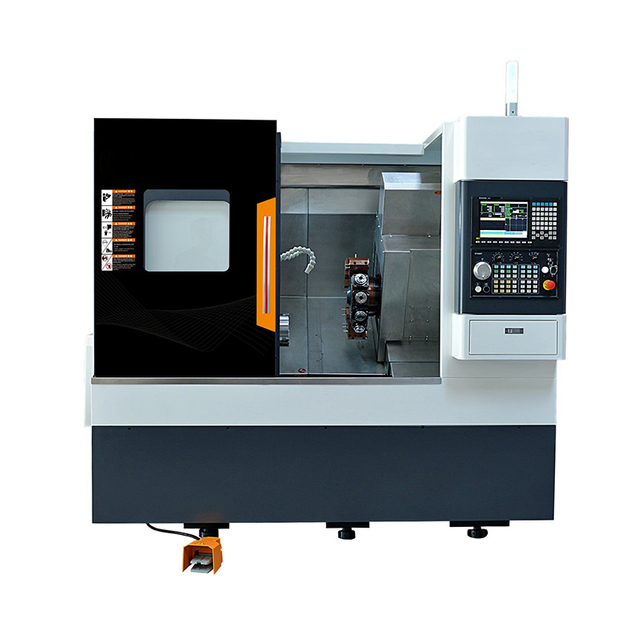
A Turning Center Lathe is a modern CNC turning machine designed as a complete production platform, integrating precision control, multi-tool capability, and automation readiness. Unlike basic CNC lathes, turning centers are built for stable, repeatable, and scalable manufacturing, making them the backbone of many CNC turning operations.
Turning centers are widely adopted as the standard solution for continuous CNC turning, where consistency, uptime, and process reliability matter more than extreme specialization.
A turning center lathe is a CNC-controlled machine that performs turning operations using a tool turret, advanced control system, and production-oriented structure. It is designed not only to cut material, but to operate efficiently as part of a modern manufacturing workflow.
Key characteristics include:
CNC-controlled multi-tool turret
Stable spindle and axis system
Support for automated loading and unloading
Consistent performance over long production runs
A turning center bridges the gap between basic CNC lathes and more specialized machines, offering versatility without unnecessary complexity.
Turning centers are favored in production environments because they deliver predictable results at scale.
Their design supports:
Stable machining accuracy over time
Consistent cycle times
Reduced operator dependency
High machine utilization
For manufacturers seeking dependable CNC turning rather than niche performance, turning centers provide a balanced and future-ready solution.
In a typical production workflow, a turning center operates as a continuous system:
Raw material is loaded via chuck, collet, or automated feeding
Multiple turning operations are completed in sequence
Finished parts are unloaded manually or automatically
The cycle repeats with minimal variation
This repeatable process makes turning centers ideal for medium to high-volume production where consistency is critical.
CNC turning is a machining process in which the workpiece rotates while a stationary cutting tool removes material to create precise cylindrical, conical, or rotational features. The entire process is controlled by a CNC (Computer Numerical Control) system, ensuring accuracy, repeatability, and stable production.
The process begins by securely clamping the workpiece using a chuck or collet mounted on the spindle.
Once clamped, the spindle rotates the workpiece at a programmed speed.
Rotation speed (RPM) is determined by material type and cutting requirements
Stable clamping is critical for dimensional accuracy and surface finish
The CNC controller executes a programmed sequence of commands (G-code), which precisely controls:
Tool position along the X and Z axes
Feed rate and cutting depth
Spindle speed and direction
Each movement is synchronized with the rotating workpiece to remove material accurately and consistently.
As the workpiece rotates, cutting tools are fed into the material to perform operations such as:
External and internal turning
Facing
Grooving and parting
Threading
Drilling and boring (using turret-mounted tools)
Material is removed layer by layer until the desired shape and dimensions are achieved.
In a CNC turning center, multiple tools are mounted on a tool turret.
The turret indexes automatically, bringing the correct tool into position for each operation without stopping the process.
This enables:
Sequential machining in one setup
Reduced manual intervention
Improved positional accuracy between features
Modern CNC turning systems continuously monitor:
Axis position
Spindle load
Cutting conditions
This ensures consistent machining results across long production runs and minimizes variation between parts.
Once all programmed operations are completed:
The finished part is unloaded manually or automatically
The next workpiece is loaded, and the cycle repeats
This workflow allows CNC turning centers to operate efficiently in continuous or automated production environments.
The CNC turning process offers:
High dimensional accuracy
Excellent repeatability
Stable cycle times
Compatibility with automation systems
Because of these advantages, CNC turning is widely used for shafts, bushings, fittings, and other rotational components in modern manufacturing.
Although the terms are sometimes used interchangeably, a turning center differs from a basic CNC lathe in its production focus.
Conventional CNC Lathe
Primarily focused on basic turning operations
Limited automation integration
Best suited for general machining or low-volume work
Turning Center
Designed for sustained production
Optimized for automation and repeatability
Suitable as a long-term manufacturing platform
When reliability and scalability are priorities, a turning center is the more appropriate choice.
Turning centers are best selected based on production characteristics, not industry labels.
They are ideal for:
Shafts and rotational components
Parts requiring consistent dimensional accuracy
Medium-complexity turned components
Products with stable, repeatable designs
These machines excel where process consistency and throughput are more important than extreme cycle-time optimization.
One of the defining advantages of turning centers is their automation compatibility.
They commonly support:
Bar feeders for continuous material supply
Robotic loading and unloading systems
Part catchers and conveyors
Integration with production monitoring systems
This makes turning centers a strong foundation for unattended or lights-out CNC turning.
Turning centers are used to machine a wide range of materials, including:
Carbon steel
Alloy steel
Stainless steel
Aluminum alloys
Brass and copper
Their stable structure and CNC control allow reliable machining across diverse material types.
Turning centers occupy a central role among CNC turning machines:
Gang Tool Lathes focus on ultra-fast machining of small, simple parts
Turret Lathes emphasize tooling flexibility for multi-step turning
Turn-Mill Machines integrate milling for complex geometries
Turning centers serve as the general-purpose production platform, covering the majority of turning applications efficiently.
A turning center is the right choice when:
Production requires consistent, repeatable turning
Automation is planned or expected
Product designs are stable over time
A versatile, long-term CNC turning solution is needed
In these scenarios, turning centers provide the most reliable balance between flexibility, efficiency, and scalability.
Turning centers are not just basic CNC lathes
They are designed as integrated production systems.
They are not limited to high-volume manufacturing
They also perform well in medium-volume, high-consistency environments.
They do not replace specialized machines
Instead, they complement gang tool, turret, and turn-mill machines.
Stable and rigid machine construction
Reliable CNC control systems
Automation-ready design
Consistent accuracy in long-run production
Flexible tooling configurations
Our turning centers are engineered to support modern CNC turning operations with confidence and efficiency.
It is used for consistent and repeatable CNC turning in production environments.
For production and automation, yes. For basic or occasional turning, a simple CNC lathe may suffice.
Yes. Turning centers are commonly integrated with bar feeders and robotic systems.
Yes. CNC turning is performed on a lathe-type machine where the workpiece rotates and a cutting tool removes material to create cylindrical or rotational features.
In modern manufacturing, CNC turning is typically done on a CNC lathe or a CNC turning center, which is essentially a production-oriented CNC lathe platform.
The terms are sometimes used interchangeably, but there is a practical distinction:
CNC Lathe often refers to the basic machine concept: CNC-controlled turning with standard turning operations.
CNC Turning Center typically implies a more production-ready system, often featuring:
a tool turret for multi-operation turning
stronger focus on repeatability and automation integration
workflow features for continuous production (e.g., bar feeding / robotic loading compatibility)
In short: a turning center is commonly viewed as a CNC lathe optimized as a production platform.
A CNC lathe may also be called a:
CNC Turning Center
CNC Turning Machine
Turning Center Lathe
In production contexts, sometimes a Turning Center
The exact wording depends on regional terminology and whether the machine is positioned as a basic lathe or a production system.
An “automatic lathe” can refer to different machine categories depending on context:
Automatic lathe / automatic screw machine (traditional high-volume production machines)
CNC automatic lathe (CNC-controlled automatic production lathe)
Swiss-type lathe (sliding headstock) for small, high-precision parts
If your page is about industrial CNC turning centers, it’s best to clarify that “automatic” usually means automated feeding and unattended production, not necessarily Swiss-type.
A manual lathe relies on an operator to control tool movement by hand, while a CNC lathe uses a computer program to control:
tool path and positioning
feed rate and depth of cut
spindle speed and tool changes (turret)
CNC lathes provide higher repeatability, stable cycle times, and better consistency for production.
A CNC lathe is defined by computer numerical control (programmable tool motion).
An automatic lathe is defined by automatic production behavior (automated cycles and feeding), which can be:
mechanical/cam-driven (traditional)
CNC-controlled (modern)
So a machine can be:
CNC but not fully automated (manual loading)
automated but not CNC (older cam machines)
both CNC and automated (turning center with bar feeder / robot)
Common disadvantages are mostly operational and application-related:
Higher initial investment than manual machining
Requires programming and process planning
Setup and tooling selection affect results significantly
Not ideal for every geometry—non-rotational, complex freeform surfaces may be better suited to milling or 5-axis machining
However, for rotational components and production, CNC turning offers strong advantages in consistency and efficiency.
CNC lathes share similar limitations to CNC turning:
Tooling and workholding must be correct to prevent vibration and tolerance issues
Complex parts may require additional machines if milling features are needed (unless using turn-mill)
Improper chip control can affect surface finish and tool life, especially in tough materials
These are not deal-breakers—just factors that require proper machine selection and process design.
Tool life depends heavily on:
material being machined
cutting speed/feed/depth
coolant strategy
tool material/coating (carbide, CBN, etc.)
stability and chip control
Instead of a fixed “lifespan,” manufacturers manage tool life through:
monitoring spindle load/finish quality
scheduled tool changes
tool-life management in CNC controls
For stable production, the goal is predictable tool life, not maximum life at all costs.
Almost any material can be machined to some extent, but some are impractical or difficult due to:
extreme hardness or abrasiveness (rapid tool wear)
brittleness (chipping/cracking)
poor machinability (heat, built-up edge, gummy behavior)
safety concerns (dust/fumes)
A more accurate phrasing is:
Some materials are difficult or cost-inefficient to CNC machine unless using the right tooling and process.
Yes, a lathe can turn wood—but industrial CNC lathes/turning centers are primarily designed for metal machining.
Wood turning on a metal CNC lathe is possible, but it may require:
appropriate dust control
different workholding and cutting tools
attention to shop safety and cleanliness
For production woodworking, dedicated wood lathes are often more suitable.
Common CNC machine categories include:
CNC Turning Center (CNC lathe)
Vertical Machining Center (VMC)
Horizontal Machining Center (HMC)
5-Axis Machining Center
CNC Grinding / EDM / Router (the fifth category can vary by industry, but these are common)
For your website structure, it’s helpful to connect the turning center page to VMC/HMC/5-axis pages through internal links.
For manufacturers seeking a reliable foundation for CNC turning, a turning center lathe offers stability, scalability, and automation readiness. Our engineers can help evaluate whether a turning center is the best fit for your production goals.
Contact us today to discuss CNC turning solutions.