
Views: 0 Author: Site Editor Publish Time: 2025-09-23 Origin: Site
CNC machining drives modern manufacturing, but its terminology can be tricky. Are you familiar with terms like vertical turning machining? Understanding CNC language is crucial for smooth operations and clear communication.
In this article, we'll cover essential CNC terms. You'll learn both basic and advanced concepts, helping you navigate the world of CNC machining more confidently.
CNC (Computer Numerical Control) machining refers to using computers to control machine tools. This technology allows for high-precision manufacturing processes, making it a cornerstone of modern industry. CNC machines can carry out various tasks, such as drilling, milling, turning, and grinding, with unmatched accuracy.
Key Points:
CNC machines are highly automated and reduce human error.
The CNC controller reads and executes commands, guiding the tool along pre-programmed paths.
CNC technology enhances production efficiency, reducing both waste and cycle times.
CNC machines rely on several key components to perform operations:
Spindle: This is the rotating part of the machine that holds and drives the cutting tool. It plays a vital role in achieving precise cuts.
Axes: CNC machines typically use three primary axes: the X-axis, Y-axis, and Z-axis. These define the movement of both the tool and the workpiece.
Tool Changer: The automatic tool changer allows the machine to swap tools without manual intervention, enabling continuous operation.
CNC machines are used for various processes, but two of the most common are milling and turning. Both are essential for different types of parts.
Milling involves rotating cutting tools to remove material from a workpiece. This process is ideal for creating shapes with intricate details.
Turning, on the other hand, involves rotating the workpiece while a stationary tool removes material, typically used for cylindrical parts.
The choice between milling and turning depends on the part shape and material requirements.
When programming CNC machines, two codes are essential: G-code and M-code. These codes control the machine's movements and other functions.
G-code: This is the language that instructs the CNC machine on movements, speed, and other key tasks. For example, G00 commands rapid positioning, while G01 handles linear movements.
M-code: These are miscellaneous commands that manage machine functions like turning the spindle on or off, activating coolant, or changing tools.
Mastering G-code and M-code is essential for optimal machine performance.
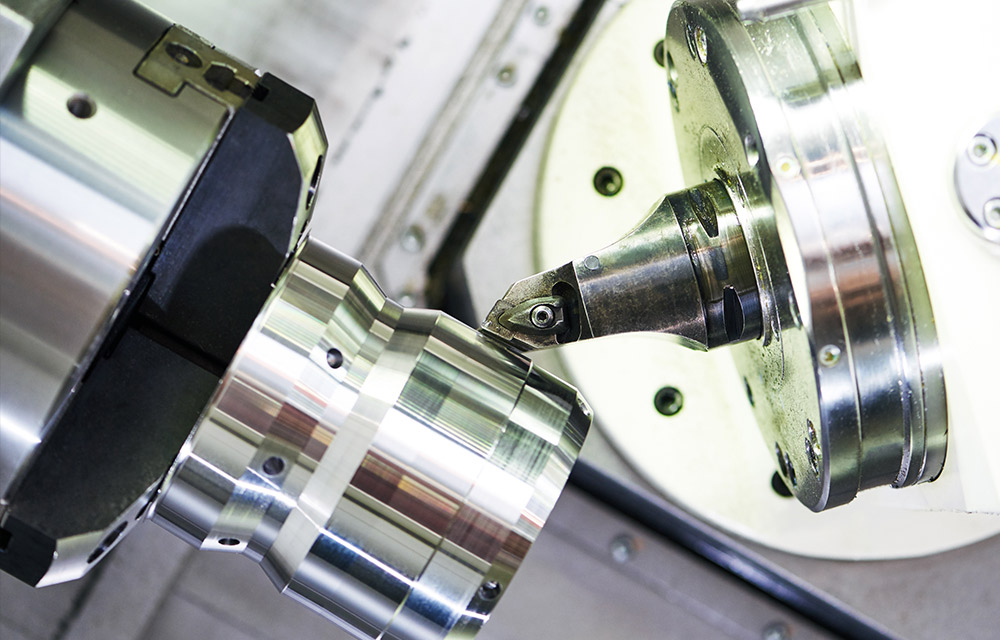
Vertical turning machining refers to a process where a CNC machine uses a vertical spindle to rotate the workpiece. This is typically done on a Vertical Turning Center (VTC), a type of CNC machine designed for heavy-duty machining. It is ideal for large parts that require precision and a high level of accuracy.
Aerospace: Manufacturing components with complex shapes.
Automotive: Producing parts like wheels, flanges, and rotors.
Energy: Machining large, heavy components for turbines and generators.
Vertical turning machining excels when working with large, heavy parts that require fine surface finishes and tight tolerances.
CNC technology has evolved, offering features that enhance precision and reduce time spent on tasks.
Live Tooling: This refers to tools that can perform secondary operations such as drilling or tapping on a turning center. This adds versatility to machines that can now carry out multiple tasks without requiring retooling or workpiece repositioning.
Multi-Axis CNC Machines: These machines feature additional axes beyond the standard three. 4-axis and 5-axis machines allow for more complex parts to be machined in a single operation, reducing setup times and increasing accuracy.
Live tooling and multi-axis operations increase the productivity of CNC machines by reducing the number of setups needed.
CNC setup involves preparing the machine to execute a particular job. This includes installing the right tools, aligning the workpiece, and ensuring everything is calibrated correctly. Here's a quick breakdown:
Select Tools: Choose tools based on the material being worked on and the specific operations required.
Align Workpiece: Use edge finders and other instruments to position the workpiece accurately.
Program the Machine: Input the required G-code and M-code into the CNC controller.
A proper CNC setup ensures that the machine runs smoothly and the product meets specifications.
CNC programming is the heart of the machining process. Whether you're writing simple or advanced programs, understanding the logic behind G-codes and M-codes is essential.
Basic Programs: Start with simple movements and operations such as linear cuts (G01) or rapid positioning (G00).
Advanced Programs: For more complex machining, like vertical turning machining, you may need to use multi-axis movement, tool offsets, and more detailed functions.
Investing time in understanding CNC programming can dramatically improve your machining skills and efficiency.
CNC machining has a vast array of specialized terms that are essential to understand. Here's a quick glossary of terms you’ll encounter in the CNC world:
Feed Rate: The speed at which a tool moves through the material.
Depth of Cut: How much material is removed with each pass of the cutting tool.
Offsets: Adjustments made to account for tool or part wear.
Inserts: Removable cutting tips that can be replaced when dull, saving time and money.
Familiarizing yourself with CNC terms ensures a smoother workflow and fewer mistakes during production.
CNC machines can encounter several issues during operation. Here are a few common ones and how to address them:
Recutting: Occurs when chips aren't removed quickly enough, causing the tool to hit them again. This can result in poor surface finish or excessive tool wear.
Solution: Adjust the feed rate and cutting speed to ensure chips are cleared effectively.
Feed Rate and Speed Issues: If the machine isn't moving at the right speeds, it can lead to poor surface finishes or incorrect cuts.
Solution: Regularly check and calibrate feed rates to match material types and operations.
Regular machine checks and recalibrations prevent common problems and extend the life of your equipment.
CNC machines are becoming increasingly automated. Technologies like robotic arms and automated tool changers are revolutionizing the industry by improving efficiency and reducing the need for manual labor.
Pallet Changers: Enable seamless loading and unloading of parts, reducing downtime.
Robotic Integration: Can perform tasks such as part handling, assembly, or quality control, increasing the overall productivity of CNC systems.
Vertical turning machining continues to evolve. New developments are focusing on improving machine rigidity, tool life, and cutting speeds. The integration of AI and machine learning is making vertical turning machines smarter, capable of optimizing settings in real-time.
Keeping up with CNC advancements ensures that your operations remain competitive and efficient.
| Term | Description |
|---|---|
| Vertical Turning Machining | CNC turning process where the spindle is vertical, ideal for large, heavy parts. |
| G-Code | Programming language used to control CNC machine movement and functions. |
| M-Code | Miscellaneous codes that control non-cutting actions, like spindle speed or coolant activation. |
| Feed Rate | The speed at which the cutting tool moves through the material. |
| Tool Changer | An automatic system that switches tools without manual intervention, increasing efficiency. |
Mastering CNC terminology, especially complex terms like vertical turning machining, is essential for success in modern manufacturing. Whether you're just starting or are already experienced, understanding the language improves communication and efficiency. This, in turn, enhances product quality. By staying up to date with new CNC technologies, you'll remain competitive in the evolving industry. Regular training is crucial to mastering CNC machining skills. Taiz Intelligence offers innovative products like advanced machining centers to help businesses improve operational efficiency and precision.
A: Vertical turning machining refers to a process where the workpiece is rotated vertically, allowing for turning operations like cutting and shaping. This technique is commonly used for large, heavy parts that require high precision.
A: Vertical turning machining uses a vertically oriented spindle, ideal for larger parts. In contrast, horizontal turning typically uses a horizontal spindle, best suited for smaller, simpler parts. Both offer unique advantages depending on the part's size and complexity.
A: Vertical turning machining is ideal for large components because the vertical setup provides better support for heavy workpieces, reducing vibration and improving cutting accuracy. This results in higher quality and more efficient machining.


