
Views: 0 Author: Site Editor Publish Time: 2026-06-08 Origin: Site
You have a significant choice to make between 3-Axis vs. 5-Axis CNC machines. This decision impacts how you handle complex parts, precision, and production speed. Recent data indicates that many companies are adopting advanced CNC machines in industries such as aerospace and automotive.
Industry | 5-Axis Adoption Rate | 3+2 Axis Adoption Rate |
|---|---|---|
Aerospace | 68% | 22% |
Automotive | 55% | 35% |
Medical Devices | 42% | 48% |
Energy | 57% | 43% |
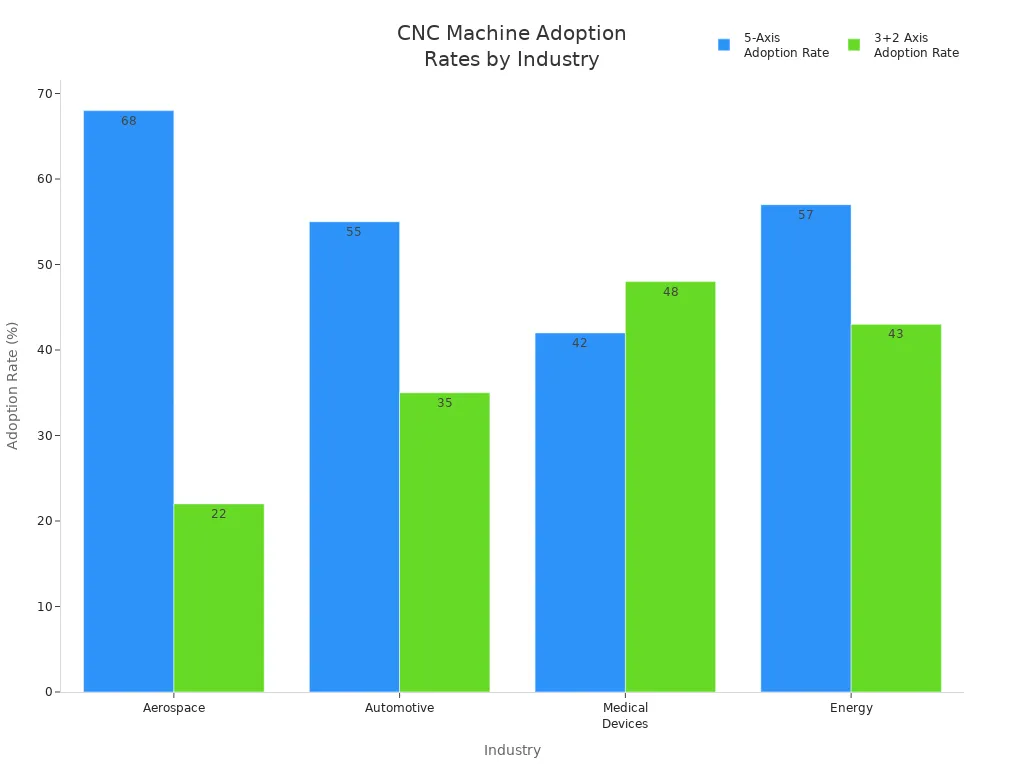
When comparing 3-Axis vs. 5-Axis CNC, you'll notice that 5-axis CNC machines feature two additional moving parts. This capability allows for the machining of more intricate shapes and enhances accuracy. Additionally, fewer setups and tool changes are required, enabling CNC machines to operate more quickly and produce higher-quality parts. Your selection of CNC machine will influence your workflow, the quality of your components, and your overall costs.
3-axis CNC machines move in three ways. They work well for simple shapes.
5-axis CNC machines move in five ways. They can make complex shapes. They are more accurate.
5-axis machines save setup time. They make fewer mistakes. They work faster and better.
3-axis machines cost less money. They are easier to use. They are good for basic parts.
5-axis machines cost more money. They give better precision. They make higher quality parts.
Aerospace and medical industries use 5-axis CNC machines the most.
TAIZHENG has advanced 5-axis machines. They give support and training.
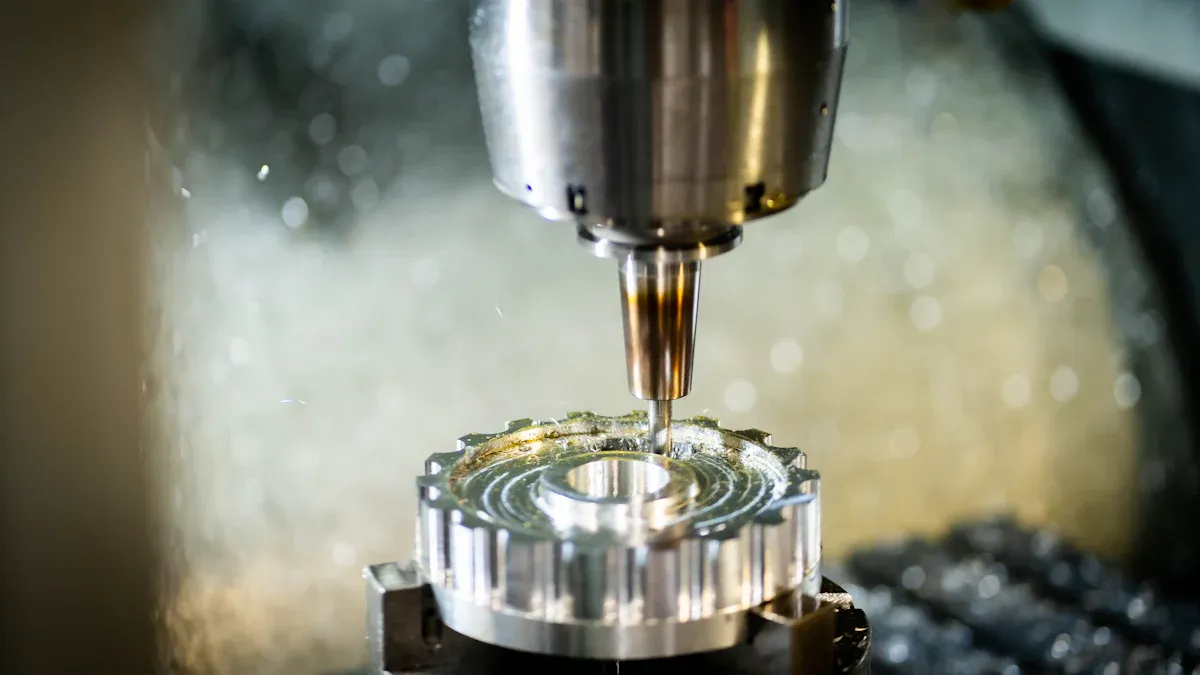
Image Source: unsplash
A 3-axis cnc machine moves in three directions. The cutting tool goes left and right, front and back, and up and down. The workpiece stays still while the tool moves around it. This setup lets you work on many materials.
Axis | Description |
|---|---|
X | Moves left and right |
Y | Moves front and back |
Z | Moves up and down |
A 3-axis cnc machine is easy to use. You can do simple jobs and make basic shapes. Shops use these machines to make covers, brackets, and enclosures. They also make flat parts for equipment like bases and plates. In medical work, you can make handles and housings for devices.
You see 3-axis cnc machines in many places. Car shops use them for brackets and covers. Electronics makers use them for aluminum housings. Equipment makers use them for bases and plates. Medical companies use them for handles and housings. These machines are best for flat or simple parts. You can use metals and plastics with them.
A 5-axis cnc machine has two more axes than a 3-axis. These extra axes let the tool or workpiece turn around certain points. You can work on parts from different angles at the same time. This is good for tricky shapes, deep holes, and undercuts. You do not have to move the workpiece, so you save time and make fewer mistakes.
Here is a quick comparison of 3-axis vs. 5-axis cnc:
Factor | 3-Axis | 5-Axis |
|---|---|---|
Cutting tool movement | Moves along X, Y, and Z axes | Moves along X, Y, Z, A, and B axes |
Efficiency | Good | Excellent, quick |
Tool changes | Needs more setups for hard parts | Few setups, works from many angles |
Capabilities | Cannot do complex shapes or undercuts | Can cut deep and make tricky shapes |
Accuracy | Good | Excellent |
Ease of operation | Easy to use and program | Needs special training and skills |
Cost | $25,000 to $50,000 | $80,000 to over $500,000 |
Maintenance/operating costs | Low | Higher |
Cost per part | Lower | Higher, but faster for hard parts |
Maintenance needs | Low, fewer moving parts | High, needs regular care |
Wear and tear | Less likely | More likely, more moving parts |
Applications | Simple parts for cars, planes, electronics | Works for many sizes and shapes, like engine parts and implants |
5-axis cnc machines can do more and are flexible. They let you reach angled spots, curved faces, and undercuts. You get smoother surfaces and finish jobs faster.
TAIZHENG makes advanced machines with its Five-Axis Machine Center. You can handle tough shapes and make parts very accurately. The Five-Axis Machine Center moves the tool or workpiece in five ways at once. You can make tricky parts in one setup, which helps accuracy and surface quality.
TAIZHENG's Five-Axis Machine Center can do both 3+2 and full 5-axis machining. You can pick 3+2 for parts with many angles or use full motion for hard surfaces. This helps you make aerospace, medical, mold, and energy parts well. You save time, get steady results, and keep tight limits.
If you want to try advanced 4th and 5th axis machining, TAIZHENG has models like T600-5 and TMU-400. You can ask TAIZHENG for machines that fit your needs. Their cnc knowledge helps you get strong, high-quality parts for tough jobs.
Tip: If you need to make tricky parts with deep holes or angled cuts, a 5-axis cnc machine from TAIZHENG can help you get great results fast.
When you look at 3-axis and 5-axis cnc machines, you see they move in different ways. A 3-axis cnc machine moves in three directions: X, Y, and Z. The tool goes left and right, forward and back, and up and down. This works well for simple shapes and flat parts.
A 5-axis cnc machine adds two more directions. These are called rotary axes, like A and B or A and C. With these extra axes, the tool or part can tilt and spin. This lets you reach almost any angle in one setup. You can make parts with curves, deep holes, and undercuts.
Here is a table that shows the differences:
Machine Type | Axes of Motion | Motion Behavior | Typical Applications |
|---|---|---|---|
3-Axis | X, Y, Z (simultaneous) | Continuous 3D cutting | Molds, housings, fixtures |
5-Axis | X, Y, Z + A, B (rotary) | Multi-angle machining | Aerospace, medical, optical parts |
A 3-axis cnc machine is best for basic parts. If you need to work on many faces or tight spots, you must stop and move the part. Each time you do this, you might make small mistakes. A 5-axis cnc machine lets you finish the part in one go. This helps you avoid errors and saves time.
With 5-axis machining, you get more freedom. You can cut at many angles and follow the shape of the part. This gives you smoother surfaces and better accuracy. If your parts have deep spaces or tricky features, 5-axis cnc is the better choice.
Setup and fixturing are important in cnc work. With a 3-axis cnc, you often need to set up the part more than once for hard shapes. Each setup means you clamp the part again and check its position. This takes time and can cause small mistakes.
A 5-axis cnc machine changes this process. You can reach more sides of the part without moving it. Most times, you only need one setup. This makes your work faster and more accurate.
Here is a table to show the main differences:
Feature | 3-Axis CNC Machines | 5-Axis CNC Machines |
|---|---|---|
Setup Complexity | Simple for basic parts | Fewer setups for complex parts |
Fixture Design | Basic fixtures | More advanced fixtures |
Machining Capability | Flat and simple shapes | Complex shapes, undercuts, angles |
Efficiency for Simple Parts | High | High for complex parts |
You can see that 3-axis machining is easy for flat or simple parts. If you need to work on five faces or hard-to-reach spots, a 5-axis cnc machine is much better. You save time and lower the chance of mistakes.
Tip: "You just position and cut. The 5-axis machining center makes every operation just one operation. Your handling time is none, your setup time obviously eliminated. Your blends are all perfect because you control them all in the same operation."
When you use a 5-axis cnc machine, you also need to think about fixturing. The fixtures may be more complex, but you spend less time moving and checking the part. This is a big advantage for parts with many sides or angles.
Programming is another area where you see differences between 3-axis and 5-axis cnc. A 3-axis cnc machine is easier to program. You use basic software and simple tool paths. Most people can learn to use a 3-axis cnc quickly.
A 5-axis cnc machine needs more skill. You must know how all five axes move together. You use advanced software to plan the tool movement. You also need to avoid crashes and make the tool path smooth.
Here is a table to compare the two:
Aspect | 3-Axis CNC Machines | 5-Axis CNC Machines |
|---|---|---|
Programming Complexity | Low | High |
Software Requirements | Basic | Advanced |
Learning Curve | Easy | Steep |
Tool Path Optimization | Simple | Complex |
Collision Avoidance | Not critical | Very important |
When you use a 5-axis cnc machine, you need to know about kinematics and tool path planning. You must plan how the tool moves to avoid hitting the part or fixture. This takes more training and experience.
A 3-axis cnc machine is a good choice if you want something simple and easy to learn. If you want to make complex parts and get the most from your cnc, you should learn 5-axis machining. TAIZHENG offers advanced 5-axis cnc machines that help you handle this complexity. Their machines use smart controls and software to make programming easier and safer.
Note: Operator skill is very important for 5-axis cnc. You need to know how to use CAM software and plan tool movement. With the right training, you can unlock the full power of 5-axis machining.
If you want your shop to be more flexible and take on harder jobs, think about getting a 5-axis cnc machine. TAIZHENG can help you pick the right machine and give support for programming and operation.
When you compare the cost of 3-axis and 5-axis cnc machines, you see big differences. The price of a 3-axis cnc machine usually ranges from $25,000 to $50,000. This makes it a good choice for shops with simple parts or lower budgets. If you look at 5-axis cnc machines, the price can start at $80,000 and go over $500,000. Some advanced models can even cost more than $1 million.
Here is a table to help you see the cost differences:
CNC Type | Purchase Cost Range |
|---|---|
3 Axis | $25,000 - $50,000 |
3+2 Axis | $150,000 - $300,000 |
5 Axis | $80,000 - $500,000+ |
You need to think about more than just the machine price. A 5-axis cnc machine often needs extra investments. You may spend $30,000 to $50,000 on special tooling. CAM software can add $10,000 to $30,000 per seat. Training for your team can cost $10,000 to $20,000. Installation and setup also add to the total. When you add these costs, your investment for a 5-axis cnc machine can easily go over $500,000.
Maintenance is another important factor. A 5-axis cnc machine has more moving parts and advanced controls. This means you will pay more for maintenance. The cost can be 25% to 40% higher than for a 3+2 axis machine. You also need to budget for software updates and ongoing training.
Here is a table that shows the maintenance cost increase:
CNC Type | Maintenance Cost Increase |
|---|---|
3+2 Axis | N/A |
5 Axis | 25-40% higher |
You should also think about return on investment (ROI). If you use your 5-axis cnc machine for only 10 hours a week, you may not get good returns. If you run it for 60 to 80 hours a week, you can see strong profits. High-mix and small-lot production benefits a lot from 5-axis cnc. You save time on setups and fixtures. You also reduce errors and speed up design changes. For mass production, 5-axis cnc gives you stable quality and lower labor costs.
Tip: Before you buy a 5-axis cnc machine, check your workload and part complexity. If you need to make complex parts often, the higher cost can pay off with better speed and quality.
TAIZHENG offers advanced 5-axis cnc solutions that help you get the most value from your investment. Their machines support both 3+2 and full 5-axis machining. You can choose the right model for your needs and budget. TAIZHENG also provides training and support to help you use your cnc machine efficiently.
When you compare 3-axis vs. 5-axis cnc, remember to look at the full picture. Think about machine price, extra costs, maintenance, and how much you will use the machine. The right choice will help you grow your business and improve your production.
You find 3-axis cnc machines in many shops. Manufacturers use them for jobs with simple shapes and flat surfaces. Electronics companies use 3-axis cnc to make housings and brackets. Car shops use them for mounting plates and covers. Medical device makers pick 3-axis cnc for handles and basic enclosures. Factories use 3-axis milling to make parts for consumer goods, machines, and small tools.
Tip: If you need to make flat parts or basic shapes, a 3-axis cnc machine is the best choice.
You can make many kinds of parts with 3-axis milling. The machine is good for jobs with flat surfaces and simple shapes. You can drill holes, tap threads, and mill pockets. You make mounting plates, brackets, and covers. You also make basic fixtures and housings.
Flat surfaces
Pockets
Holes
Basic contours
Simple shapes like mounting plates and brackets
You use 3-axis milling for:
Flat-surface milling
Facing
Drilling
Tapping holes
You get reliable results for parts that do not need complex surfaces or tight angles. The process is easy to set up and fast to run.
You use a 5-axis cnc machine for making very complex 3d shapes. Many industries use 5-axis cnc for advanced jobs. Aerospace companies use 5-axis cnc for turbine blades, aircraft parts, and satellite parts. Car makers use it for engine housings, transmission parts, and light structural pieces. Medical device makers use it for implants, surgical tools, and dental prosthetics. General manufacturing uses 5-axis cnc for molds, dies, and precision parts.
Industry | Key Applications |
|---|---|
Aerospace | Making turbine blades, aircraft parts, and satellite parts needing high precision and complex shapes. |
Automotive | Engine parts, transmission parts, and structural pieces, especially for electric cars and light materials. |
Medical | Making implants, surgical tools, and dental prosthetics with very high precision. |
General Manufacturing | Making complex molds, dies, and precision parts for electronics and consumer goods. |
You get the most value from 5-axis cnc when you need to cut complex surfaces, deep spaces, or tricky angles. The machine lets you reach many faces in one setup. You save time and make fewer mistakes.
TAIZHENG's Five-Axis Machine Center helps you make parts for aerospace and medical jobs. You can make turbine blades, structural brackets, and aerospace alloys. Medical device makers use TAIZHENG for surgical tools and orthopedic implants.
Sector | Applications |
|---|---|
Aerospace | turbine blades, structural brackets, aerospace alloys |
Medical devices | surgical tools, orthopedic implants |
You get high precision and efficiency. TAIZHENG's Five-Axis Machine Center lets you make complex parts with tight limits. You meet strict quality needs for important jobs.
High precision
Efficiency
Ability to make complex parts with tight limits
TAIZHENG's Five-Axis Machine Center is important for industries that need very accurate and efficient work. You can trust TAIZHENG to give reliable results for advanced jobs.
You use 5-axis milling to machine complex surfaces and shapes. The process lets you cut parts in fewer setups. You lower alignment risks and save time. You use one clamping method, which makes fixtures simpler. You cut more features in one setup, reducing errors across faces.
Factor | 3-axis approach | 5-axis approach | Why it matters |
|---|---|---|---|
Number of setups | Often many setups for many sides | Often fewer setups, sometimes just one | Each setup adds risk and takes time |
Fixturing | More special fixtures or rework of jaws | More use of one clamping method | Fixture complexity can be a hidden cost |
Datum transfer | Needs careful datum pickup each time | More features cut in one setup | Reduces errors across faces |
You improve precision by lowering misalignment and human mistakes. 5-axis milling lets you get tighter limits on complex parts. You avoid shape mismatch and error build-up from moving parts many times.
You can machine:
Turbine blades
Impellers
Engine housings
Implants
You follow a workflow for 5-axis cnc machining:
Workflow Step | Detailed Action |
|---|---|
Design update | Change and improve part design for better fit with 5-Axis CNC Milling |
DFM check focused on tool access + datums | Check if the cutting tool can reach and define datums for complex parts |
Choose indexed 5-axis where possible; simultaneous where required | Pick indexed 5-axis for normal jobs and simultaneous for hard shapes |
Machine part in fewer setups | Use single setup benefits of 5-axis to lower errors from many setups |
Inspect critical relationships | Check size and position relationships across surfaces |
Feed results back into next design revision | Use machining and inspection data to help with the next design changes. |
You match the right machine to the job. 5-axis milling gives flexibility and precision. You avoid extra costs by picking the best solution for your needs.
Note: 5-axis cnc machining is the best solution for parts with complex surfaces and tight limits. You get the best results for advanced jobs.
You want your parts to be very exact. This means they must fit well and work right. Machining accuracy is about how well the CNC machine moves and holds the tool. A 3-axis CNC machine is good for simple shapes. It can make the same part again and again. But if you need even more accuracy, a 5-axis CNC machine is better. You can make hard shapes in just one setup. This means you do not move the part many times. Fewer moves mean fewer mistakes. You get better repeatability and tighter tolerances. The 5-axis CNC machine can repeat moves as close as ±0.0002". You can trust your parts will fit and work as planned.
You want your parts to look and feel smooth. How the surface looks is important for how the part works. With a 3-axis CNC machine, you often need to set up the part many times. Each time you move the part, you might make a mistake. This can make the surface rough or leave marks. A 5-axis CNC machine can reach all sides in one setup. You do not have to move the part again and again. This helps you get a smoother finish. You can keep the tool at the best angle for each spot. This makes the part more exact and saves time. You can also reach deep spots and undercuts that are hard for 3-axis machines. If you use the right tool and plan, you get a finish that meets high standards. This is very important for aerospace, medical, and mold parts.
You want to make parts fast and not waste time or tools. Production efficiency is about how quick and correct you finish jobs. A 5-axis CNC machine helps you more than a 3-axis CNC machine. You spend less time making each part. You do not need to set up the part as much. Your tools last longer. Workers do not have to stop the machine as often. The parts come out better.
Metric | 3-Axis CNC Machines | 5-Axis CNC Machines |
|---|---|---|
Total Cycle Time Reduction | N/A | 40-60% |
Setup Reduction | N/A | 70-80% fewer changes |
Tool Life Improvement | N/A | 25-40% longer |
Quality Enhancement | N/A | ±0.0002" repeatability |
Labor Efficiency | N/A | Reduced intervention |
With 5-axis CNC machining, you get:
More accuracy
Faster production and shorter wait times
Fewer setups
Ability to make harder shapes
Smoother surfaces
Better drilling
You see that 5-axis CNC machines help at every step. You save time, make fewer mistakes, and get parts with great finish and accuracy. You can do harder jobs and meet tough industry rules.
You want your CNC machine to work well every time. TAIZHENG gives you smart machines that help you get better accuracy, smoother parts, and faster work. These machines use strong designs and good materials.
The frame uses Mehanite-style cast iron. This keeps the machine strong and steady for a long time. The frame goes through a special process so it does not bend. You keep making accurate parts.
TAIZHENG builds the frame to stop shaking. The shape of the frame helps control spinning forces. You get less noise and smoother parts. Your finished parts look better.
Some models move very fast and use special parts. You can make parts that fit well every time. You know your machine will make the same part again and again.
TAIZHENG has many machines for different jobs. You can use them for cars, planes, medical tools, and electronics. The machines stay strong and keep parts accurate.
TAIZHENG CNC Turning Center Machines have more smart features. The controls help you set up jobs faster. You can change what you are doing quickly. The spindle spins fast and cuts hard materials easily. You can make small, detailed parts with less mistakes.
TAIZHENG also uses automation in their machines. You can add robots or other systems to help you work faster. This means you need fewer workers and save money. The machine can change how it cuts by checking itself as it works. You use your time and tools better and keep costs low.
Here is a table that shows how TAIZHENG helps you:
Feature | Benefit to You |
|---|---|
Advanced material science | Strong frame, keeps parts accurate |
Optimized geometry | Less shaking, smoother parts |
High-speed kinematic components | Parts fit well, same results each time |
Product diversification | Accurate parts for many industries |
Automation integration | More work done, less money spent |
Streamlined workflow | Faster jobs, saves money |
TAIZHENG cares about every part of the machine. You get machines that make smooth, exact parts quickly. You can do hard jobs and trust your results. Your shop can meet tough rules and work well every day.
Tip: If you want better results, TAIZHENG gives you the right machines and technology to help you work faster and more accurately.
You need to look at your shop’s work before you choose a CNC machine. Think about the shapes and features you want to make. If you often work with flat parts or simple shapes, a 3-axis CNC machine can do the job. If you need to cut at many angles or make complex parts, a 5-axis CNC machine gives you more options. You can finish tricky parts in one setup and get better accuracy.
Here is a table to help you compare:
Criteria | 3-Axis CNC Machines | 5-Axis CNC Machines |
|---|---|---|
Multi-angle machining | Needs fixture changes for angled features | Cuts in many directions at once, fewer errors |
Performance and precision | May need many setups for complex parts | Makes complex parts in one go, better accuracy |
Production cost | Higher due to more setups and fixtures | Lower with fewer steps and faster cycles |
You should ask yourself these questions:
Do you need to cut deep holes or undercuts?
Do your parts have many faces or angles?
Is high precision important for your products?
How much time do you want to spend on setups?
If you answer “yes” to most, a 5-axis CNC machine may fit your needs best.
You must think about your budget and what you expect to get back from your investment. The price of a CNC machine is not just the money you pay at first. You also need to think about the cost to run and keep the machine working well.
Here are some things to consider:
Upfront Costs: Advanced machines cost more at the start. Make sure your budget can handle the price.
Operational Costs: You will spend money on tools, energy, and maintenance. These costs add up over time.
Return on Investment (ROI): A higher-quality machine can help you make more parts, save labor, and improve quality. This can make the higher price worth it.
Software Compatibility: Check if the machine works with your current software. This can make your work easier and faster.
You should balance what you spend with what you hope to gain. If you make many complex parts, a 5-axis CNC machine can pay for itself by saving time and reducing mistakes.
You do not have to make this choice alone. TAIZHENG offers support to help you pick the right CNC machine for your shop. You can get advice that matches your products and goals.
Here is what TAIZHENG can do for you:
Service Type | Description |
|---|---|
Technical Advice | Gives you expert tips based on your needs and the parts you want to make. |
Assistance During Commissioning | Helps you set up your new machine so it works right from the start. |
After-Sales Support | Offers training, process checks, and troubleshooting after you buy the machine. |
Tip: You can talk to TAIZHENG’s team to get answers about machine features, setup, and how to get the best results. Their experts help you feel confident in your choice.
You can reach out to TAIZHENG for a custom plan. They help you match the right machine to your budget, your parts, and your goals. This support makes your decision easier and helps your business grow.
You can spot big differences between 3-axis and 5-axis CNC machines. The table below shows how each one changes your work and results:
Feature | 3-Axis CNC Machines | 5-Axis CNC Machines |
|---|---|---|
Motion Axes | Three linear axes | Adds two rotational axes |
Setup Requirements | Frequent re-clamping | Single setup for many sides |
Accuracy | More setup errors | Improved consistency |
Cost Efficiency | Higher fixture costs | Lower rework costs |
Human Error | More prone to mistakes | Fewer errors |
Think about what your shop needs before you choose a machine. Check your budget and what you want to achieve. Ask experts or suppliers if you need help. Look for more information to make the best choice for your business.
A 3-axis CNC machine moves in three ways. A 5-axis CNC machine moves in five ways. With five axes, you can make hard shapes faster. You also get better accuracy.
You cannot turn a 3-axis CNC machine into a 5-axis one. You need a new machine with more rotary parts. TAIZHENG has 5-axis machines for tough jobs.
Industries like aerospace, medical, and automotive use 5-axis CNC a lot. Mold-making shops also use them. These machines help make parts with tight fits and tricky shapes.
You can finish a part in just one setup. This means you move the part less and make fewer mistakes. The tool stays at the best angle. You get smoother and more accurate parts.
Programming a 5-axis CNC machine is harder. You need special software and must learn new skills. TAIZHENG gives training and support to help you learn.
TAIZHENG gives you advice and helps set up your machine. You can ask about features and how to use the machine. They help you pick the best machine for your work.
Think about how hard your parts are to make. Also think about how exact they must be and your budget. Pick 3-axis for easy shapes. Pick 5-axis for hard parts. You can ask TAIZHENG for expert help.


