
Views: 0 Author: Site Editor Publish Time: 2026-09-16 Origin: Site
Imagine you need to make very detailed parts for a medical device and a bigger, tougher part for a car. Which machine—a CNC Swiss lathe or a standard CNC lathe—would you pick for each job? The main difference is how each machine holds the material. A Swiss machine pushes the metal bar through a guide bushing, supporting it right where the cutting happens. A standard machine grips the part in a chuck, leaving it unsupported along its length. This key difference affects how precise you can be, the best part size and shape, and how fast you can produce parts. Knowing these factors helps you choose the right machine for your CNC work.
Swiss CNC lathes support material near the cut. This design prevents bending. It makes very precise parts.
Standard CNC lathes hold material in a chuck. Long parts can bend. This bending harms accuracy.
Swiss machines excel with small, long parts. They handle high length-to-diameter ratios. They achieve tight tolerances.
Standard lathes suit larger, shorter parts. They offer flexibility. They cost less money.
Swiss machines often finish parts in one cycle. They combine many operations. This saves time.
Standard lathes need extra steps for complex parts. They may require polishing. This adds cost.
Choose a Swiss machine for small, precise parts. Choose a standard lathe for bigger jobs. Match the machine to your needs.
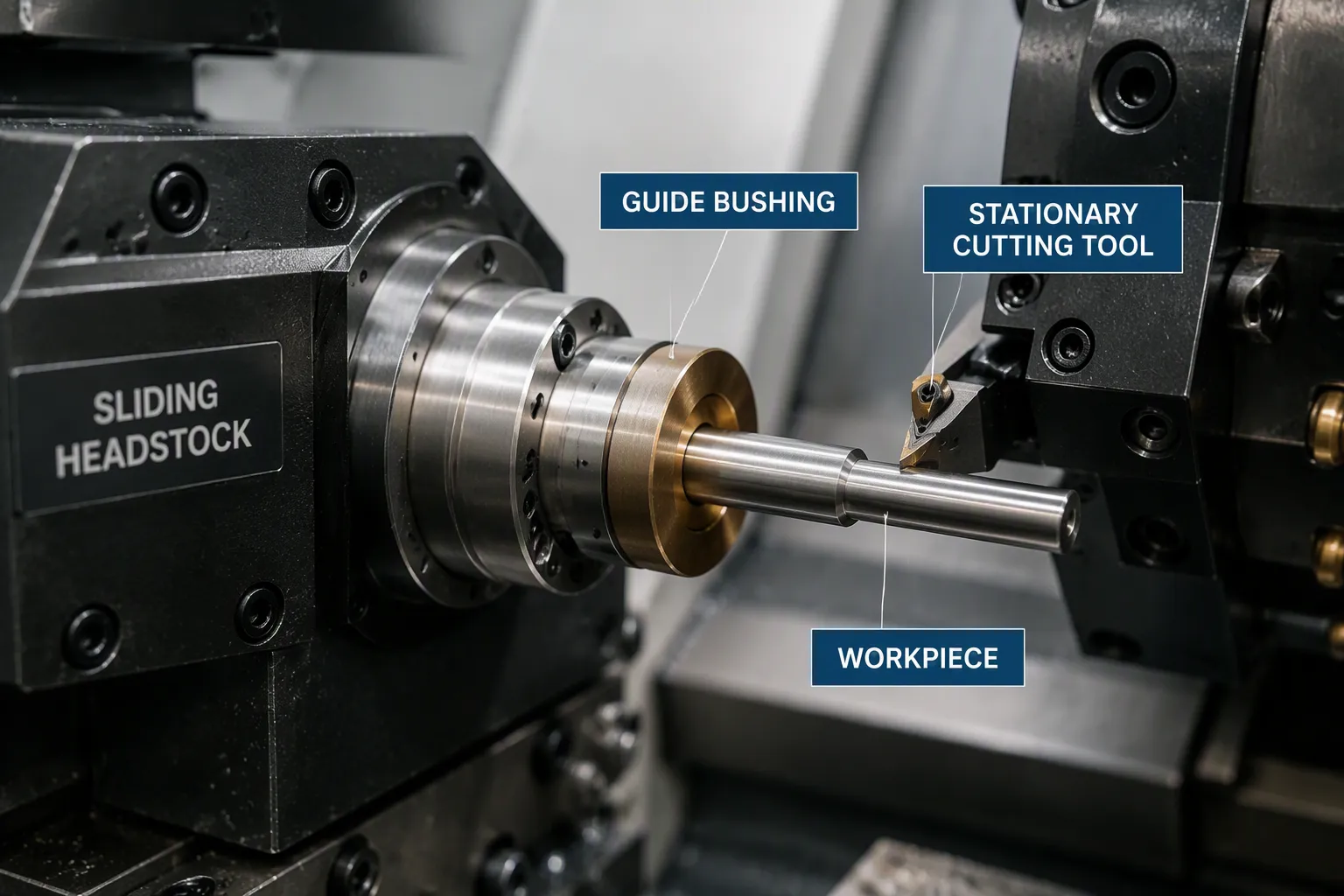
A CNC lathe of this type works differently from a standard CNC lathe. The key difference lies in the sliding headstock mechanism. The material moves forward through a guide bushing. The cutting tools stay in a fixed position. This setup changes how you approach precision work.
The guide bushing is the core feature of this machine. It supports the workpiece right at the cutting point. This support eliminates the long unsupported length you see in conventional turning.
The sliding headstock moves the bar stock along the Z-axis. The material passes through a guide bushing. Cutting tools operate just 1 mm to 3 mm from the bushing. This close proximity reduces material deflection and vibration. Only the section being machined is exposed. This design enables tight tolerances on high aspect-ratio parts.
The guide bushing provides rigidity by supporting the material close to the cutting tool. This support effectively reduces deflection to zero, which eliminates the need for multiple shallow passes. Consequently, the cutting tool can perform a single deep pass, reducing tool wear and improving consistency and accuracy.
The difference in deflection behavior is significant. A chuck-based setup has an unsupported length that increases as the tool moves away. Deflection grows with the cube of the unsupported length. For example, a 4-inch length deflects 64 times more than a 1-inch length. The guide bushing design changes this completely. The unsupported length stays near zero, within about 2 mm of the cut. Deflection is neutralized.
Holding Method | Effective Unsupported Length | Deflection Behavior |
|---|---|---|
Chuck-based | Increases as tool moves away | Deflection ∝ (unsupported length)⊃3;; e.g., 4-inch length deflects 64× more than 1-inch length |
Guide bushing | Near zero (within ~2 mm of cut) | Deflection neutralized; constant rigid support regardless of total part length |
This design also improves roundness. This machine type can typically improve the roundness of a part by approximately 50% relative to the raw stock.
Surface finish also improves. These machines can achieve surface finishes below Ra 16 microinches without requiring secondary finishing. This capability saves time and reduces handling costs.
A CNC Swiss lathe is ideal for small parts with high length-to-diameter ratios. The machine design suits particular part geometries and industries.
You use this machine for small parts with high length-to-diameter ratios. The guide bushing supports the workpiece along its entire length. This support makes this machine the best choice for long, slender components. Parts like medical guidewires, dental implants, and electronic connector pins are typical examples. The machine handles these complex small parts with ease. You also produce cost-effective miniature parts with this process.
Industries that need precision metal parts rely on this machine. The medical industry uses it for surgical instruments and implants. The aerospace industry depends on it for precision aerospace hardware. The electronics industry needs it for connectors and sensor components. All these sectors require high-precision parts with tight tolerances. The global market for CNC lathes of this type reflects this growing demand. The market is estimated at $1,626 million in 2025. It is projected to grow at a CAGR of 5.7% from 2026 to 2032, reaching $2,381 million by 2032. This growth rate shows the increasing adoption of the CNC Swiss lathe for precise machining.
Like any machine tool, this type of lathe has clear advantages and some limitations.
The main advantages of this machine are accuracy and surface finish. The guide bushing eliminates deflection, which allows you to hold tight tolerances consistently. You achieve surface finishes up to Ra 16 microinches without secondary operations. The machine also offers excellent repeatability. You can produce high-precision parts in large volumes with minimal variation. This high accuracy makes this machine ideal for demanding applications. The machine produces consistent quality parts. A CNC Swiss lathe offers clear advantages for precision work.
This machine has limitations. The main limitation is part diameter. It typically handles small diameter parts. The maximum diameter depends on the guide bushing size. Setup time is another limitation. Guide bushing configuration, collet selection, tool arrangement across multiple posts, and spindle synchronization make setups run several hours. This setup complexity means this machine is less suitable for short production runs. You need to plan your production batches carefully.
A standard CNC lathe works on a different idea than a Swiss machine. It holds the part in a chuck that is attached to a fixed headstock. The cutting tools move toward the material, not the other way around. This classic design has powered machine shops for many years.
The chuck grips the workpiece firmly at one end. The headstock spins the material at the speed you choose. Cutting tools on a turret move along several axes to form the part. This setup feels natural: the material stays in place, and the tools come to it.
The turret holds many tools and rotates them into place when needed. You can load turning tools, boring bars, drills, and threading tools all at once. The turret moves along the X and Z axes to bring each tool to the spinning workpiece. Newer machines add live tooling and Y-axis movement for milling tasks. This flexibility lets you finish many operations in one setup.
The main weakness of this design shows up when you machine long parts. The workpiece sticks out from the chuck without support. Cutting pressure pushes against this unsupported length, causing deflection. The link between length and deflection follows a cubic pattern. When the distance from the chuck doubles, deflection grows by eight times. A 2.0-inch part that bends 0.001 inches will bend 0.008 inches at 4.0 inches under the same force.
You can handle this issue with extra support. For length-to-diameter ratios above 3:1, you need a tailstock. For ratios over 6:1, a steady rest or follow rest must hold the middle of the workpiece. These support tools help, but they add setup time and block access to some features.
Standard CNC lathes work best when part shapes stay within reasonable sizes. The machine handles many materials and part sizes with equal skill.
Standard lathes accept workpieces from tiny sizes up to 32 inches (about 813 mm). The swing over bed sets the largest part diameter. For example, when the swing over bed is 200 mm (7.9 in), the biggest machinable part diameter is slightly less than this value. This reduction gives enough tool clearance and ensures safe operation. You can machine short shafts, flanges, pulleys, and housings without special tooling.
For parts with length-to-diameter ratios below 3:1, standard lathes give excellent output. The rigid chuck provides strong holding force. You can take heavy cuts at high speeds. This ability makes standard lathes perfect for high-volume production of strong parts like bearing races, gear blanks, and hydraulic fittings.
Knowing the trade-offs helps you pick the right machine for your production needs.
Standard CNC lathes offer clear cost benefits over Swiss-type machines. The table below compares typical costs across several areas:
Cost Dimension | Conventional CNC Lathe | Swiss-Type CNC Lathe |
|---|---|---|
Initial Capital Investment (Range) | $50,000 - $300,000 | $150,000 - $500,000+ |
Tooling Costs | Moderate (standard inserts) | Higher (specialized tools) |
Maintenance Frequency | Standard intervals | More frequent (complex mechanisms) |
Energy Consumption (Average) | 10-20 kW | 15-25 kW |
Operator Training Time | 3-6 months | 6-12 months |
Programming Complexity | Moderate (2-3 axis) | High (multi-axis, synchronization) |
These benefits make standard lathes available to smaller shops and job shops. You can train operators faster and begin production sooner.
The main limit appears with long, thin parts. Standard lathes find it hard to hold tight tolerances on these shapes. Thermal expansion makes the problem worse. A 10°C temperature change on a 4-inch aluminum part uses up nearly 0.001" of tolerance before machining even starts. Standard lathes usually hold tolerances of ±0.005" to ±0.002", far above sub-micron precision. The machine lacks the rigid frames, linear encoders, and temperature control systems found in high-precision equipment. For most production work, this precision level is enough. For demanding jobs, you need the Swiss approach.
The biggest practical difference is part size. A standard CNC lathe works well for parts with a length-to-diameter ratio below 3:1. For ratios between 3:1 and 5:1, you should use a Swiss-type lathe. For any ratio above 5:1 with a diameter under 1.5 inches, you need a CNC Swiss lathe. The guide bushing supports the material along its whole length. This support lets you reach length-to-diameter ratios up to 30:1 regularly. One machine achieves an extreme ratio of 96:1 with a part length of 12 feet and a max diameter of 1.5 inches. In contrast, a conventional machine needs extra support for L:D ratios over 4:1. You need steady rests or tailstocks to hold the workpiece. Even with these supports, bending at a 10:1 L:D ratio is 10 to 20 times greater than on a guide bushing machine. This limitation shapes your decision. For small, long parts, you choose the CNC Swiss lathe. For shorter, sturdy parts, the standard CNC lathe works fine.
The number of axes on each machine tells a clear story. A guide bushing machine offers 7 to 13 axes. A standard unit offers 2 to 5 axes. The guide bushing design performs multiple operations at the same time. You do milling, threading, boring, and drilling all at once. The guide bushing supports the material close to the cutting tool. This support stops bending during complex cuts. A conventional lathe performs one operation at a time. You must change tools between steps. Longer parts with L:D above 4:1 suffer from bending because the material hangs unsupported. This limits the complexity you achieve. The guide bushing machine handles complex shapes and fine details in one cycle. The conventional unit often needs extra finishing steps. For parts with cross-drilled holes, milled flats, and threaded ends, this machine type finishes everything in a single setup.
The guide bushing changes everything about precision. When your part has micrometer-sized features, you cannot afford bending. The bushing holds the material within 1 to 3 mm of the cut. This rigid support lets you hold tight tolerances consistently. The conventional machine leaves the material unsupported along its length. The farther the cut moves from the chuck, the more the material bends. This bending directly affects the final result. Swiss CNC machines achieve higher precision and repeatability on small diameters. This leads to fewer rejected parts and less rework. The repeatability means every part matches the last one. For the conventional machine, parts from longer stock show more variation.
Surface finish follows the same pattern. The stable cutting conditions of a bushing machine produce smooth surfaces. The guide bushing absorbs cutting forces before they vibrate the material. You get surface finishes that often need no extra polishing. The conventional machine introduces vibration as the unsupported length grows. This vibration leaves tool marks on the surface. You may need grinding or polishing after machining. This adds time and cost to your CNC machining process.
The speed difference between the two machines is striking. A bushing machine executes multiple operations at the same time. This integration of multiple operations leads to much faster turnaround. While a traditional machine may need over an hour per part, one bushing machine achieves 30 parts per hour. The 7-axis configuration provides a wide range of motion. You produce complex parts in a single cycle. Simultaneous machining on main and sub-spindles enables front and back-end work in one cycle. This removes multiple setups and reduces overall cycle times. You get faster cycle times with fewer handling errors.
Material waste is another area where these machines excel. The guide bushing supports the material right at the cut. You do not need extra material for clamping. Fewer rejected parts also reduce waste. The higher quality of Swiss CNC machines means more good parts from every bar. You can also run these machines unattended. Modern CNC Swiss lathe models run with automatic bar feeders and sub-spindles. This enables lights-out production. You let the machine operate overnight or on weekends. This boosts output and lowers costs. The consistent quality of every part means you spend less time inspecting and reworking.
You now understand the main differences between these two machine types. Your choice comes down to picking the machine that fits your parts, order sizes, and quality goals. No single option works best for every shop. Your decision depends on an honest look at what you make now and what you plan to make later.
Start with your actual parts. Measure their widths, lengths, and needed tolerances. Then compare those numbers against what each machine does well. This review helps you avoid costly errors.
Ask yourself several questions about your usual workpiece. What is the length-to-diameter ratio? Does the part go beyond a 3:1 ratio? Is the width under 1.5 inches? Do you need tolerances tighter than ±0.002 inches? Does the surface finish need to stay below Ra 16 microinches without extra work? If you say yes to most of these, a cnc swiss lathe fits your needs well.
For shorter, stronger parts with ratios below 3:1, a standard cnc lathe gives great results. The rigid chuck holds the material firmly. You take heavy cuts at high speeds without worrying about bending. Parts like bearing races, gear blanks, and hydraulic fittings suit this machine perfectly.
Think about your order size as well. A swiss-type lathe shines at high-volume runs of small, complex parts. The guide bushing keeps micron-level tolerances across thousands of cycles. You get steady quality without constant operator attention. For medium volumes of larger parts, the standard machine offers better flexibility. You change setups quickly and handle varied jobs with ease.
The purchase price tells only part of the story. You must look at the total cost over the machine's life. The table below compares key money factors.
Factor | Swiss-type lathe | Standard CNC lathe |
|---|---|---|
Initial cost | Higher (purchase + setup) | Lower, more accessible for SMEs |
Cost per part (long-term) | Lower in high-volume, high-precision runs | Higher if multiple setups are needed |
Productivity | Faster cycle times for small, tight-tolerance parts | Slower for complex parts; better for larger components |
Maintenance & flexibility | Specialized; less flexible for large parts | Lower maintenance; versatile for diverse jobs |
Market demand fit | Best for medical, high-precision sectors | Best for general machining, larger parts |
The growth picture also differs between the two machines. A swiss cnc machine finishes a typical part in 4–5 minutes. A conventional lathe needs about 10 minutes for the same part. That time saving adds up across long production runs. Swiss machines also offer 5 to 13 axes versus the 3 to 4 axes on standard units. More axes mean more operations in a single setup.
Swiss machines support lights-out manufacturing. You run them overnight with little oversight. This ability lowers labor costs per part over time. Low scrap rates and first-pass quality further boost cost savings at scale. For long-term production of small, precise parts, the swiss-type lathe delivers better economics.
TAIZHENG understands that manufacturers need both machine types. The company builds a full range of cnc lathes and machining centers. You find solutions for high-precision medical parts and rugged automotive parts under one roof.
TAIZHENG's swiss cnc machines handle the most demanding precision work. The RA-550MY Automatic Turn-Mill CNC Lathe shows this capability well. It combines turning and milling operations in a single cycle. You produce complex parts without moving them between machines. The HMS-550M Automatic Turning Center offers similar benefits for smaller parts. These machines deliver the accuracy and repeatability that medical and aerospace industries need.
The CNC Gang Lathe from TAIZHENG suits small parts production. It provides the rigid support you need for slender workpieces. You hold tight tolerances steadily across high-volume runs. These swiss cnc machines connect easily with automation systems. You build a production line that runs with little human help.
TAIZHENG also makes standard cnc lathes for broader uses. The HMS-1000 Efficient Turret Lathe handles mass production of strong parts. Its advanced closed-loop feedback systems watch and fix errors constantly. You keep dimensional accuracy across demanding industrial tolerances. The easy-to-use interface simplifies programming. You cut setup time and remove human mistakes.
These machines handle a wide range of materials. You machine solid metals, alloys, and plastics with equal success. Advanced chucking systems secure parts during high-speed machining. The unique slanted bed design gives better stability and rigidity. Your manufacturing process runs without stops and gives great results.
TAIZHENG adds Industry 4.0 principles into its standard lathes. IoT connectivity allows real-time data tracking. Predictive maintenance features spot issues before they grow. You cut unplanned downtime and boost overall equipment effectiveness. The rapid tool-change system allows quick switches between operations. High spindle speeds handle complex parts well.
Many shops choose a mixed fleet. They run swiss cnc machines for small, precise parts. They use standard lathes for larger, simpler parts. This method boosts flexibility while controlling costs. TAIZHENG supports this plan with complete cnc machining solutions. You talk with their experts to set up the right configuration for your production goals. Whether you need a high-precision swiss machine or a versatile turning center, TAIZHENG provides the equipment and support you need to succeed.
Your choice between these machines depends on your parts, not brand loyalty. A CNC Swiss lathe shines with small, thin parts that need tight tolerances. A standard lathe handles larger, shorter workpieces with more flexibility and lower cost. Neither machine wins overall. Each one fits specific jobs.
Think about what matters most before you buy:
Pick a Swiss machine for parts under 32 mm wide with length-to-diameter ratios above 3:1, especially when you need steady bar feeding and one-cycle finishing.
Choose a standard CNC lathe for bigger diameters, shorter parts, or odd shapes where regular chucking works well.
TAIZHENG makes both machine types. Contact their team today to talk about your project needs and get a custom recommendation for the best, most affordable option.
You should choose a Swiss CNC lathe for parts exceeding a 3:1 length-to-diameter ratio. The guide bushing supports the material right at the cutting point. This support prevents deflection. A standard lathe cannot hold tight tolerances on slender parts without extra support equipment.
A Swiss CNC lathe costs significantly more upfront. Standard lathes range from $50,000 to $300,000. Swiss machines range from $150,000 to $500,000 or more. You also pay more for specialized tooling and longer operator training. Consider your production volume before making this investment.
Standard lathes struggle to match Swiss machine finishes on long parts. Swiss machines achieve surface finishes below Ra 16 microinches without secondary operations. The guide bushing absorbs cutting forces and prevents vibration. Standard lathes often require grinding or polishing after machining to reach similar quality.
Swiss CNC lathes typically handle small diameter parts. The guide bushing size limits the maximum diameter you can machine. Most Swiss machines work best with parts under 32 mm wide. For larger diameters, a standard CNC lathe offers more flexibility and capacity.
Swiss machines require more setup time than standard lathes. Guide bushing configuration, collet selection, and tool arrangement across multiple posts make setups run several hours. Programming complexity also increases with 7 to 13 axes. Standard lathes with 2 to 5 axes are easier for operators to learn.
Standard CNC lathes generally cost less to maintain. Their simpler mechanisms require standard maintenance intervals. Swiss machines have more complex components that need frequent attention. Energy consumption also differs. Standard lathes use 10-20 kW, while Swiss machines use 15-25 kW. Factor these ongoing costs into your decision.


