
Views: 0 Author: Site Editor Publish Time: 2026-09-09 Origin: Site
Have you ever wondered how precision cylindrical parts are made with such accuracy? A CNC lathe rotates the workpiece while a stationary tool cuts it, all controlled by a computer. This automation removes human mistakes and ensures steady quality. Modern manufacturing depends a lot on this lathe to make parts with very small measurement errors. The turning process removes material effectively, shaping parts from metal or plastic. The machine controls movement and cutting to get the same results every time, something hand methods cannot do. The CNC system guides each axis movement exactly, making sure every cut fits the design perfectly. Understanding how a CNC lathe works shows its very important role in industries like automotive and aerospace. This technology is necessary for making many parts and complicated shapes.
CNC lathes use computer control to spin the workpiece and cut it with exactness, so the quality stays the same every time.
The main parts of a CNC lathe are the bed, headstock, spindle, chuck, tool turret, and tailstock.
Common operations are turning, facing, grooving, drilling, boring, threading, and knurling.
Use a horizontal lathe for long parts, a vertical lathe for heavy parts, and a Swiss-type for small parts.
CNC lathes can shape metals such as aluminum, steel, and titanium, along with plastics.
Industries such as car making, plane building, and medicine depend on CNC lathes to create exact parts.
CNC lathes cut down waste from about 6.5% to 2.0%, saving both material and money.
Automation and live tooling let complex parts be made in one setup, which saves time and boosts accuracy.
With a manual lathe, you move the cutting tool by hand while watching measurements. A CNC lathe removes that guesswork. The machine holds your workpiece firmly in a chuck and spins it at a set speed. The cutting tool stays still in its holder and moves only along exact paths you program. This difference between manual and computer control gives the automation and repeatability that modern manufacturing needs.
The turning process itself is simple. Your workpiece rotates, and the tool moves into it at a controlled speed. Each pass removes a thin layer of material, slowly shaping the final part. You control the rotation speed and tool movement through the program. That means every part comes out exactly the same.
As the cutting edge touches the rotating surface, it shears away material as chips. The rotation speed and cut depth control how much material you remove each pass. For example, when turning common aluminum alloys like 6061 or 3003, you often start with surface speeds between 600 and 1200 SFM using carbide inserts. This range gives you a safe starting point to remove material well without wearing out the tool too fast.
Chip formation matters more than most beginners think. Good chip flow keeps the cutting area cool and stops damage to your finished surface. The shape of your cutting tool, along with the feed rate, decides if you get small, easy chips or long, stringy ones that can wrap around the workpiece.
The computer inside your CNC lathe speaks a language called G-code. These commands tell the machine exactly where to move, how fast to spin, and when to change tools. M-code handles extra jobs like turning coolant on or off and starting or stopping the spindle.
For rough turning cycles, you use a command like G71 to remove bulk material quickly. The two-line format starts with G71 U(1) R; where U(1) sets the depth of cut per pass and R sets the retract distance. The second line, G71 P Q U(2) W F;, points to the profile subroutine and sets finishing allowances. After roughing, you call G70 to run the finishing cycle that removes those allowances and gets your final dimensions.
Standard CNC lathes work on two main axes. The Z-axis runs parallel to the spindle and controls tool movement along the workpiece length. The X-axis moves the tool perpendicular to the spindle and controls the diameter you cut. Many modern machines add a C-axis, which lets the spindle position for rotation when doing milling.
Understanding these axes helps you see how the machine makes different features. Straight turning moves the tool along Z. Facing moves it along X. Taper turning moves both axes at the same time at a set angle.
Your machining cycle starts before the spindle turns. You load the program into the machine controller and check that all tools are properly installed in the turret. Each tool needs its geometry set in the offset table so the machine knows exactly where the cutting edge is.
Before running production, you simulate the program to catch any errors. Then you run a test cut on a scrap piece to check dimensions. Only after you confirm everything works do you start actual production runs.
Once you start the cycle, the machine follows a logical order. Initialization moves all axes to home and gets the spindle ready. Roughing passes remove most of the material quickly. Semi-finishing brings you closer to final dimensions. Finishing passes get your tight tolerances and smooth surface finishes.
A typical example helps show the timing. For a simple steel shaft 150 mm long, running at 800 RPM with a feed rate of 0.25 mm/rev, you get a feed of 200 mm/min. Each pass takes about 45 seconds. With two passes for roughing and finishing, your total cycle time is about 1.5 minutes. After machining finishes, you inspect the part and remove it from the chuck, ready for the next workpiece.
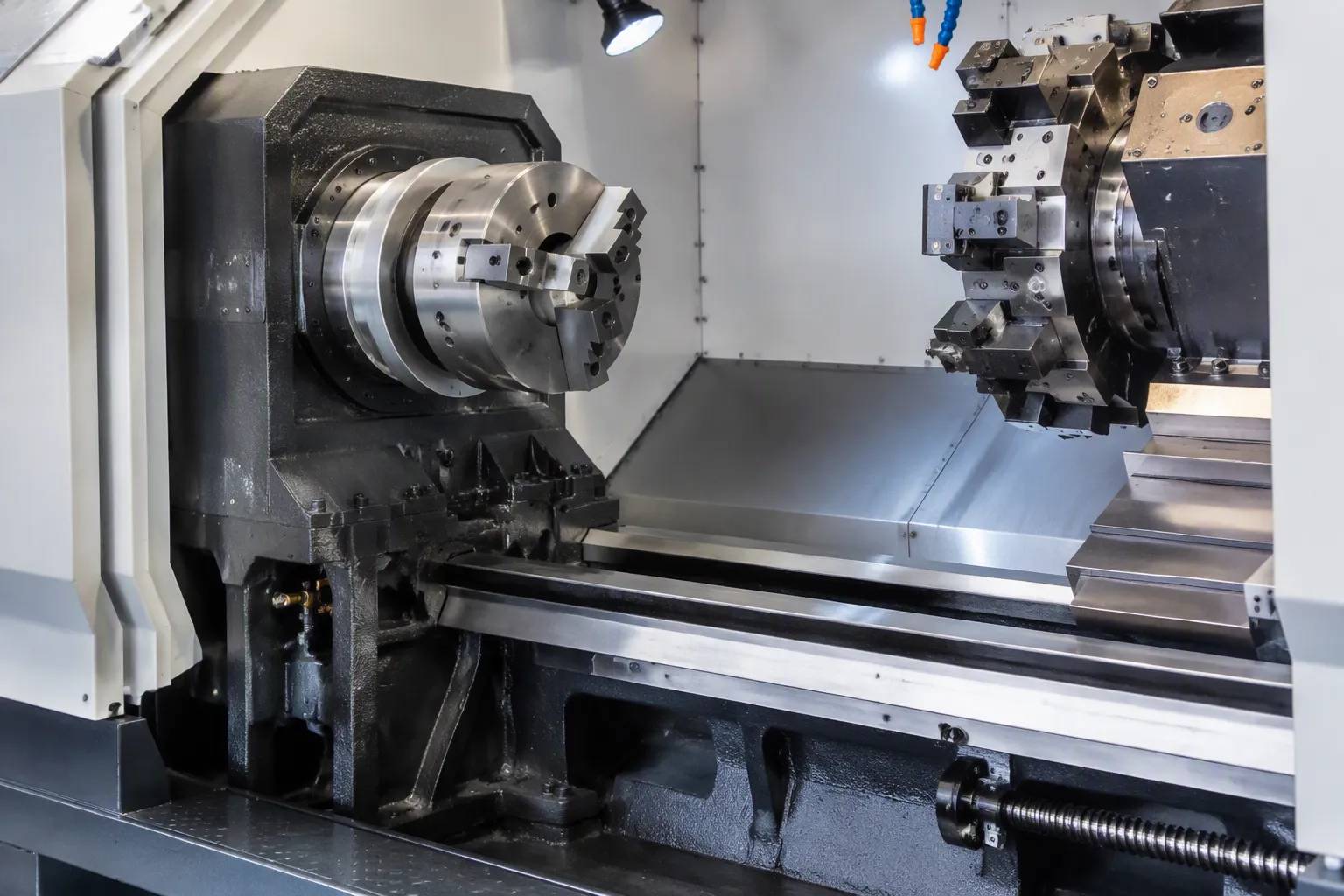
Every CNC lathe machine depends on a set of core components that work together. Each part has a specific job in turning raw material into finished products. Knowing these CNC lathe machine parts helps you run equipment safely and fix problems effectively. You will find these same parts across different brands and models, including TAIZHENG machines built with high-quality materials for durability and precision.
The bed forms the backbone of the entire CNC lathe. This heavy base sits on the floor and supports every other part. Manufacturers cast the bed from rigid iron or steel to absorb vibrations during cutting. A stable bed keeps the cutting tool and workpiece aligned during machining. Without a solid base, you cannot get accurate dimensions or smooth surface finishes.
The frame also includes guideways that let moving parts slide precisely. These guideways control the path of the carriage and tailstock. Many modern machines use hardened and ground guideways for longer service life. You should keep these surfaces clean and lubricated to maintain accuracy over years of use.
The headstock houses the main spindle, which holds and rotates your workpiece. This assembly mounts on the left side of the bed. Inside the headstock, you find gears, bearings, and sometimes a motor that drives the spindle. The spindle has a hollow bore that allows long bar stock to pass through for bar-feeding operations.
The main spindle connects to a chuck or collet that grips your workpiece. Spindle speed directly affects cutting performance and surface quality. Higher speeds work well for soft materials like aluminum, while lower speeds suit harder metals like steel. The CNC controller adjusts spindle speed automatically based on your program commands.
Workholding parts secure your material firmly during machining. The chuck is the most common workholding device on a CNC lathe machine. Three-jaw chucks grip round stock automatically and center it with reasonable accuracy. Four-jaw chucks allow independent adjustment for irregular shapes or off-center work.
Collets offer another gripping method for smaller diameter workpieces. These precision sleeves close around the material with even pressure. Collets provide better concentricity than standard chucks, making them ideal for tight-tolerance jobs. You can change collets quickly to fit different bar diameters. For high-volume production, hydraulic or pneumatic chucks reduce setup time considerably.
The tool turret holds multiple cutting tools and rotates them into position as needed. A typical turret carries 8 to 12 tools, allowing you to perform several operations without manual tool changes. The CNC controller indexes the turret automatically between operations. This automation reduces cycle time and eliminates errors from manual tool swapping.
Gang tooling offers a different approach for small parts. Instead of a rotating turret, tools mount directly on a slide in a row. The machine positions the desired tool by moving the slide. Gang tooling provides excellent rigidity and is common on compact CNC lathe machines designed for precision small parts. TAIZHENG offers both turret and gang-style machines to match different production needs.
The tailstock slides along the bed and supports the free end of long workpieces. It contains a quill that extends to press against the workpiece center. Using the tailstock prevents bending when turning shafts with significant length. You should engage the tailstock whenever your workpiece extends far from the chuck.
For very long shafts, a steady rest provides extra support at intermediate points. This device mounts on the lathe bed and uses three adjustable jaws or rollers to hold the middle of a rotating workpiece. It acts as an intermediate support, increasing rigidity and preventing bending during heavy cutting operations. You need a steady rest when the length-to-diameter ratio exceeds 2.5:1. This support improves surface finish and dimensional accuracy by reducing vibrations and bending.
The control panel serves as the link between you and the machine. Modern panels feature a screen, keyboard, and sometimes a touchscreen. You use these controls to load programs, set tool offsets, and monitor machining progress. The panel shows real-time information about spindle speed, feed rate, and axis positions.
Drive systems turn control signals into physical motion. Servo motors drive each axis with precise positioning. Spindle drives maintain consistent rotation speed under varying cutting loads. These parts must work together smoothly for accurate machining. Quality drives respond quickly to program commands and hold position without drifting. TAIZHENG machines use advanced drive technology to deliver reliable performance across demanding production environments.
Understanding these essential CNC lathe machine parts gives you confidence when operating or buying equipment. Each part adds to the overall capability of the machine. You can evaluate a CNC lathe more effectively when you know what each part does and why it matters.
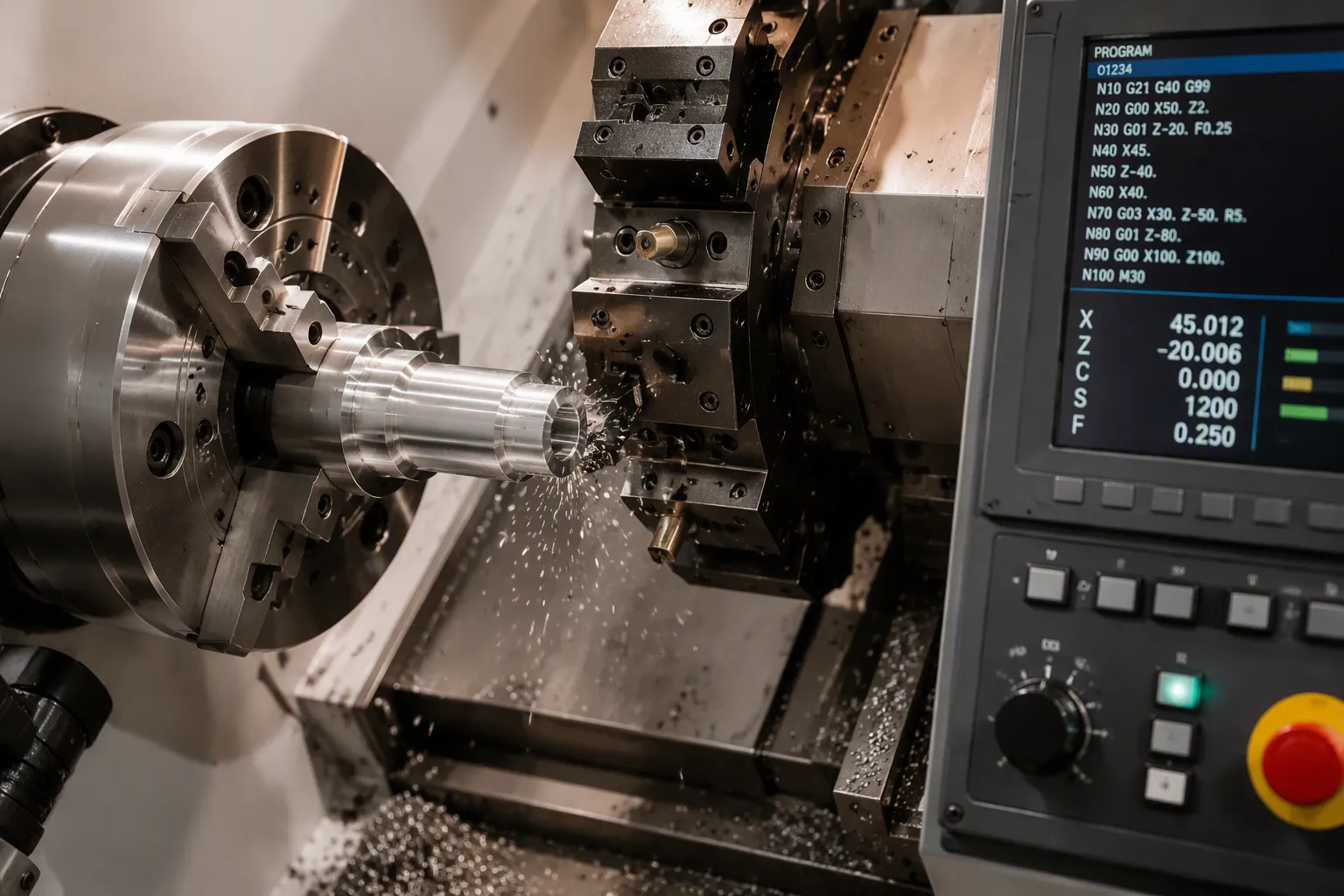
A CNC lathe machine can shape raw material into finished parts in many ways. Each operation uses special G-code commands to run automatically. You can program the machine once and make hundreds of identical parts without adjusting anything by hand. Knowing these cnc lathe machine operations helps you choose the best machining plan.
Straight turning makes a workpiece smaller along its length. The cutting tool moves parallel to the spindle axis and removes material evenly. You tell the Z-axis how far to travel while the X-axis stays in one spot. This operation creates round sections with the same diameter throughout.
Taper turning makes angled surfaces between two different diameters. The tool moves along both X and Z axes at the same time at a set rate. You program how much the tool moves on each axis to get the angle you want. Common uses include conical fittings, tool holders, and tapered shafts. The G-code command G71 handles rough turning cycles, while G70 performs the finishing pass that achieves final dimensions.
Facing removes material from the end of a workpiece. The tool moves from the outside edge toward the center to create a flat, smooth face. This operation gets the part end ready for more machining or assembly. You use facing to make accurate reference surfaces and get exact part lengths.
Grooving cuts narrow channels into the workpiece surface. The tool pushes straight into the material at a certain spot. You can make external grooves for retaining rings, oil channels, or decorative features. Internal grooving works inside pre-drilled holes for similar purposes. The width of your groove depends on the cutting tool geometry you select.
Drilling makes holes in the center or face of a rotating workpiece. The drill bit moves along the Z-axis into the material. For shallow holes with a depth-to-diameter ratio under 3:1, you use a straight plunge command like G81. This non-pecking method drills the full depth in one continuous motion. Deeper holes require pecking cycles that retract the drill periodically to clear chips.
Boring makes an existing hole bigger to get a precise diameter and smooth surface. A single-point boring bar enters the hole and removes small amounts of material. This operation fixes any drift from drilling and achieves tighter tolerances. You can also use boring to create stepped holes or internal tapers.
Thread cutting makes screw threads on outside or inside surfaces. The tool follows a spiral path that matches the spindle rotation. Multiple passes remove material slowly until the thread reaches full depth. CNC thread cutting gives excellent accuracy and repeatability.
The tolerance class you can achieve depends on your application requirements. Here is a reference for common thread tolerance classes:
Tolerance Class | Standard | Typical Application |
|---|---|---|
6g / 6H | ISO 965 | General engineering, standard free-fit combination |
4h / 4H | ISO 965 | Aerospace structural fasteners, medical bone screws |
3A / 3B | ASME B1.1 | Aerospace structural fasteners (UN threads) |
2A | ASME B1.13M | General-purpose external metric threads |
5H / 4h | ISO 965 | Close-fit precision assemblies with minimal play |
7H / 8g | ISO 965 | Loose-fit for high-temperature or coated parts |
Tapping makes internal threads using a tap tool. The spindle rotates the tap into a pre-drilled hole at a controlled feed rate. CNC machines reverse the spindle to pull the tap out after reaching depth.
Knurling presses a patterned tool into the rotating workpiece to make a textured surface. This pattern gives grip for handles, knobs, and other manual parts. The knurling tool uses hardened rollers that shape the pattern without cutting material. Speed selection matters for good results. Here are typical speeds for different materials:
Material | Workpiece Diameter (mm) | Speed (SFM) |
|---|---|---|
Mild Steel | 8.9 | 115 |
Mild Steel | 14.5/15 | 148 |
Mild Steel | 21.5/25 | 197 |
Tool Steel | 8.9 | 82 |
Tool Steel | 14.5/15 | 115 |
Tool Steel | 21.5/25 | 164 |
Stainless Steel | 8.9 | 72 |
Stainless Steel | 14.5/15 | 98 |
Stainless Steel | 21.5/25 | 131 |
Aluminum | 8.9 | 197 |
Aluminum | 14.5/15 | 197 |
Aluminum | 21.5/25 | 197 |
A maximum surface speed of about 150 SFPM prevents seizing of the rolls on the pin. For harder steels and stainless, slowing to about 50 SFPM improves knurl life and appearance.
Parting cuts off a finished part from the remaining bar stock. The parting tool feeds straight into the workpiece until it separates. This operation finishes the production cycle for each part.
Live tooling brings milling ability right to your CNC lathe. Rotating tools in the turret do operations without moving the part to another machine. This cnc turning approach saves a lot of time and improves accuracy.
Live tooling allows many milling processes on the lathe:
Turning and Milling: Both operations happen without changing machines
Drilling and Tapping: Precise holes and threads in one setup
Grooving and Slotting: Detailed features on cylindrical surfaces
Contour Machining: Complex shapes machined accurately
Cross-Drilling: Holes at various angles on cylindrical parts
This live tooling solution works much faster than stopping turning and loading the part into a separate mill. You can add edge rounding, square features, or axial and radial details efficiently. CNC turning machines with live tooling handle complex metalworking features including precisely-cut grooves and slots.
These cnc lathe machine operations cover most production needs. Each operation uses programmed commands to run automatically. You combine these operations in order to make complete parts in one setup. Understanding these cnc lathe operations helps you improve your machining process and cut cycle times.
CNC lathe machines come in many shapes and sizes. Each type fits a different job. Understanding the differences helps you pick the right machine for your parts. The choice affects your production speed, part quality, and cost. You can match the machine to your work by looking at orientation, complexity, and part size.
A horizontal CNC lathe has its spindle parallel to the ground. This design works best for long, slender parts like shafts, tubes, and axles. The workpiece lies flat between centers or in a chuck. Gravity pulls the chips down and away from the cutting area. This setup gives you excellent support for extended workpieces.
Horizontal lathes provide great stability during heavy cuts. The weight of the workpiece rests evenly on the bed. This reduces vibration and improves surface finish. You can hold tight tolerances more easily on long parts. Many production shops use horizontal lathes for high-volume turning of cylindrical components.
A vertical CNC lathe has its spindle perpendicular to the ground. The workpiece sits on a horizontal table like a rotating platform. This design handles large, heavy, and asymmetrical parts very well. Gravity helps hold the workpiece in place during machining.
Vertical lathes make loading and unloading heavy parts much easier. You lift a heavy flange or gear blank straight onto the table. No need to fight gravity during setup. The vertical orientation also improves chip removal. Chips fall away from the cutting zone naturally. This prevents re-cutting and extends tool life.
Aspect | Horizontal CNC Lathe | Vertical CNC Lathe |
|---|---|---|
Spindle Orientation | Parallel to the ground | Perpendicular to the ground |
Best for | Long, cylindrical, and heavy parts | Large, heavy, and asymmetrical pieces |
Gravity Effect | Less impact on spindle precision | Gravity stabilizes the workpiece |
Loading Heavy Parts | Standard loading methods | Easier loading and unloading |
Swiss-type lathes are special machines for very small, precise components. The workpiece moves through a guide bushing very close to the cutting tool. This design supports the material right at the cut point. It prevents bending and deflection during machining.
Swiss-type lathes handle parts with a diameter range from 1 mm to 38 mm. The maximum bar capacity is 38 mm. These machines excel at making tiny medical screws, watch parts, and electronic connectors. You get excellent accuracy and surface finish on small diameters.
Multi-axis and turn-mill centers combine turning and milling in one machine. They add extra axes beyond the standard X and Z. The C-axis lets the spindle position for milling operations. Live tooling in the turret rotates to cut slots, flats, and cross holes.
These machines reduce your need for secondary operations. You can complete a complex part in one setup. This saves time and improves accuracy. TAIZHENG offers the RA-550MY turn-mill center for this type of work. It handles complex parts with both turning and milling features. The single setup eliminates errors from moving a part between different machines.
Part size guides your first decision. Small parts under 38 mm diameter suit Swiss-type machines. Medium shafts work well on horizontal lathes. Large heavy flanges need a vertical configuration.
Production volume matters too. High-volume runs of simple parts benefit from horizontal turret lathes. TAIZHENG's HMS-1000 turret lathe is a good example for mass production. Lower volumes might allow more flexible machines with fewer setups.
Complex parts with many features need more axes. A two-axis lathe handles basic turning and facing. Adding a C-axis with live tooling lets you mill, drill, and tap in the same cycle. The global cnc machining and turning centers market continues to grow as manufacturers demand this versatility.
Tighter tolerances require more rigid machines. The bed, spindle, and guideways must absorb vibration. Swiss-type lathes offer high precision for small parts. Turn-mill centers provide accuracy for complex geometries. Match your tolerance requirements to the machine's capability.
Choosing the right CNC lathe improves your production efficiency. You save time, reduce scrap, and deliver higher quality parts.
You can machine parts from many different materials on a CNC lathe. Each material has unique properties that affect your cutting speeds, tool selection, and surface finish. The machine must handle the specific demands of each workpiece material.
Aluminum is a common material for turning work. Alloys like 6061-T6 and 7075-T6 offer excellent machinability. They cut easily at high speeds. Steel provides greater strength but requires slower speeds. Titanium offers exceptional strength-to-weight ratios but presents machining challenges.
The machinability rating helps you compare how easily different materials cut. This rating uses a baseline material set at 100 percent. Here is a reference for common alloys:
Material | Machinability Rating |
|---|---|
Ti-6Al-4V (Grade 5) | ~22% |
6061-T6 Aluminum | ~170% |
7075-T6 Aluminum | ~200% |
A higher percentage means the material cuts more easily. Aluminum machines at nearly twice the rate of the baseline material. Titanium demands much slower speeds. When you work with titanium, use sharp carbide tools and coolant to manage heat.
Steel falls between these extremes. Standard carbon steel machines reasonably well. Stainless steel and tool steel need slower speeds and more attention to tool wear.
CNC turning also handles many plastic materials. Nylon, acetal, and PTFE are common choices for machined components. Plastics require sharp tools and proper chip evacuation to prevent melting. You must control heat carefully because plastic softens at much lower temperatures than metal.
Other engineering materials include brass, bronze, and composites. Brass machines very easily and produces excellent surface finishes. Bronze offers good wear resistance for bearings and bushings. Composites require special tooling to prevent delamination and fiber pullout.
Many industries depend on CNC lathe technology for their production needs. Lathe machining applications span automotive, aerospace, medical, and electronics sectors. TAIZHENG serves customers across all these industries.
The automotive industry uses CNC lathes for engine components, transmission parts, and brake system items. Crankshafts, camshafts, and pistons start as raw material on a lathe. High-volume production requires reliable machines that run consistently for long periods.
Aerospace applications demand the highest precision and material quality. You machine turbine blades and landing gear components from tough alloys like titanium. These items must meet strict certification standards. The RA-550MY turn-mill center from TAIZHENG handles complex aerospace components that need both turning and milling.
The medical industry requires CNC lathes for surgical instruments and implant components. Bone screws and dental implants need fine tolerances and smooth finishes. Medical-grade materials include titanium, stainless steel, and specialized polymers. Swiss-type machines excel at making these small, precise components.
Consumer electronics manufacturing uses turning centers for connector housings and smartphone components. These items require tight tolerances and consistent quality. Aluminum and brass are common materials for electronic components. TAIZHENG provides digital factory solutions that help manufacturers optimize production.
TAIZHENG is a top maker of high-quality CNC lathes and machining centers. They build machines that are precise, long-lasting, and use smart technology. You get tools made for real factory work, not just test parts. Every CNC lathe goes through strict quality checks before it leaves the factory. This focus on quality makes TAIZHENG a trusted company for makers around the world.
The HMS-550M Automatic Turning Center can handle medium-sized production runs easily. It gives consistent accuracy over long shifts. You load your program, set your tools, and let the machine run. The automatic cycle reduces worker tiredness and keeps quality steady all day.
The HMS-1000 Efficient Turret Lathe is for high-volume mass production. Its strong turret holds many tools for non-stop work. You can do turning, facing, grooving, and threading without stopping to change tools. This machine works well when you need thousands of same parts with tight size limits. The strong bed and good spindle bearings reduce shaking, giving you smoother surfaces on every part.
The RA-550MY Automatic Turn-Mill CNC Lathe gives you real multitasking power. This machine does both turning and milling in one setup. You save the time and avoid mistakes from moving parts between different machines. The Y-axis and live tooling let you cut complex shapes that normally need a machining center.
Parts with flat sides, slots, or holes drilled across become simple jobs. You load the raw material once and get a finished part. This method cuts cycle times a lot. The RA-550MY is very useful for aerospace and medical parts where accuracy is most important.
TAIZHENG machines work well with robotic loading and unloading systems. You can automate the whole process from raw metal to finished parts. A robotic arm puts blanks into the chuck, the machine does its cycle, and the robot takes out the finished piece. This automation lets you run production without lights, even all night.
Built-in robots lower labor costs and remove human mistakes in repeat jobs. You let your skilled workers do more valuable tasks like programming and checking quality. The robot talks directly to the CNC lathe controller, making sure everything times well and works together.
TAIZHENG offers digital factory solutions that link your machines into a smart production network. You can watch machine status, production numbers, and tool wear live from a central screen. This data helps you find problems before they stop work. You can follow every part through production with full records.
The digital platform gathers performance data from each lathe and shows it in clear reports. You see which machines work well and which need care. This view helps with better planning and steady improvement. TAIZHENG's idea for future-ready factories begins with these connected systems. You build a factory that changes quickly to new needs and keeps high quality at every step.
Running a manual lathe needs your skill and focus. You measure, change, and hope every cut matches the last one. Being tired, distracted, or making small mistakes leads to uneven parts. A CNC lathe takes away all these problems. The computer runs the same program exactly every time. You don't need good hand-eye skills or lots of experience to keep quality.
The scrap rate shows the difference well. Manual lathe work usually creates 5–8% scrap. CNC lathe work brings that down to 1–3%. The middle scrap rate goes from 6.5% to 2.0%. That means you save 4.5% of material that would be waste. For big production runs, this saving adds up to big cost savings.
Precision is important when you make parts that must fit together well. A CNC lathe machine keeps tolerances that manual methods can't match every time. The servo motors move each axis with exact repeatability. You set the size once, and the machine makes the same part thousands of times.
Temperature changes, tool wear, and shaking affect manual work. The CNC controller fixes these things by itself. You get the same size, same finish, and same thread on every part. This consistency makes CNC turning the best choice for aerospace, medical, and car parts where failure cannot happen.
A CNC lathe runs on its own after you set up the program and tools. The machine does roughing, finishing, and other steps without stopping. You don't need to stop for measurements or hand adjustments between passes. This automation directly raises your output.
Industry data shows CNC lathes make 25–40% more parts than manual lathes in the same time. They also take about 30% less time for the same work. You can run many machines with fewer workers. One person watches several CNC lathe machines while they run their cycles. This efficiency helps you meet tight deadlines and take more orders.
Manual lathes only let you make simple round shapes. A CNC lathe machine gives you many more options. You can program tapered surfaces, complex curves, and exact thread shapes. Adding live tooling and a C-axis lets you mill flat surfaces, drill side holes, and cut slots without moving the part.
Complex parts that used to need many machines now finish in one setup. You remove the errors and moving time from shifting work between steps. The machine follows the programmed tool path exactly, making shapes that would be almost impossible by hand. This ability grows what you can offer your customers.
Using a manual lathe puts you near spinning machines and sharp tools. Every measure and adjust brings your hands close to the cutting area. A CNC lathe keeps you away from these dangers. You load the part, start the cycle, and stand back while the machine runs.
The automatic tool changer and turret swap tools without your help. The machine guards and locks stop access while running. You lower the risk of accidents that cause injuries and stop work. A safer workplace also cuts your insurance costs and boosts worker morale.
Paying for skilled manual lathe operators costs more each year. A CNC lathe machine needs one operator to run several machines instead of one per machine. You lower your labor cost while raising your production. The first cost of CNC technology pays for itself through lower running costs.
Training new CNC operators takes less time than making expert manual machinists. The programming interface guides you through setup and use. TAIZHENG machines have advanced control systems that make learning and daily work easier. You build a flexible team that adapts fast to new jobs and changing production needs.
These benefits make CNC lathe technology a smart investment for any factory. You get precision, speed, safety, and cost control that manual methods can't give.
You now know how a CNC lathe machine changes raw material into exact round parts. The bed, spindle, chuck, and turret all work together with computer control. You learned about key operations like turning, facing, threading, and knurling. Different machine types fit different needs, from Swiss-type lathes for small parts to turn-mill centers for complex shapes.
CNC technology gives you accuracy, consistency, and safety that manual methods cannot offer. You cut down on waste, reduce labor costs, and get steady quality in every batch. Modern manufacturing relies on these machines for automotive, aerospace, and medical uses.
Think about how adding a CNC lathe to your production could boost efficiency and widen your options. The future of manufacturing moves toward automation and smart factory systems.
A CNC lathe uses computer control to automate the cutting process. You load a program and the lathe follows it exactly. This removes human mistakes and makes identical parts every time. Manual machining needs your full attention and skill at all times.
Aluminum, steel, titanium, brass, and plastics all work well on a CNC lathe. Each material needs its own cutting speeds and tooling. Aluminum cuts fast. Titanium needs slower feeds and sharp carbide tools.
The tailstock supports long workpieces during turning on a lathe. It moves along the bed and holds the free end. This stops bending and shaking when you machine shafts that are quite long.
G-code is the programming language that runs your machine. Commands like G71 handle rough turning cycles. G70 runs final finishing passes. You learn these codes to set up efficient operations.
Good chip flow keeps the cutting area cool. Use proper feed rates and tool shape to make small, easy chips. Long stringy chips can wrap around the workpiece and hurt the finished surface.
A steady rest supports the middle of long workpieces during turning. It stops bending when your length-to-diameter ratio goes above 2.5 to 1. This makes the surface finish and size accuracy better.
Automotive, aerospace, medical, and electronics industries all depend on turning for precision parts. Engine parts, surgical tools, and smartphone cases all begin on a turning center.


