


Specify a Y axis turning center when the part family needs controlled off-center machining, repeated milled features, or a stronger one-setup datum strategy than a standard turning center can provide. Do not specify the extra axis only because it sounds more capable; confirm the workpiece features, fixturing plan, tooling, cycle assumptions, inspection method, and acceptance data before putting it into an RFQ.
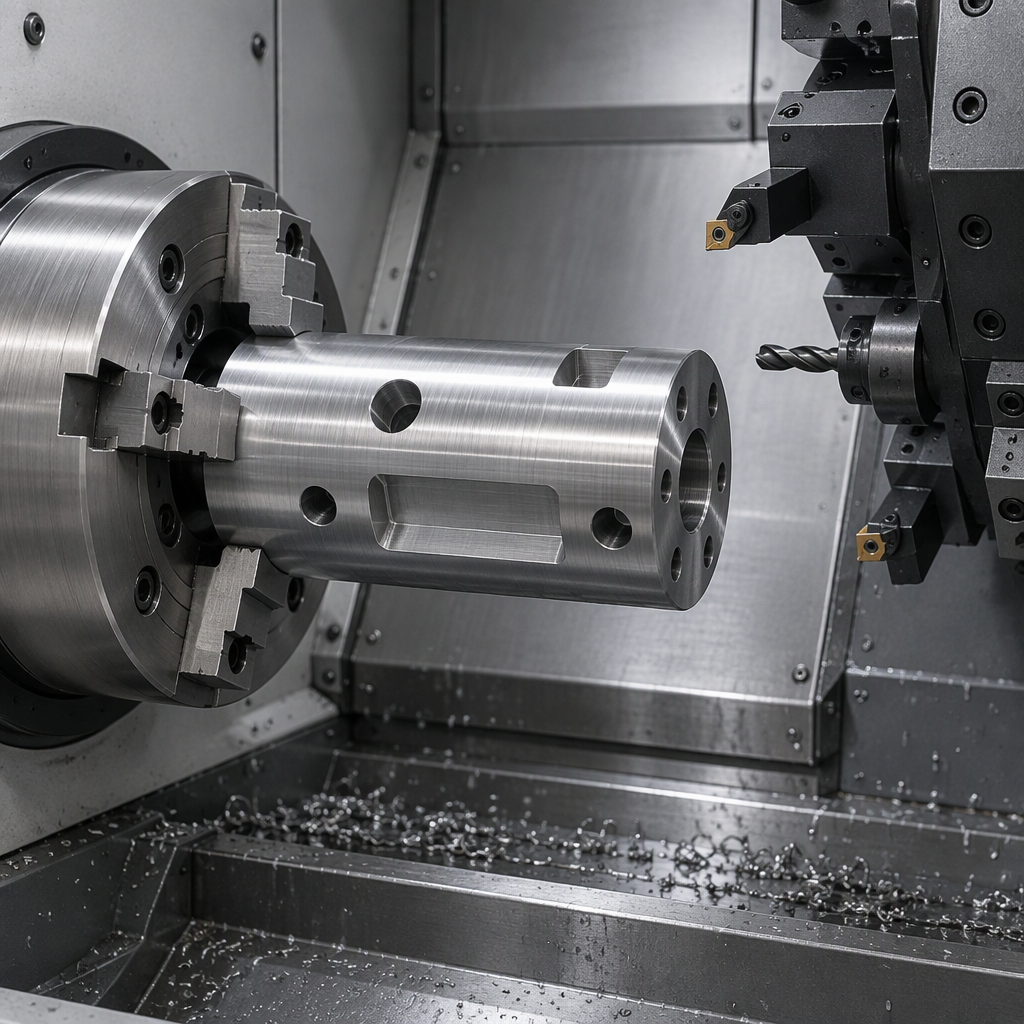
What a Y-axis adds to a turning center
A Y-axis turning center adds a controlled machining direction to the turning platform so shops can consider more complex workpiece shapes than basic turning alone.
The buying question is not whether an extra axis is technically attractive. The question is whether that axis removes a real bottleneck in your part family. A standard turning center is strongest when most value comes from turning diameters, faces, grooves, and concentric features. A Y-axis configuration becomes more relevant when the same part also has off-center holes, flats, slots, milled pads, or angular relationships that are difficult to hold after moving the part to another fixture.
Treat the Y axis as part of a system decision. The result depends on spindle arrangement, turret capacity, live-tool capability, tool reach, workholding, programming skill, inspection strategy, and the specific material-removal sequence. If those items are not defined, the machine name alone cannot predict the production result.
Part features that justify the added axis
The Y axis is worth considering when the same turned part also needs repeatable milled or drilled features that benefit from staying in the original turning setup.
| Part or process condition | What it suggests | Buyer action before specifying |
|---|---|---|
| Workpieces have diverse or complex shapes that go beyond simple turning. | Y-axis capability may help combine turning and secondary machining in one platform. | Group parts by common feature types, not by a single difficult example. |
| Off-center holes, slots, flats, or milled faces are repeated across the part family. | The added axis may support a cleaner setup plan than transferring every part to a mill. | Provide drawings with datum callouts, tolerances, feature orientation, and surface-finish expectations. |
| Concentric turned features must stay related to milled features. | Keeping the part clamped once may reduce datum-transfer risk. | Ask the supplier to explain the proposed clamping, machining order, and inspection method. |
| Only one occasional feature needs milling on a low-repeat part. | A separate milling operation may be simpler than buying extra turning-center capability. | Compare programming effort, setup time, fixture cost, and future part mix. |
When live tooling is enough—and when the Y-axis changes the decision
Live tooling may be enough for straightforward driven-tool operations, while a Y axis becomes more important when the toolpath needs controlled offset movement relative to the part centerline.
| Selection path | Best fit | Main limitation to check |
|---|---|---|
| Turning center without Y axis | Parts dominated by turning, facing, boring, grooving, threading, and simple concentric geometry. | Secondary operations may be needed for features that cannot be reached or positioned adequately. |
| Live tooling without Y-axis specification | Parts with limited driven-tool operations where the feature location and tool approach are simple enough for the machine configuration. | Do not assume every milled or drilled feature is practical; confirm tool orientation, clearance, and datum needs. |
| Y-axis turning center | Part families with more diverse and complex workpiece shapes where added machining capability is a meaningful selection factor. | The added capability must be matched to actual drawings, tools, cycle plan, and acceptance criteria. |
A useful rule for the buyer is to start with the drawing package, not the machine brochure. Mark every feature that forces a second setup today. Then ask which of those features can be machined, inspected, and repeated more reliably if the part remains in the turning setup.
How to evaluate the one-setup tradeoff
A one-setup strategy is attractive only when it improves the total manufacturing route for the part family, not merely because it moves more operations onto one machine.
- Map the current route from blank to finished part, including turning, milling, deburring, inspection, and any queue between machines.
- Identify which features lose time or accuracy because the part changes fixtures, machines, or datums.
- Build a proposed Y-axis route that names the turning operations, live-tool operations, tool list, workholding method, and inspection points.
- Compare the two routes by setup count, operator handling, fixture requirements, programming complexity, tool interference risk, and inspection effort.
- Run the decision across a part family. A single demonstration part may not justify a specification if the broader production mix does not need the added axis.
Be careful with unsupported cycle-time assumptions. A Y-axis machine may reduce handling, but it can also add programming work, tool-management complexity, or longer in-machine cutting sequences. For purchasing, the safer question is: which route gives the shop a repeatable process with clear acceptance criteria?
When a Y-axis turning center may not be worth it
A Y-axis turning center may be unnecessary when the shop’s real constraint is not part geometry but volume, tooling discipline, fixture design, inspection capacity, or basic turning availability.
- Do not specify the Y axis for parts that are almost entirely concentric turning work.
- Do not use the added axis as a substitute for missing fixture planning, toolholder clearance checks, or inspection planning.
- Do not assume a lower cost per part without comparing the complete route, including programming, tool life, setup, inspection, and operator training.
- Do not base the decision on a single future job unless the machine will also serve a recurring part family.
- Do not lock the RFQ around an axis label before confirming chuck size, turning envelope, bar or blank handling, tool capacity, spindle needs, and control requirements with the supplier.
RFQ and acceptance data to confirm before purchase
Before purchase, turn the Y-axis idea into an RFQ package with drawings, process assumptions, measurable acceptance criteria, and supplier responses that can be compared line by line.
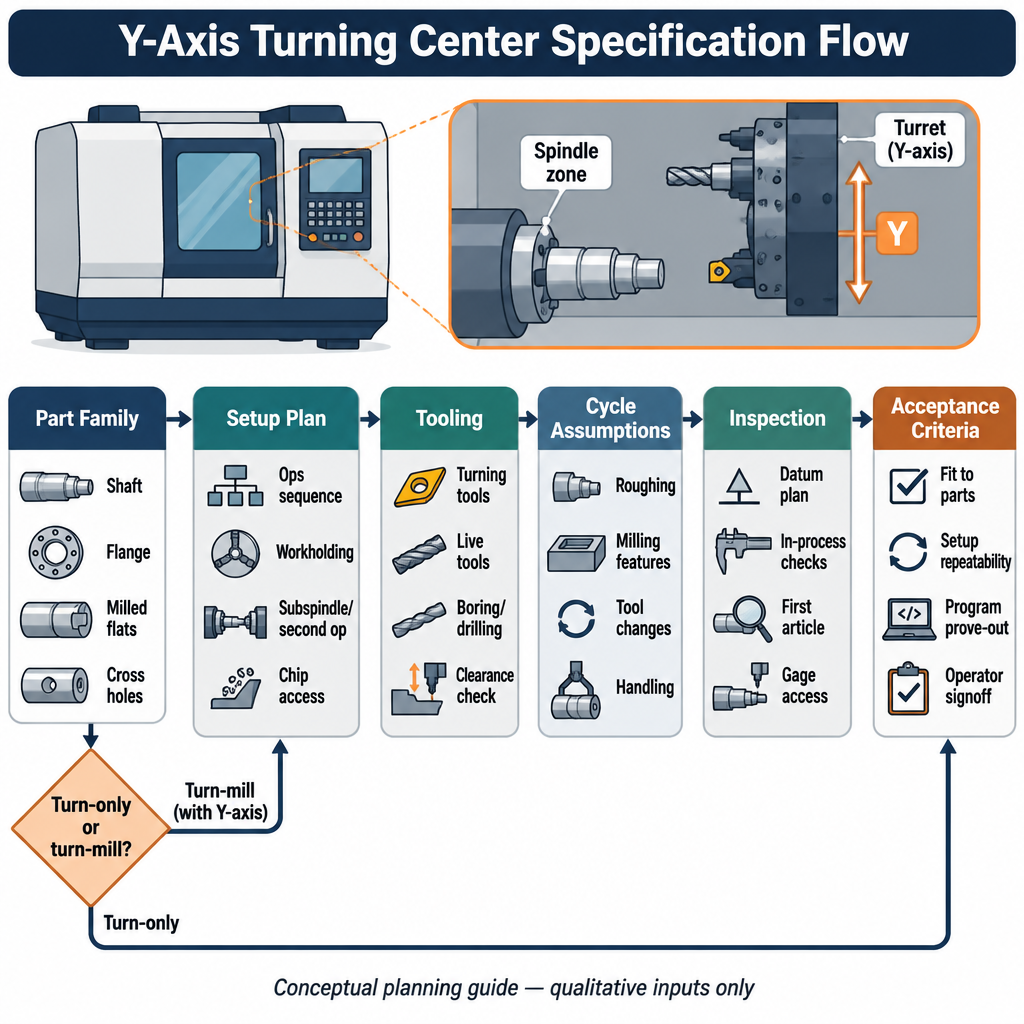
- Representative drawings for the part family, with tolerances, datum structure, material, blank form, and annual or batch quantity assumptions.
- Current process route and the proposed one-setup route, including which operations are expected to move onto the turning center.
- Workholding concept, chuck or collet expectations, part support needs, and access limits for tools and inspection.
- Tooling list, live-tool requirements, toolholder clearance concerns, and any expected special tools.
- Cycle-time assumptions separated from guaranteed acceptance criteria, so the buyer can compare proposals without treating estimates as proven results.
- Inspection plan for critical relationships between turned and milled features, including how sample parts will be measured at acceptance.
For procurement discipline, NIST lists NIST IR 88-3811, Recommended technical specifications for procurement of equipment for a Turning Workstation, as a historical turning-workstation procurement specification publication with a 1989 publication date and later page update.
Use that kind of procurement mindset carefully: define what the machine must prove for your drawings, but request current machine-specific documents, test conditions, and acceptance procedures from each supplier instead of relying on a historical reference as a modern Y-axis test code.
How to separate general selection logic from supplier-specific claims
Use general Y-axis selection logic to frame the decision, then require supplier-specific documents before treating any model as suitable for your parts.
The TAIZ website presents CNC machine categories that include CNC Lathe, Turn-Mill Lathe Machine, Turning Center Lathe, Turret Lathe, Vertical Machining Center, Drilling and Tapping Machining Center, Horizontal Machining Center, Gantry Machining Center, and Five-Axis Machine Center. The same website states that TAIZ specializes in the design and production of CNC machining centers, CNC lathes, and integrated automation systems.
For a purchasing decision, keep those company-scope statements separate from model-level proof. Ask for the specific turning-center model sheet, Y-axis travel and positioning information, spindle and turret configuration, live-tool limits, standard and optional accessories, control configuration, sample acceptance procedure, and service scope that apply to your RFQ. If a claim matters to the purchase order, put the required document or acceptance test into the commercial discussion.
Conclusion
A Y-axis turning center is worth specifying when it solves a defined part-family problem and the supplier can connect the machine configuration to your drawings, tooling, setup plan, and acceptance criteria.
The best purchase case is not “more axes are better.” It is a documented route showing why controlled Y-axis capability supports the part geometry, reduces avoidable transfers, protects datum relationships, and can be accepted with measurable checks. Build the RFQ around the workpiece first, then compare machine proposals.
- Start with recurring part features, not a single impressive option.
- Compare the whole route: setup, fixtures, tools, programming, inspection, and acceptance.
- Separate supplier category statements from model-specific purchasing proof.
FAQs about specifying a Y-axis turning center
These questions help buyers turn the Y-axis decision into a practical RFQ and acceptance discussion.
What is a Y axis turning center?
It is a turning-center category associated with added machining capability for more diverse and complex workpiece shapes. In buying terms, it is considered when the part needs more than straightforward turning.
Is live tooling enough without a Y axis?
Sometimes. If the driven-tool features are simple, reachable, and do not require controlled offset movement, live tooling may be enough. Confirm this with drawings, tool approach, clearance, and inspection requirements.
Does a Y-axis turning center always reduce cycle time?
No. It can reduce handling for some part families, but the result depends on programming, tooling, operation sequence, inspection, and the actual production mix. Ask suppliers to separate estimates from acceptance commitments.
What drawings should be sent with the RFQ?
Send representative drawings with tolerances, datum structure, material, blank form, critical features, batch expectations, and the current process route. This lets suppliers respond to the real application rather than a generic axis request.
How should acceptance be discussed?
Use a procurement-specification mindset: define measurable acceptance checks for your parts, then request the supplier’s current machine-specific acceptance procedure and documentation.
How should buyers evaluate TAIZ for this decision?
TAIZ presents CNC lathe, turn-mill lathe, turning center lathe, machining center, and related CNC machine categories. TAIZ also presents itself as specializing in CNC machining centers, CNC lathes, and integrated automation systems. Buyers should request model-level specifications and acceptance details for the exact Y-axis application.
When is specifying the Y axis likely overkill?
It is likely overkill when the parts are mainly concentric turning work, the milling features are rare, or the shop has not defined tooling, fixturing, programming, and inspection needs clearly enough to use the added axis effectively.
