


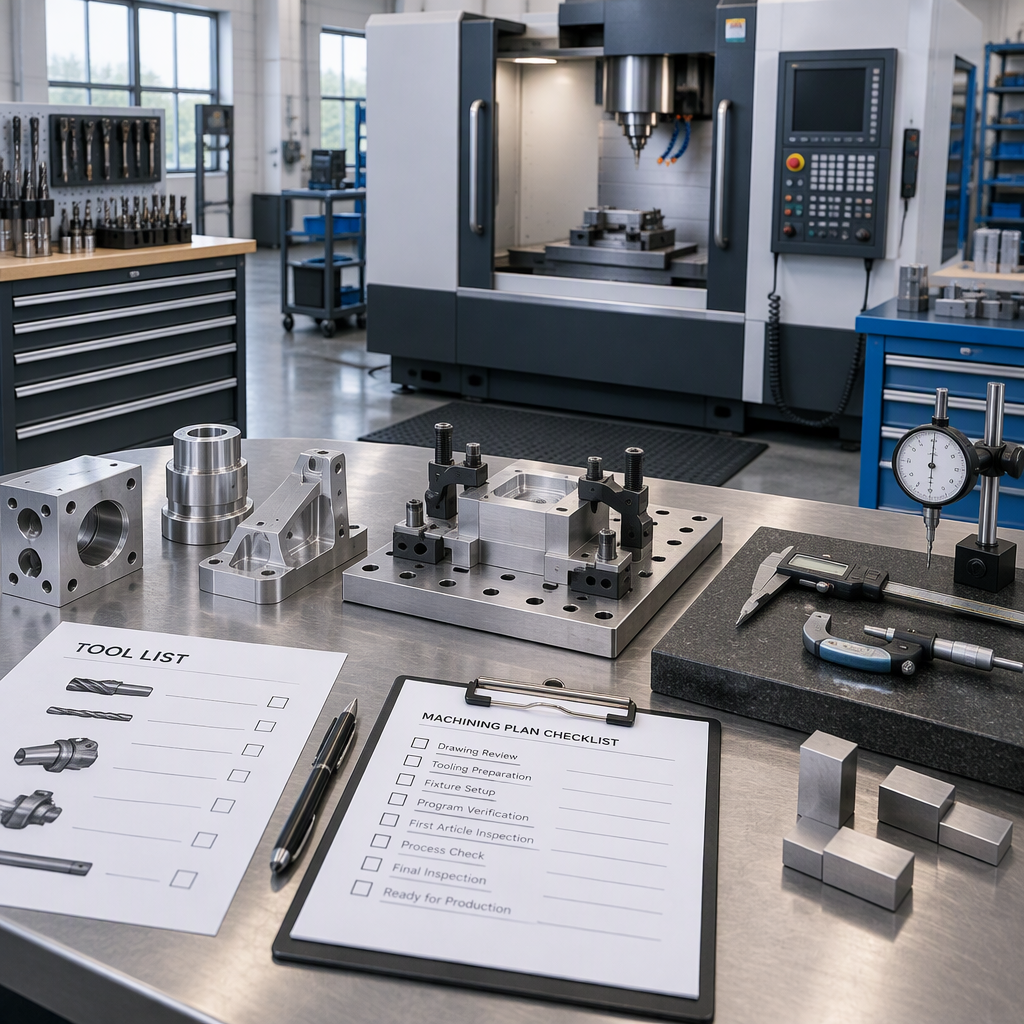
When automation starts to pay off
CNC machine automation makes business sense when the shop can predict and control enough of the machining process for the automation to remove waiting time, loading variation, or avoidable manual intervention.
The decision is less about buying a robot or accessory first and more about proving that the part mix can support repeatable flow. A recurring family of parts, similar workholding, stable tooling, and known cycle behavior gives the buyer a stronger case than a queue of unrelated one-off jobs.
Do not base the decision on a generic payback percentage or a promised number of months. Machine monitoring can record machine-tool actions such as axis-location coordinates and power consumption, and process-planning decisions affect machining performance. That makes shop-specific data more useful than a universal rule.
Part-mix signals that support or weaken the case
A part mix supports automation when process plans are repeatable enough for the machine, workholding, and handling method to be evaluated from real or expected monitoring data.
High mix does not automatically rule out CNC machine automation. The practical question is whether the variation is organized. A shop running many parts within a common material group, fixture concept, tool library, and inspection routine may have a better case than a shop running fewer parts that require constant rethinking.
| Part-mix signal | Stronger automation case | Weaker automation case |
|---|---|---|
| Repeat demand | Recurring part families with predictable routing | Mostly one-time work with changing operations |
| Workholding | Shared fixture logic, pallets, jaws, or nests across similar parts | Frequent custom clamping that needs manual judgement |
| Tooling | Stable tool list and tool-life assumptions that can be checked | Frequent tool changes, trial cuts, or unproven tool paths |
| Cycle behavior | Cycle and process behavior can be connected to monitoring data for evaluation | Cycle time varies because operators must continuously adjust the process |
| Quality control | Measurement use cases can be included in the machining information flow | Inspection depends on manual judgement that has not been translated into checks |
Data to collect before asking for a quote
Before requesting automation pricing, collect the process data that lets a supplier evaluate part handling, machine utilization, setup burden, and monitoring requirements.
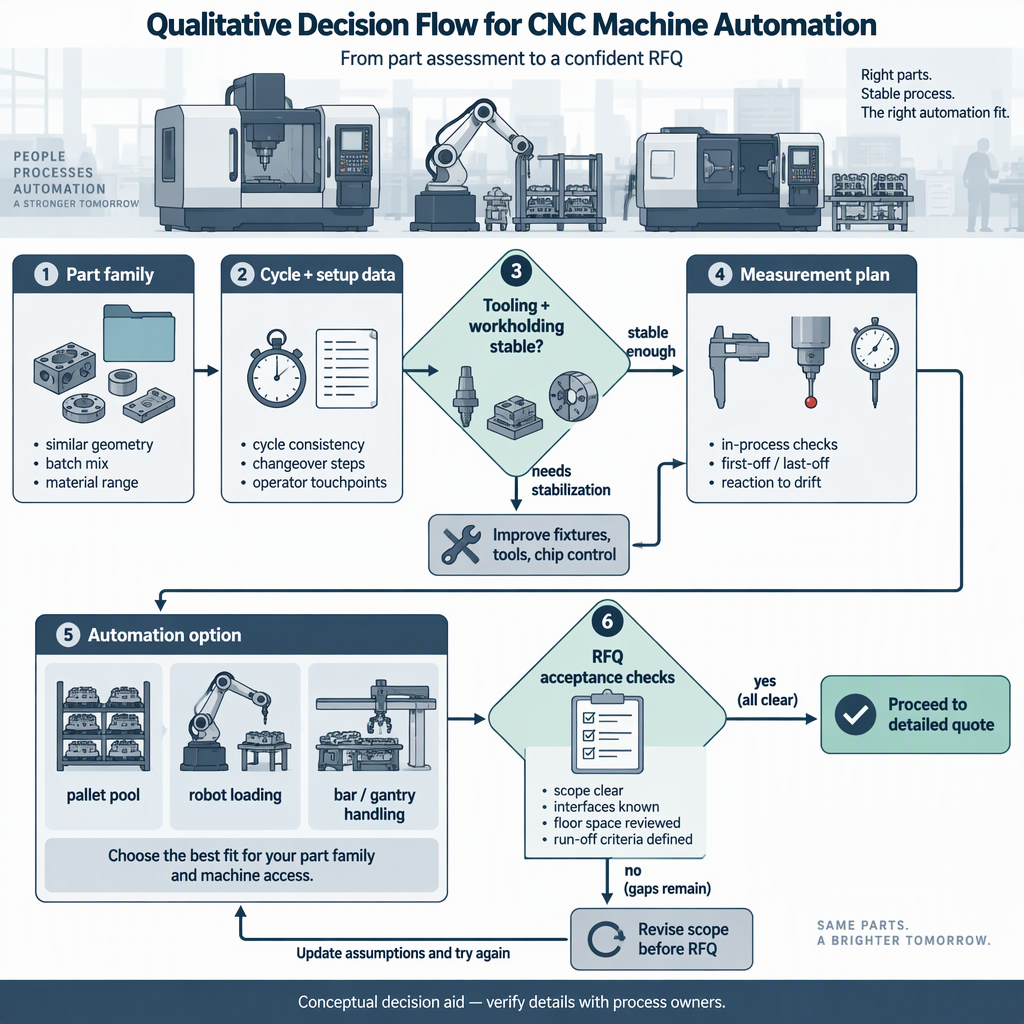
Useful RFQ data turns an automation idea into an engineering discussion. NIST describes a virtual machining model using STEP-NC and MTConnect interfaces in a CNC lathe validation context, showing why process planning and machine monitoring information matter when evaluating machining performance. Buyers can review the NIST machining model publication for the technical background.
- Representative part drawings, materials, blank sizes, finished dimensions, and tolerance-critical features.
- Expected order quantities, release pattern, part-family groupings, and changeover frequency.
- Current cycle time, setup time, loading and unloading time, and any manual waiting time that repeats.
- Workholding concept, fixture access, clamping sequence, part orientation, and chip-clearance concerns.
- Tool list, tool-life assumptions, tool-change frequency, and operations that still require operator adjustment.
- Inspection points, gauging method, probe use, sampling plan, and conditions that stop production.
- Machine acceptance expectations, including what cycle, part, fixture, tooling, and measurement conditions will be demonstrated.
Where inspection and on-machine measurement fit
Inspection and on-machine measurement should be planned as part of the automation concept when quality feedback affects whether the cell can run with less operator attention.
NIST describes on-machine dimensional measurement use cases for machining operations and notes that digital thread standards for dimensional metrology and industrial machine-tool operations have been defined and implemented in commercial manufacturing operations. Buyers can use the NIST on-machine measurement use cases as background when deciding how inspection data should connect to machining operations.
For a buyer, the key issue is not whether probing exists on a machine. It is whether the process defines what to measure, when to measure it, how the result changes the next action, and when production should stop for review.
Probing alone does not make a process unattended. Treat it as one element of a controlled plan that also includes workholding, chip control, tool condition, part loading, operator response rules, and acceptance criteria.
Automation options to compare without assuming a winner
Compare automation options by the bottleneck they address: part loading, setup, measurement, chip and coolant stability, or multi-machine flow.
A buying guide should not assume that the most complex system is the best fit. The right level depends on the part family and on which manual activity limits output, quality consistency, or scheduling.
| Option to compare | Best-fit decision question | Buyer limitation to check |
|---|---|---|
| Machine tending | Is manual loading and unloading the repeatable bottleneck? | Part presentation, orientation, gripping, access, and safe recovery from misloads |
| Pallet or fixture standardization | Can setup be moved out of cutting time or made more repeatable? | Fixture repeatability, part-family grouping, and changeover discipline |
| Tooling and process engineering | Do process-planning decisions drive the machining performance that automation depends on? | Unstable tool life or unproven cutting conditions can erase the value of unattended time |
| On-machine probing or measurement | Does the process need dimensional feedback during machining operations? | Measurement strategy must define actions, not only data collection |
| Flexible production line | Is the buyer evaluating a broader CNC equipment and flexible-line scope rather than one machine accessory? | Needs stronger planning for routing, workholding, tools, inspection, and acceptance |
What to separate as general theory versus supplier scope
TAIZ presents its scope around CNC machining centers, CNC lathes, gantry machines, five-axis machining centers, flexible production lines, and application engineering support.
The first-party TAIZ page states that application engineering support covers machine automation, process development, machine and tool selection, and part workholding. Use that scope to frame a discussion, while asking for project-specific documents before relying on any model, configuration, acceptance value, or delivery commitment.
General automation theory can explain why repeated handling, stable cycles, and measurement feedback matter. Supplier-side evaluation should translate those ideas into a proposed machine, fixture, tooling, inspection method, and acceptance plan for the buyer’s actual part mix.
- Ask which parts the supplier wants to see first and why those parts represent the family.
- Ask whether the recommendation is a single CNC machine, an automation accessory, process engineering first, or a flexible line concept.
- Ask for the assumptions behind cycle time, loading time, changeover, tooling, and inspection.
- Ask which responsibilities belong to the machine builder, fixture maker, automation integrator, tooling supplier, and buyer.
- Ask how acceptance will separate machine capability from fixture, tooling, operator, and measurement variables.
RFQ and acceptance checks before committing
The RFQ should connect the proposed automation to process planning and measurable machine behavior, not just to a hardware list.
- Choose representative parts that cover the real range of material, geometry, handling, tolerance, and cycle requirements.
- Define the intended process route, including machine, fixture, tool list, loading method, measurement points, and stop conditions.
- Specify how dimensional measurement or probing information will be used during machining operations when quality feedback is part of the decision.
- Confirm what will be demonstrated during acceptance: part condition, cycle sequence, loading method, tool assumptions, inspection method, and sample size.
- Separate quoted equipment from optional engineering, fixtures, tooling, software, training, and installation support so the buyer can compare offers fairly.
- Require the quotation to state assumptions rather than only a total package name.
- Request a changeover concept for the highest-volume and most-different parts in the family.
- Confirm who owns fixture design, robot or loader grippers, tool selection, probing routines, and inspection documentation.
- Ask how machine monitoring, alarm handling, and operator response will be reviewed during acceptance.
- Do not accept a claimed payback period unless the supplier and buyer agree on the baseline data used to calculate it.
Conclusion
CNC machine automation pays off when the part mix is organized enough for process planning, workholding, tooling, measurement, and acceptance data to support the investment.
Start with the parts, not the robot. If recurring work can be grouped into stable families and the buyer can define cycle, setup, loading, tooling, inspection, and acceptance conditions, automation is ready for a serious RFQ. If those inputs are still unclear, process engineering and data collection should come before a hardware commitment.
- Process planning and machine monitoring data are central to judging automation fit.
- Measurement planning matters when unattended or semi-attended machining depends on quality feedback.
- Supplier scope should be checked against the actual machine, fixture, tooling, and line concept being quoted.
FAQs about CNC machine automation and part mix
The best follow-up questions test whether the automation idea matches the buyer’s real parts, controls, and acceptance requirements.
Does a high-mix, low-volume shop automatically rule out automation?
No. High mix becomes difficult when every job needs a different process, fixture, tool strategy, and inspection plan. It can still support automation if parts can be grouped into repeatable families and evaluated from stable process data.
Is probing enough to make a CNC process unattended?
No. On-machine measurement can support machining-operation use cases, but the buyer still needs defined actions for measurement results, tool issues, loading errors, chips, alarms, and acceptance limits.
Should the buyer ask for one machine, a flexible line, or only process engineering first?
TAIZ lists CNC machines, flexible production lines, and application engineering support within its public scope, so the buyer should ask which level fits the part family before assuming a full line is necessary.
What is the first data point to collect for CNC machine automation?
Start with representative parts and current process timing: setup, loading, cutting, inspection, waiting, and rework. Those numbers show where automation may remove a real constraint.
Can chip and coolant management decide the automation case?
It can be an important constraint when chips or coolant interrupt stable running, but it should be evaluated as part of the full process plan rather than as a separate promise of payback.
What should be in an automation RFQ package?
Include drawings, materials, volumes, part-family logic, cycle and setup data, workholding concepts, tool assumptions, inspection requirements, acceptance expectations, and the buyer’s current bottleneck.
Should a buyer demand a guaranteed payback period?
A buyer should first demand transparent assumptions. A payback claim is only useful when the baseline cycle, labor involvement, utilization, scrap, inspection, and changeover data are agreed before quoting.
