


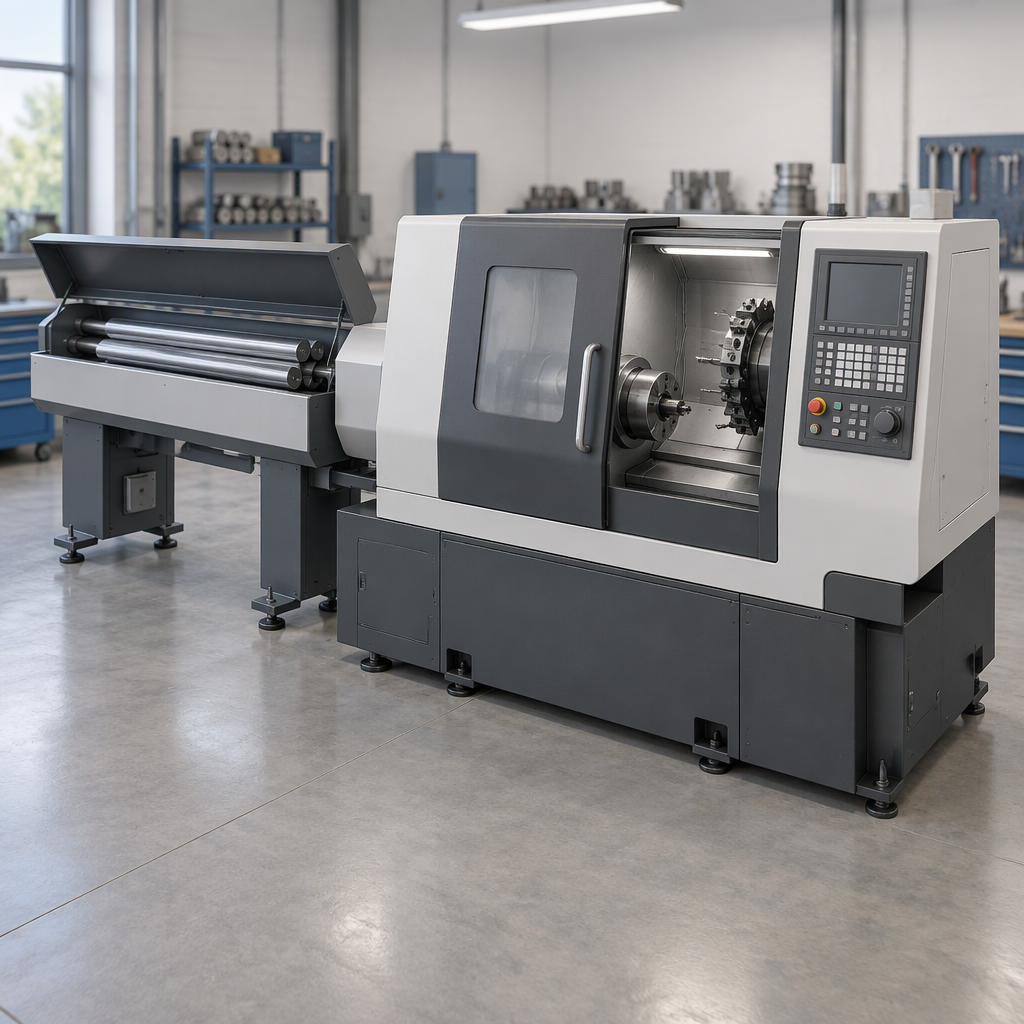
A bar feeder fits your job only when four things agree: the bar's outside diameter with its tolerance envelope, the lathe's published bar capacity and spindle bore, the bar length the feeder's magazine and push mechanism accept, and the remnant left on every bar. Bar capacity is published on the lathe side — TAIZ lists up to Ø52 mm bar capacity as an optional configuration on its RA-550MY automatic turn-mill CNC lathe — while the feeder's accepted diameter range, straightness allowance and minimum push length come from the feeder supplier. The fit is confirmed between both parties, not assumed from a single number.
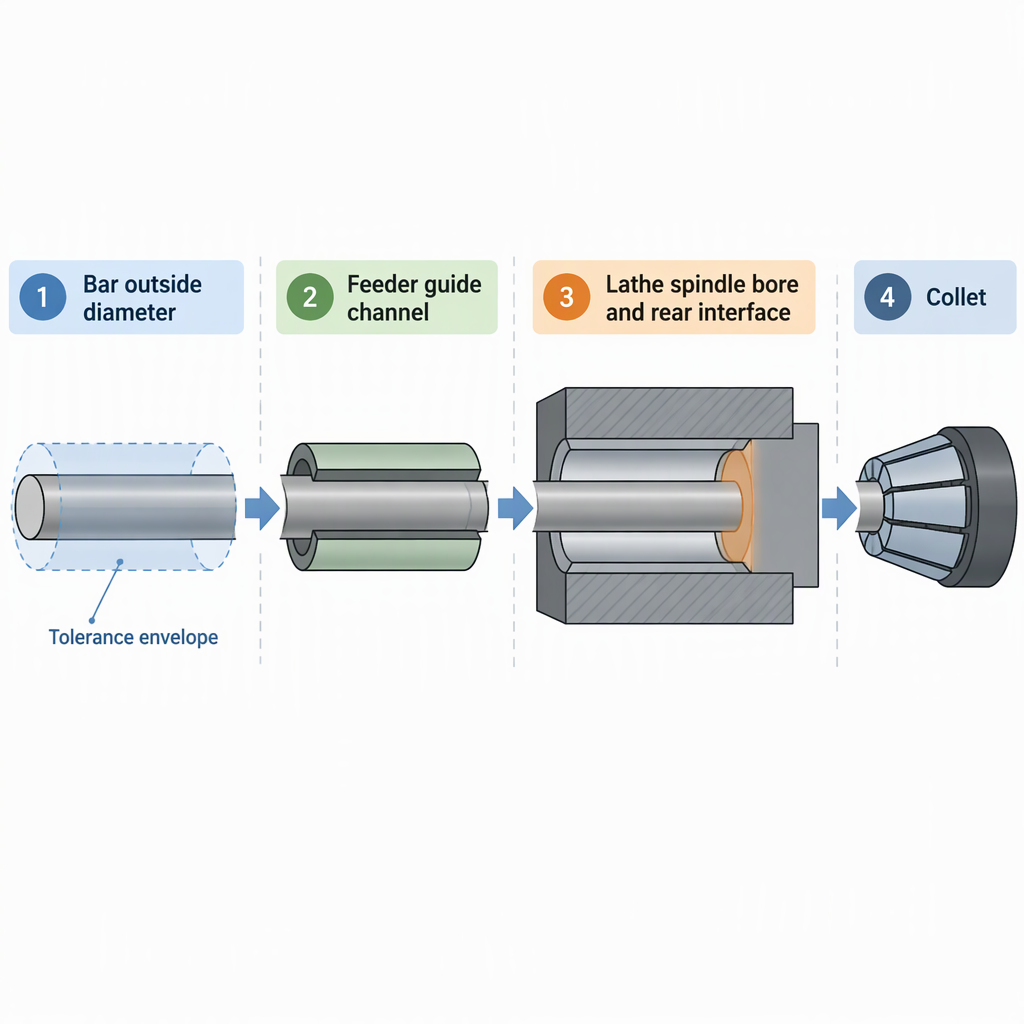
Four confirmations decide the fit, and each one is owned by a different party:
- Bar data: outside diameter with its actual tolerance, straightness and end condition — from you and your bar supplier.
- Lathe data: published bar capacity, spindle bore and rear interface for the exact configuration — from the lathe builder.
- Feeder data: accepted diameter range, guide-channel size, bar-length range and expected remnant — from the feeder supplier.
- Site data: risk assessment, handover documents, isolation points and inspection regime — from the team that runs the machine.
Matching bar diameter: start from the lathe figure, then confirm the feeder's accepted range
Work the diameter match in two directions: the bar must sit inside the feeder's accepted range, including its tolerance and straightness allowance, and it must clear the lathe's published bar capacity and spindle bore. Bar capacity is a lathe-side configuration figure — the RA-550MY automatic turn-mill CNC lathe, for example, is published with up to Ø52 mm bar capacity as an option — so confirm the feeder's accepted range for your exact bar.
| What to check | Comes from | What it decides | What to get in writing |
|---|---|---|---|
| Bar outside diameter and tolerance band | Bar supplier | Whether the bar enters the guide channel without binding | Nominal diameter, actual tolerance band, straightness |
| Feeder accepted diameter range | Feeder supplier | The model and guide-channel size that can run your stock | Minimum and maximum bar diameter for that model and channel |
| Lathe published bar capacity | Lathe builder | The largest bar the machine configuration is marketed to run | Capacity for the exact configuration you are buying |
| Spindle bore and rear interface | Lathe builder | Whether the bar reaches the collet and the feeder mounts correctly | Bore dimensions and interface drawing for your configuration |
Nominal diameter is not a fit. A bar at the top of its tolerance band, or bent along its length, can bind in a channel sized for nominal stock even though it would pass a collet check. Send the feeder supplier the tolerance band and straightness you actually receive, and ask which guide-channel size covers that band.
Matching bar length: magazine limit, push limit and the remnant you pay for
Length has three limits: the longest bar the magazine and guide channel accept, the shortest bar the push mechanism can feed reliably into the collet, and the remnant — the bar end that cannot be machined and leaves as scrap or rework. Ask the feeder supplier for the accepted bar-length range and the remnant at your diameter, then price that leftover length into material cost per part.
- Longest and shortest bar the feeder accepts, stated for the guide-channel size you will run.
- Shortest bar the push mechanism feeds reliably, including enough material for the collet to grip the first part of each bar.
- Expected remnant per bar at your diameter and bar length, and whether that end is scrapped or reworked.
- The lathe's published bar capacity and spindle bore for the exact configuration you are buying, such as the optional up to Ø52 mm bar capacity published for the RA-550MY, so length is never matched against a diameter-blind limit.
- How often the magazine must be reloaded at your bar length, because reload frequency sets how long the machine can run unattended.
Remnant is a material cost, not a footnote: a shorter remnant means more parts from the same stock, while the shortest bar the feeder pushes reliably sets the minimum length worth buying. Get both figures in writing, and for expensive material weigh the stock saved against buying bars the feeder handles well.
Installation and handover: documents, guarding and isolation points to record
Close the handover package before the feeder is installed, while both suppliers are still on the project. In Great Britain, new machinery placed on the market must be UKCA or CE marked, supplied with a declaration of conformity and accompanied by instructions in English, and work equipment must be maintained in an efficient state, efficient order and good repair, with maintenance logs kept up to date and maintenance carried out safely by competent persons following the manufacturer's instructions. Confirm the same package, or the local equivalent, where the machine will actually run.
Those duties are set out in the Health and Safety Executive's guidance on the maintenance of work equipment, which also covers market placement, the declaration of conformity and English instructions. Read it before you agree what the supply includes, so the document list is settled in the purchase order.
- Record the machine and the feeder: model, serial number, the delivered configuration's published bar capacity, spindle bore and rear interface, plus the feeder model and guide-channel size. File the declaration of conformity and the instructions in English with those records.
- Confirm in writing that the feeder's accepted diameter range, straightness allowance, bar-length range and expected remnant match the stock you actually buy.
- Review the risk assessment for the combined arrangement, because machine and equipment choice and the control measures that follow belong inside that assessment: covers and guards, the rotating bar path behind the spindle, and the isolation points for the feeder drive as well as the lathe.
- Before any manual access inside the magazine, guide channel, spindle bore or collet area — clearing a jam, cleaning, measuring or inspecting — switch the machine off and disconnect or isolate its power supply using the lock-off procedure, then follow only the access steps the manufacturer's manual permits. Never reach into the bar path or remove a guard while the machine can still be energised.
- Run your own bar stock for acceptance: bars feed without jamming, the remnant matches the figure the supplier gave you, and the part, cycle time and tooling setup you agreed are reproduced. Record the guide-channel size and settings so the setup can be repeated.
- Set the inspection and maintenance interval from your own risk assessment and the manufacturer's recommendations.
The limits to close before ordering: tolerance, straightness, remnant and inspection regime
Four limits are usually still open when a bar-feeder enquiry starts: the accepted diameter range with its tolerance allowance, the straightness the guide channel tolerates, the remnant per bar, and the inspection and maintenance interval. Close the first three in writing with the feeder supplier, and set the interval from your own risk assessment and the manufacturer's recommendations.
A catalogue diameter range is not a tolerance specification. A minimum and maximum bar diameter tells you what the channel accepts nominally, not how much diameter variation or bend a bar can carry. Ask the feeder supplier for the tolerance and straightness allowances of the specific model and guide-channel size you are buying, and your bar supplier for the actual tolerance and straightness of the batches you run.
The inspection interval is yours to set, not one to copy. Under Great Britain's PUWER guidance, the need for inspection and its frequency are determined by risk assessment, taking account of the manufacturer's recommendations, and records should be kept at least until the next inspection. The Health and Safety Executive's page on the inspection of work equipment sets out that approach.
The data package that makes a bar-feeder RFQ answerable
Send the enquiry as five groups — bar, lathe, feeder, site and commercial frame — and ask for a written confirmation against each one. A quotation that answers only the nominal bar diameter is not a fit check; the checklist below shows what a usable reply covers.
- Bar: material, nominal diameter, actual tolerance band, straightness, end and surface condition, and the smallest and largest bar you intend to run.
- Lathe: model and exact configuration, published bar capacity, spindle bore, rear interface, collet type, and the spindle speed range you use.
- Feeder: accepted diameter range, guide-channel size, bar-length range, minimum push length, expected remnant, magazine capacity, and the control interface to the lathe.
- Site: market and its marking and documentation duties, the risk assessment and guarding for the combined machine, isolation points, and the language your operators need.
- Commercial frame: what the supply covers, whether the rear interface adaptor and installation are included, commissioning and training responsibilities, spare guide channels and wear parts, and the acceptance checks to be run on your own stock.
Conclusion: a fit is four written agreements, not one capacity number
Treat the decision as four written agreements: diameter and tolerance envelope, length and remnant, interface and handover documents, and inspection and maintenance. If any of the four is still open, keep asking until the party that owns that number has confirmed it in writing — a verbal assurance that the feeder will run your bar is not a fit.
Fix the bar first: the material you buy sets the diameter, tolerance and straightness the feeder must accept. Then confirm the lathe configuration's published bar capacity and spindle bore, settle the length range and remnant, and close the handover documents, isolation points and inspection regime.
- Confirm diameter twice: against the feeder's accepted range, and against the lathe's published bar capacity and spindle bore.
- Confirm length three ways: longest bar accepted, shortest bar the push mechanism feeds reliably, and the remnant you pay for on every bar.
- Confirm duties in writing: market marking and documentation, risk assessment and isolation points, maintenance tasks, and who sets the inspection interval.
Frequently asked questions about matching a bar feeder to stock diameter and length
The questions below cover bar capacity versus spindle bore, tolerance and straightness, the remnant, handover documents, guarding and inspection.
Is a lathe's bar capacity the same thing as its spindle bore?
No. Bar capacity is the diameter the machine is marketed to run — up to Ø52 mm on the RA-550MY automatic turn-mill CNC lathe, for example — while spindle bore is the physical spindle dimension the bar passes through. Ask the lathe builder for both figures and the rear interface drawing for your configuration.
How do I know which bar diameter range a feeder accepts?
Ask the feeder supplier for the accepted minimum and maximum bar diameter of the model you are considering, with the guide-channel size that suits your range, then check the top of that range against the lathe's published bar capacity and spindle bore.
How straight does bar stock need to be for a bar feeder?
Straightness governs how smoothly a bar travels through the guide channel, and a bowed bar can drag or jam as it rotates. Ask the supplier to state the straightness allowance for your diameter and channel size, and check incoming deliveries against it.
What is the remnant in bar-feeder work?
The remnant is the bar left after the last part is machined — the end the push mechanism cannot feed to the collet. It leaves the machine as scrap or rework on every bar, so ask for the expected remnant at your diameter and cost it into your material per part.
Which documents should be handed over with a lathe and bar feeder?
For the Great Britain market: UKCA or CE marking, a declaration of conformity, instructions in English, and the maintenance and isolation information operators need, plus the risk assessment for the combined machine and the feeder interface drawing. Elsewhere, use the duties that apply where the machine runs.
Does adding a bar feeder change the guarding or risk assessment?
Assume it does, and assess the combined arrangement as a whole: machine choice and the control measures that follow belong inside a risk assessment. A bar rotates behind the spindle and the magazine moves under power, so review covers, guards and access with both suppliers before first production.
Which bar tolerance and straightness values should I request?
Request them from the party that controls them: the feeder supplier for the accepted diameter range and the tolerance and straightness allowances of the specific model and guide-channel size, and your bar supplier for the actual tolerance and straightness of the batches you buy.
