Check bar diameter, tolerance and bar length against a lathe's published bar capacity, then confirm remnant, handover documents and inspection in writing.
Choose a CNC lathe part catcher by part envelope, grip point on finished surfaces, contact materials, machine interlocks and a first-article acceptance test.
Gang-Tool vs. Turret Lathes: Which Fits Your Tool Count and Part Mix?
Views: 0 Author: Site Editor Publish Time: 2026-11-16 Origin: Site
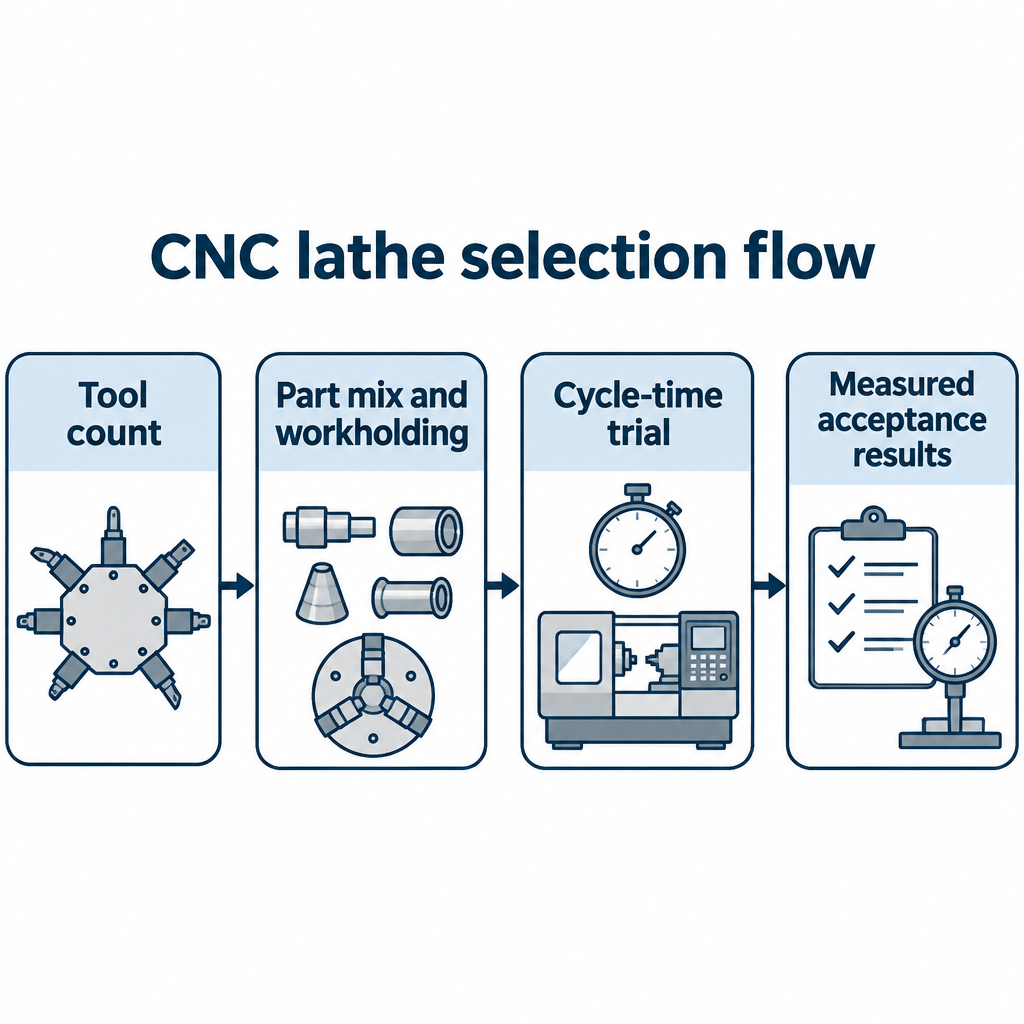
For the gang tool vs turret lathe decision, start with the actual part family: gang tooling is usually considered when a compact row of tools can cover repeated, simpler work, while a turret is usually considered when the job needs more stations, more variation, or broader flexibility. Confirm the choice with the same workpiece, workholding, tool list, cycle-time trial and acceptance measurements before purchase.
Gang-tool vs. turret lathe basics
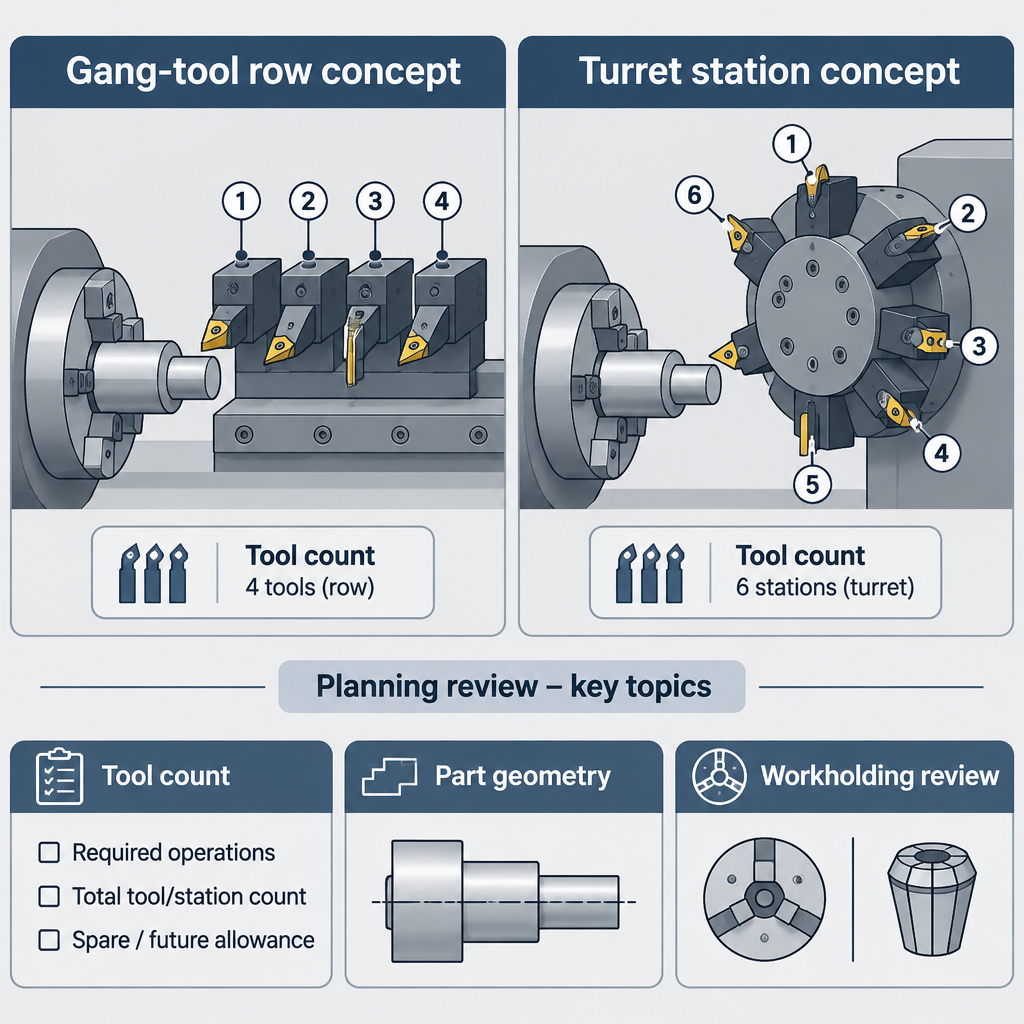
A gang-tool lathe arranges tools in a line on the cross-slide, while a turret lathe indexes a tool-holding station into position; the practical choice depends on geometry, tool count and flexibility rather than on one layout being universally better.
Gang-tool layout
Gang tooling keeps tools mounted in a row, so the machine moves the slide to bring the needed tool to the cut. This can suit a repeatable part family when the required tools fit the available gang plate and the work envelope does not create interference.
Turret layout
A turret carries multiple tools around an indexing station and rotates the selected station into the cutting position. This format is commonly evaluated when the shop needs more tool positions or expects part families to change.
For a precision parts factory or machining shop, the first comparison should be the operation list for the real part: turning, drilling, grooving, threading, boring, cutoff, secondary spindle work if applicable, and any special holder requirement. The configuration is only useful if it can run the whole operation sequence without awkward compromises.
Which fits your tool count?
If the complete operation list uses a small, stable set of tools that can be arranged without interference, gang tooling may fit; if the job needs more stations, reserve tools, or frequent tool-set changes, a turret is usually the safer configuration to evaluate.
Tool-count question
Gang-tool implication
Turret implication
How many cutting tools are required for the finished part?
Works best when the needed tools fit in a compact row and can be positioned without collisions.
Better candidate when the job needs more indexed stations or future tool additions.
Will the same tool set run many batches?
More attractive when the tool list is stable across a repeated part family.
More attractive when tool sets change often between jobs.
Do any tools need special holders or orientation?
Check holder spacing and slide travel carefully before assuming the row can fit.
Check station capacity, adjacent-station clearance and indexing sequence.
Do not compare only the nominal number of tool positions. Compare the usable positions after accounting for part diameter, stick-out, holder clearance, cutoff approach, chip flow and any tool that must remain in the setup for inspection or backup.
Which fits your part mix?
Gang tooling tends to favor repeated families of smaller or simpler parts, while turret tooling tends to favor a broader part mix where geometry and operation sequences change more often.
When the mix is narrow
If the shop runs a stable group of similar parts, the buyer can optimize the tool row, offsets and workholding around that family. The evaluation should focus on whether the selected tool arrangement covers the full family without repeated hardware changes.
When the mix is broad
If the shop quotes many geometries, materials and operation sequences, the turret’s indexed stations may provide more practical flexibility. The evaluation should focus on how quickly a new job can be tooled and proven.
Check workpiece and workholding fit before cycle time
Before comparing cycle time, confirm that the workpiece size, length, support method and clamping plan suit the configuration; a fast tool change does not help if the part cannot be held and supported correctly.
Workpiece condition
Buyer check
Selection effect
Small, short parts in a repeated family
Check whether all required tools fit in the gang row and clear the stock, collet or chuck.
Gang tooling can be a strong candidate when the tool row and work envelope are clean.
Long or slender parts
Confirm the support method, allowable stick-out and whether tailstock or other support is needed.
Support needs may shift the decision toward the machine layout that handles the part more reliably.
Larger-diameter or clearance-sensitive work
Review holder clearance, tool approach, chip evacuation and adjacent-tool interference.
A nominally suitable tool count may fail if the real work envelope is too tight.
Ask for the comparison to use the same blank size, chuck or collet concept, tool stick-out, part support and inspection features. Changing these inputs between trials can hide the real cause of a cycle-time or quality difference.
Validate cycle time under the same operating conditions
A fair cycle-time comparison must run the same part, operation list, tools, workholding and quality target; configuration alone does not prove the actual takt time.
Freeze the part drawing, material, blank condition and finished-feature requirements before comparing layouts.
Create a complete tool list, including roughing, finishing, grooving, drilling, threading, boring, cutoff and spare or sister tools if the process needs them.
Use the same workholding assumptions for both configurations, including clamping method, support, stick-out and part transfer if used.
Measure tool-change motion, cutting time, non-cutting moves, loading method and inspection interruptions as separate items.
Record the test conditions and results in a structured format so the acceptance record remains usable over the machine life cycle.
Compare cost components without guessing prices
When exact prices are not available, compare cost categories instead of inventing savings: machine configuration, toolholding, fixtures, programming, setup labor, trial cuts, inspection and future changeover risk all belong in the RFQ.
Cost component
What to request
Why it matters
Machine configuration
Quote the gang-tool and turret alternatives against the same part and acceptance scope.
Different configurations solve different tool-count and flexibility problems.
Toolholders and plates
List every holder, plate, bushing, boring bar sleeve, drill holder and cutoff setup needed for the real operation list.
A low apparent tool count can become expensive if special holding hardware is required.
Fixtures and workholding
Quote collets, chucks, support devices and any change parts under the same workpiece assumptions.
Workholding can decide whether the proposed layout is practical for the part.
Trial and acceptance time
Include programming, sample cutting, measurement, documentation and correction loops.
Structured test records help keep performance-test results usable after commissioning.
Future part mix
Ask how many expected part-family changes can be handled without new major tooling.
A configuration that fits today’s part may be less economical if the part mix changes frequently.
Plan machine acceptance tests before purchase
Acceptance should include actual part measurement under the buyer’s conditions because turned-diameter measurement can be affected by machine-axis errors, thermal effects, surface finish, curvature, vibration and sensor-method uncertainty.
Define the test part, material, tooling, workholding, program revision and inspection method before the run.
Record machine-tool performance-test properties and results in a structured acceptance file.
Measure critical turned diameters on actual sample parts rather than relying only on configuration assumptions.
Account for thermal condition, surface finish, curvature, vibration and measurement-method uncertainty when judging the result.
Include process-monitoring or measurement checkpoints where the buyer’s production risk requires them.
Keep the same acceptance criteria for gang-tool and turret alternatives so the comparison remains fair.
Keep safety and standards checks separate from performance claims
A tooling-configuration comparison is not a safety approval, regulatory approval or substitute for the machine manual; require the supplier to provide the current destination-market safety documents, guarding information and acceptance procedures for the exact machine offered.
Do not let a successful sample cut replace a safety review. Ask the supplier to identify the current standards, local regulations and manuals that apply in the installation country, and confirm them with the responsible local authority or qualified safety professional where required.
Conclusion
Choose gang tooling when the real part family, tool count and work envelope remain compact and repeatable; choose a turret when the tool count, geometry or future part mix requires more indexed flexibility, then verify either choice with measured acceptance results.
Start with the operation list, not the machine label.
Treat tool count as usable tool count after clearance and workholding checks.
Record cycle-time and acceptance results in a structured test file.
Measure actual parts under production-like conditions before final acceptance.
For a shop comparing gang tool vs turret lathe options, the best RFQ package includes the drawing, tool list, workholding plan, target cycle-time method, inspection plan and acceptance criteria. That package lets suppliers compete on the same job instead of on different assumptions.
FAQs
These questions help a machining buyer convert the configuration comparison into a practical RFQ and acceptance plan.
What is the main difference between a gang-tool lathe and a turret lathe?
A gang-tool lathe uses a row of tools on the cross-slide, while a turret lathe indexes a tool station into position. The difference affects tool arrangement, changeover planning and flexibility.
How many tools make a turret worth considering?
There is no universal number. The buyer should count only usable tools after clearance, holder type, part diameter, cutoff approach and reserve-tool needs are considered.
Are gang-tool lathes only for small parts?
Gang tooling is often evaluated for smaller, repeated part families, but the practical boundary is whether the workpiece, holders and tool row fit the real work envelope without interference.
Which configuration is better for frequent part changes?
A turret is usually the stronger candidate when part geometry, operation sequences and tool sets change often, because indexed stations can support a broader tooling plan.
Can the faster tool-change motion decide the purchase?
No. The buyer should measure the full cycle, including cutting, non-cutting moves, loading, inspection and any setup effects under the same operating conditions.
What should be measured before accepting the machine?
Record the test part, program, tools, workholding, performance-test properties and measured results so the acceptance file is useful after installation.
Why measure actual turned diameters during acceptance?
Actual turned-diameter measurement helps reveal effects from machine axes, thermal condition, surface finish, curvature, vibration and measurement-method uncertainty.
How should buyers compare cost without published prices?
Ask each supplier to quote the same part package, including machine configuration, holders, fixtures, programming, trial cutting, inspection and expected future changeover needs.