
Choosing between CNC Machining vs. Plastic Injection Molding determines your production success in 2026. You pick CNC machining for smaller runs under 500 to 1,000 items, strict precision down to ±0.01 mm, and no upfront tool costs. This direct shaping method speeds up fast prototyping because you skip time-consuming mold creation. On the other hand, pick injection molding for large-scale manufacturing above 1,000 items. Making custom molds needs significant initial funding, but extremely low item costs make that investment worthwhile. Engineers, buyers, and product developers should review critical differences in speed, material choices, total expenses, and design freedom when analyzing CNC Machining vs. Plastic Injection Molding. Modern high-tech automated machinery improves total factory efficiency for today's connected manufacturing plants.
CNC machining is cheaper for small orders of under 500 parts.
Injection molding costs less money when you make big batches of over 1,000 parts.
CNC machines quickly make test models right from CAD software files.
Making a custom metal mold costs more money at the very beginning.
Advanced CNC machines can make parts with exact measurements within a tiny fraction of a millimeter.
Hybrid workflows combine rapid plastic molding with precise CNC finishing passes.
You need to understand the main physical differences when comparing cnc machining vs. plastic injection molding. Subtractive methods carve custom shapes out of solid blocks. Modern equipment removes extra material right from raw stock materials. For instance, TAIZHENG 5-axis CNC machining centers and turn-mill lathes shape raw stock right away. These advanced systems skip long wait times for small orders without extra tooling.
Modern multi-axis machines offer complete design freedom during fast product updates. You just update your CAD files and software tool paths. You avoid costly physical redesigns of heavy steel tooling plates. Multi-axis cnc systems carve complex features without extra mold sliders or complex mechanical side-actions.
Automated high-speed spindles push sharp cutting tools through raw workpieces. Precision tool paths carve solid material smoothly and accurately. You get great surface finishes and steady accuracy on every single cut. Standard vertical mills can hold tight dimensional tolerances down to +/-0.002". High-end setups achieve an achievable tolerance around +/-0.001".
Machining solid plastic stock requires careful heat control during fast cuts. Quick spindle spins generate local heat from friction along cutting edges. High friction heat can soften or bend weak polymers if tools move too fast. You must balance spindle speeds and tool feed rates to protect plastic parts from heat damage.
Formative manufacturing works differently than subtractive cutting methods. Plastic injection molding uses high-pressure liquid resin flowing into hard metal cavity channels. Internal heaters melt raw plastic pellets inside a heated barrel. A spinning reciprocating screw pushes liquid resin right into a closed mold.
This injection molding technology offers clear operational benefits for mass production. You fill several mold cavities at the same time during one fast machine cycle. However, liquid resin hardens inside closed cavities under changing heat conditions. Molded parts usually produce wider tolerance ranges near +/-0.005".
Internal cooling channels control heat removal inside heavy mold bases. Chilled water absorbs heat energy quickly from hot polymer resin. The liquid material hardens fully into its target shape before the mold opens.
Ejector pins push finished plastic items out of open cavity plates easily. This quick step creates a reliable production method for identical parts. These different manufacturing styles affect your overall build speed and per-part production costs.
Evaluating cost structures and project lead times helps you pick the best manufacturing approach for your 2026 projects. You must weigh upfront expenses against long-term part expenses. Financial success depends on matching your target production volumes with the proper fabrication technique.
CNC machining requires minimal initial investment because you do not need complex hard tooling. Operators secure raw material blocks directly onto machine tables using standard vises, modular clamps, or soft jaws. Custom fixturing costs remain very low compared to hardened metal molds. You lower your initial financial risk during early product design stages.
Initial setup expenses stay low, but cutting workpieces individually increases per-unit cost. Spindle run times, tool wear, and operator supervision drive up expenses for every part you manufacture. CNC machining delivers high cost-effectiveness for low production volumes under 500 units. You avoid heavy capital risks while keeping total spending low.
Plastic injection molding requires substantial upfront capital for tooling design and fabrication. Machinists must cut heavy steel or aluminum mold bases with intricate runner channels and cooling lines. These hardened metal cavities require significant financial resources before you produce a single part.
Manufacturing Parameter | CNC Machining | Plastic Injection Molding |
|---|---|---|
Initial Tooling Cost | Low (standard clamps/vises) | High (custom metal molds) |
Per-Unit Part Cost | High (steady per-part expense) | Very Low (pennies per part) |
Economical Batch Size | Under 500–1,000 units | Over 1,000+ units |
Initial Lead Time | Days (direct CAD setup) | Weeks to months (tooling build) |
High upfront investments pay off when you enter mass manufacturing. The cost per part drops drastically once molten resin fills multi-cavity molds. Plastic injection molding yields unmatched cost-effectiveness during high volume production.
Speed to market often dictates success in modern industries. CNC technology excels at rapid prototyping because programmers convert CAD files into G-code within hours. You load digital files, clamp raw stock, and start cutting metal or plastic workpieces immediately. You skip multi-week tooling lead times entirely when testing functional designs.
Fast turnaround times give CNC methods clear advantages during early design iterations and immediate testing phases.
Injection molding demands several weeks or months for tooling creation and mold testing. Toolmakers build, test, and adjust mold cavities before starting factory production. Molded operations achieve impressive production speed once technicians complete the initial mold validation. Automated machinery fills cavities and ejects finished parts every few seconds. Fast cycle time and efficiency reduce total manufacturing hours for large order quantities.
Manufacturing precision directly impacts functional assembly performance and final part quality. Modern CNC turning centers and multi-axis milling centers deliver exceptional geometric accuracy. Automated cutting tools remove stock material to achieve tight dimensional tolerances down to ±0.01 mm. Engineers select CNC methods when manufacturing critical aerospace components or specialized medical equipment.
Plastic parts shaped inside mold cavities exhibit slightly wider dimensional variations. Resin shrinkage, cooling contraction, and thermal expansion affect final outer dimensions during part ejection. Molded components achieve standard tolerances near ±0.005 inches. Molders often add secondary machining passes on critical sealing surfaces to guarantee supreme part quality.
You must review total order quantities and design goals when evaluating cnc machining vs. plastic injection molding. Multi-axis CNC equipment gives you high design flexibility for quick product revisions. Injection molding setups deliver incredible output rates for high volume production. Understanding these core financial and operational trade-offs ensures complete project success.
You should compare design limits before choosing a production method. Geometric flexibility determines if plastic injection molding or CNC machining creates your custom parts better.
Subtractive processes grant high geometric freedom since cutting bits move across many directions. Multi-axis CNC machining accesses hidden areas directly from various positions. You can cut complex geometries, angled holes, tilted bosses, and side pockets without extra mold actions.
Multi-axis machine paths permit tool entry from many angles.
Specialized T-slot and lollipop cutters shape internal undercut features directly.
TAIZHENG intelligent turning centers and gantry machining centers keep exact alignment on complex shapes without draft angles.
Spinning end mills cannot make sharp internal corners inside deep cavities. You should plan internal corners with a radius slightly bigger than your cutter. Setting internal corner radii to 1.3 times the tool radius stops bad tool friction.
Design Area | Design Rule | Supporting Rationale |
|---|---|---|
Internal Corners | Radius ≥ 1.3× tool radius | Stops tool chatter and heavy chip loads |
Pocket Depths | Radius ≥ 1/3 cavity depth | Cuts long tool stick-out and vibration |
Tool Clearance | Add 0.02–0.05 inches relief | Keeps smooth cutting arcs in tight corners |
Formative plastic processes need equal wall thickness over all areas. Unequal wall thickness leads to uneven cooling, internal gaps, and surface sink marks.
Material | Recommended Wall Thickness (mm) | Key Risk if Exceeded |
|---|---|---|
ABS | 1.5–3.0 | Sink marks, longer cycles |
Polycarbonate | 1.0–3.5 | Stress cracking, warpage |
Nylon PA6/66 | 1.5–3.0 | Shrinkage, sink marks |
Polypropylene | 1.2–3.5 | Warpage, poor finish |
TPU/TPE | 1.0–3.0 | Ejection tearing |
Glass-filled nylon | 2.0–4.0 | Warpage, fiber orientation issues |
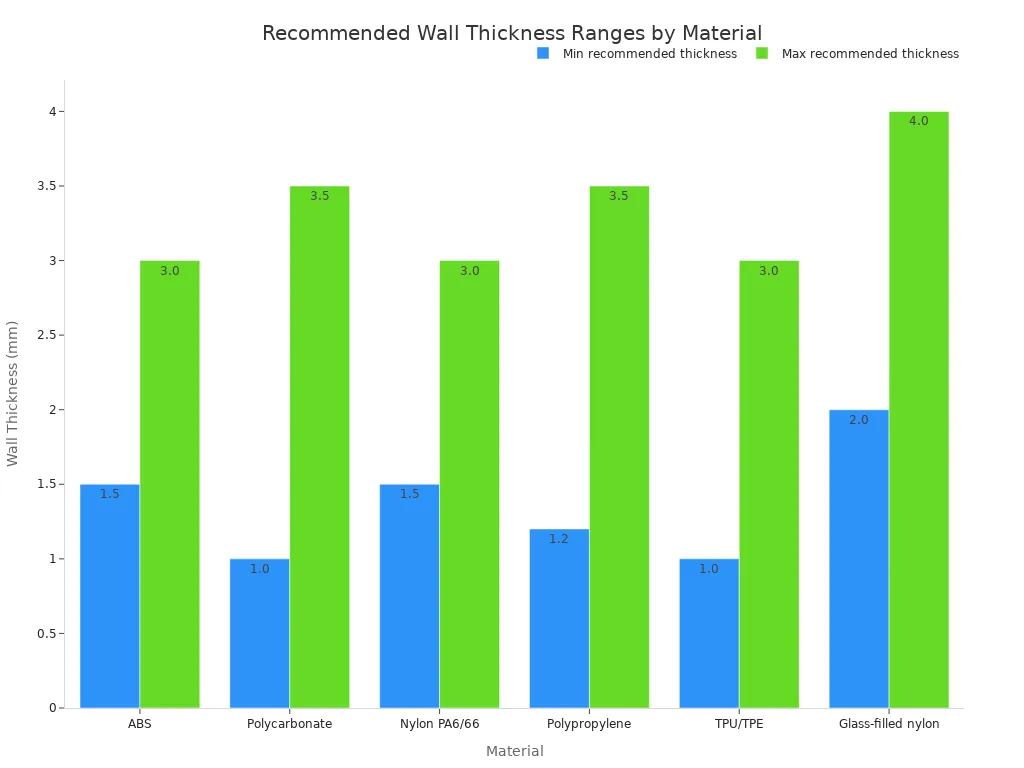
You must keep supporting ribs around 50% to 60% of the main wall thickness. This design step stops heat sink marks on outer visible faces.
Plastic parts require sloped vertical walls so ejector pins can pop parts out. Without correct draft, components stick inside cavity plates during part release.
Add at least 0.5 degrees of draft on all basic vertical walls.
Use 1 degree or more on surfaces needing clean cosmetic finishes.
Lack of draft brings deep scratches, drag marks, and part warping.
In contrast, modern CNC setups cut vertical walls straight without adding draft angles.
You can choose from a wide range of solid stock when you select subtractive methods. The process cuts engineering polymers like ABS, nylon, POM, acrylic, and PEEK directly into finished components. High-performance polymers like PEEK achieve exceptional strength and performance in critical flight-control and engine parts. CNC machining preserves original material integrity better because the process avoids resin melting steps. You also work with lightweight aluminum alloys, stainless steels, conductive brass, copper, and high-strength titanium.
Material / Process | Best suited for | Key thermal/mechanical support |
|---|---|---|
PEEK | CNC machining of critical flight-control and engine components | High strength-to-weight ratio; tight tolerances; no custom tooling |
Torlon® PAI | Powertrain and fastening components under extreme mechanical stress | Extreme mechanical stress resistance; high dimensional stability |
Ultem® PEI | Cabin interiors, ventilation, and thermal insulation parts | High flame resistance; low smoke; low thermal conductivity |
Vespel® | High-heat, wear-critical aerospace components | High wear resistance; vacuum compatibility; high-heat capability |
Subtractive processing delivers superior precision for parts requiring tight tolerances and complex internal geometries. You shape raw materials directly to maintain ultimate mechanical performance and structural stability.
Formative operations use melted plastic pellets to fill detailed mold cavities quickly. Amorphous plastics like ABS and polycarbonate shrink less during cooling. These polymers give you higher dimensional stability across variable factory temperatures. Amorphous polycarbonate loses most mechanical properties over a narrow temperature range at its glass transition point. Semi-crystalline plastics like nylon retain about 20% of their room-temperature modulus under elevated heat.
You can select specific resin formulations based on melt flow rate behavior to optimize manufacturing.
High melt flow rate resins flow easily into thin-walled cavity channels.
Low melt flow rate resins provide higher impact resistance, better creep resistance, and improved fatigue strength.
Glass fillers reduce natural mold shrinkage and increase total part rigidity.
For example, 43% glass-filled nylon 6/6 achieves a low expansion coefficient between 0.000034 and 0.000071 across varying thermal ranges. Plastic injection molding converts these specialized resins into consistent high-volume plastic products.
Subtractive cutting creates continuous material waste by turning solid stock into excess chips. Friction during fast cutting generates intense local heat along raw workpiece edges. You must manage coolant spray carefully so heat does not warp delicate polymer structures. Modern CNC mills recover clean metal chips efficiently for high-value recycling programs.
Plastic injection molding reduces immediate raw material scrap by recycling runner systems. Injection molding setups melt runner sprues and re-grind excess plastic for future production cycles. However, repeated heat cycles break down resin strength and performance over time. You balance raw material cost, thermal stability, and recyclability when selecting between injection molding and multi-axis CNC methods.
Modern smart factories do not force you to select only one process. You can mix plastic molding with extra cutting steps to get great structural strength. Molding shapes complex hollow parts fast. Extra cutting steps then smooth out active surfaces to match exact design needs.
Injection molding creates basic part shapes fast during big factory production runs. Shrinking and heat warping can stop molded threads or bearing seats from meeting exact fits. You fix this problem by placing rough molded parts into secondary cutting stations.
Smart factory stations make extra finishing easy using fully automated setups:
Material choice makes sure plastic flows easily in molds while staying easy to cut later.
Mold design fixes complex shapes early, which cuts down on needed secondary machining steps.
Connected systems join molding machines directly to TAIZHENG automated turn-mills and tapping tools with robot arms.
Special clamps hold flexible plastic parts tight to keep accurate alignment during fast secondary milling steps.
Automated TAIZHENG turn-mill tools cut sharp extra features into molded parts with ease. You fix tight fit problems while keeping the fast speed of plastic injection molding.
Overmolding lets you put custom metal cores inside plastic covers. You lock strong metal rings, threaded rods, or power pins inside tough plastic walls. Precise CNC machines cut these metal inserts with great accuracy before workers put them in mold slots.
Design / Tolerance Requirement | Specification / Guidance |
|---|---|
Substrate Mold Machining Tolerance | ±0.003 in (0.08 mm) |
Tooling Tolerance for Multi-Cavity/Multi-Insert Parts | 0.005–0.01 mm |
CNC-Machined Mold Precision | Below 0.01 mm for accurate insert alignment |
Resin Shrinkage Tolerance | No less than 0.002 in/in |
LSR Overmold Tolerance | 0.025 in/in |
Retention Features | Use undercuts, knurls, grooves, holes, or ribs to lock parts mechanically |
Exact insert sizes protect your mold space from costly crushing damage. Solid metal cores take on heavy twisting forces, while outer plastic walls shield inside electric parts.
Fast CNC milling speeds up quick mold making. Skilled toolmakers shape hard steel or soft aluminum mold blocks using advanced multi-axis cutters. You skip long normal tool wait times and start early plastic molding test runs very quickly.
Quick setup shops hit fast turnaround times through smooth daily steps:
Software path setup: 0.5–1 business day
High-speed mold cutting: 1–3 business days
Surface polishing and smoothing: 1–2 business days
Mold assembly and quality checks: 0.5–1 business day
You can build full test molds in just 2 to 7 workdays. Early CNC carving of sample parts gives you real test pieces before you cut final metal molds. You cut redesign costs, avoid risky mold fixes, and move easily into large mass production.
Top factory fields choose specific build methods using clear quality rules and job sizes. You can see how air, health, and car builders pick their tools in the chart below:
Sector | CNC machining | Injection molding | Tolerance / application basis |
|---|---|---|---|
Aerospace | Used for precision-critical components and prototypes | Not covered in this source | CNC achieves very tight tolerances, often ±0.01 mm or finer |
Medical | Used for medical device components requiring precision and flexibility | Implantable devices, surgical tools, disposables, device housings, sterile packaging | CNC suits low/medium volumes; molding meets ISO 13485 and FDA cleanroom standards |
Automotive | Not covered in this source | High-volume parts such as interior lighting systems | Molding favors large quantities with consistent quality |
Air travel uses need super exact sizes for key engine pieces and main flight parts. Health care jobs often use plastic molding for big batches of throwaway tools, surgery gear, and clean items. Health gear makers also pick metal cutting paths for small test sets that need very accurate shapes. Car plants run high-speed plastic molds to make giant orders of inside light sets fast.
New smart plants tie robotic tools straight to main computer networks. You can boost your shop setup by putting TAIZHENG smart mill gear and multi-way tools into auto work cells. Robot arms slide fresh raw blocks into exact cutting tools without any human help.
Built-in sensors watch tool wear, motor heat, and push power right away. These smart setups tweak feed speeds on the spot to save part quality during non-stop jobs. Linked TAIZHENG gear talks to your main network to balance factory tasks on its own. You get round-the-clock machine runs day and night while keeping part quality super steady.
Smart tech shops focus on power savings to cut running costs and environmental harm. New multi-way tools use fast speed-ups and smart power-saving brakes. These smart drive motors send electric power right back to your shop grid when the spindle slows down.
Digital control setups shift power use based on real-time tool push back. Your tools draw heavy power only during hard cutting moves. Modern oil units spray tiny drops of cooler right on sharp tool edges. This focused style cuts liquid waste while keeping heat control high. You stretch overall cutter life and drop main plant power use. Smart energy tools help your plant hit great green goals and trim total factory costs in 2026.
You must balance part counts, tool costs, and part prices when picking between CNC tools and molding. CNC tools work best for small jobs from 1 to 5,000 parts because they need no custom molds. You skip pricey custom parts and keep your setup costs down. This method delivers your finished items in just 1 to 10 days.
Plastic injection molding saves more money when you make huge batches of parts. Metal molds require big up-front payments between $3,000 and $100,000 or more. But long-lasting molds make up to 1,000,000 parts, dropping part prices to pennies. Molding speeds up your builds once the mold is built, filling big orders fast.
Selection Criterion | CNC Machining | Plastic Injection Molding |
|---|---|---|
Ideal Volume Range | 1 – 5,000 parts | 1,000 – millions of parts |
Upfront Tooling Cost | Low (no dedicated molds) | High ($3,000 – $100,000+) |
Delivery Lead Time | 1 – 10 days | 4 – 12 weeks (including mold build) |
Production Speed | Medium | Very fast |
You can follow a simple plan to move from early ideas to big factory runs safely. Teams use CNC machines to build test parts early and check how well they work.
Test part strength, weather resistance, fit, and breaking points on CNC parts.
Follow simple factory design rules early by cleaning up shapes and setting easy measurements.
Switch to real production materials before locking your design to test actual strength.
Run small test builds with temporary tools to fix problems and smooth out work steps.
Choose a trusted factory team that has enough gear to handle your full job.
This step-by-step plan helps you move from test parts to full factory jobs easily. Testing 10 to 100 molded items protects your tool money before starting big runs.
You must check shape limits, plastic types, target accuracy, and overall project costs. The chart below shows the main technical perks for each building choice:
Evaluation Criterion | CNC Machining | Injection Molding | Near-Net Molding + Finish Machining |
|---|---|---|---|
Part Geometry | Best for undercuts, through-holes, variable walls; cavity depth limited to four times width. | Best for thin walls, delicate detailing, overmolding; requires draft angles. | Molds near-net shapes and machines complex undercuts or tight features later. |
Material Capabilities | Works well with hard plastics and high-performance engineering stock; friction melts soft polymers. | Uses molten polymers, overmolding, and insert molding; some resins need annealing. | Reduces material waste for expensive polymers by finish machining key features. |
Dimensional Accuracy | Delivers tight tolerances directly through multi-axis tool execution. | Delivers consistent parts; tightest tolerances require secondary CNC operations. | Reaches high precision by finish machining critical target surfaces. |
Project Cost | No mold investment; highest cost-effectiveness for small to medium volumes. | High mold cost; offers unmatched cost-effectiveness at high-volume scales. | Cuts material scrap and machining hours to reduce total production cost. |
Both build choices give you strong options for fast speeds and versatile material choices. Pick CNC setups for small orders, quick design updates, and tricky side cuts. Pick plastic injection molding when massive part orders pay off the high tool costs.
When picking between CNC machining vs. plastic injection molding, you need to weigh initial tooling prices against per-item costs. CNC setups need almost no tooling money, giving you fast shipping for small order sizes. Still, per-item prices never drop. Injection molding demands big starting tool payments, but it cuts per-item prices way down during huge manufacturing jobs.
Injection molding usually wins when you need real production materials, steady part quality, and tight fits for large orders, but you must spend starting time and cash on tools. For small orders or quick early checks, CNC machining is often quicker. Injection molding works best between 500 and 100,000+ items, making 1,000 items a great fit while 500 items sits right at the starting line.
CNC machining works best for short runs under 500 to 1,000 pieces. Injection molding becomes the smarter choice once your order total tops 1,000 pieces. Big production runs drop the single part price sharply after you clear the first mold building step.
CNC machining provides much faster delivery times when making early sample parts. Engineers send digital CAD files straight to processing tools instead of waiting long weeks for custom molds. This approach saves crucial time during early design reviews and functional testing.
Multi-axis cutting centers can easily reach very tight measurements within ±0.01 mm. Modern carving tools shape tiny features directly out of solid material blocks. Your finished parts stay within strict specs without unexpected resin shrinkage or heat warping.
You mix both manufacturing steps when plastic parts need super exact fitting dimensions. Extra cutting tools trim precise screw threads and smooth seals onto pre-formed plastic pieces. This hybrid process keeps overall output fast while securing exact target quality.
Direct carving offers big benefits for making hard shapes without special mold restrictions. Multi-axis systems cut tricky side pockets and deep holes without requiring sloped walls. You can update CAD designs instantly to make layout fixes without rebuilding heavy physical tools.
Building custom metal molds takes large upfront payments for detailed design and machining work. Toolmakers carve tough steel or aluminum bases with built-in cooling paths and ejector mechanisms. Massive production runs pay back those high initial mold costs by driving unit prices down.


