
Views: 0 Author: Site Editor Publish Time: 2026-09-18 Origin: Site
You stare at a new order. The parts need tricky shapes and large amounts. Should you buy a CNC lathe or a turret lathe? Your choice affects your whole production plan.
CNC tech shines on easy, low-volume jobs. Changing programs takes just minutes. A turret-style machine handles hard, high-volume work. Multiple tool setups switch fast. This cuts downtime and cycle times.
Automation and smart factories grow quickly in 2026. Your pick impacts today's output and future growth. Each lathe fits a different need. The best lathe matches your part difficulty and order size. Knowing these differences guides your buying choice.
CNC lathes are a low-cost and flexible choice for making simple parts in small amounts.
Turret lathes are great for making many complex parts quickly. They switch tools fast and can use powered tools while the part spins.
Choose the machine based on how complex the part is. Simple parts work best with a CNC lathe, while parts with many features need a turret lathe.
Jobs with many different parts but few of each are better for CNC. Jobs with few part types but many of each are better for a turret lathe with automation.
The total cost takes into account tooling, labor, scrap, and downtime, not just the purchase price.
Automation such as bar feeders increases production for both machines, but turret lathes fit into this setup with less effort.
Look at your current and future needs honestly, and ask experts for the best choice.
A CNC lathe uses a computer to control the turning process. You set up the machine once with a program. Then it makes the same cuts over and over with great accuracy. This precision makes it popular for job shops and small-batch makers.
Most CNC lathes have a single spindle. This spindle holds your part and spins it at high speed. A chuck grips the material tight. The motor gives steady power at different speeds. You can change the speeds from the control panel. This design keeps the machine simple and small. It also has fewer parts that can break compared to complex setups.
The single-spindle setup works well for parts that need just one operation per setup. You put in the material, run the program, and take out the finished part. This simplicity means fewer things can go wrong. It also makes training new workers easier. They pick up the machine quickly.
The key part of a CNC lathe is its programmed tool paths. You write or create a program using G-code. This code tells the machine exactly where to move the cutting tool. It controls depth, speed, and feed rate. You can save many programs in the machine's memory. Switching jobs takes minutes, not hours.
Newer CNC controls have conversational programming. You answer easy questions about part size. The system makes the code for you. This feature cuts down on programming mistakes. It also lets you change existing programs fast. Need a different diameter? Change one line of code. The machine updates right away.
CNC lathes work best for low-volume production. You might need fifty parts this week and two hundred next week. Each job needs different sizes. The CNC lathe handles this variety well. You load the right program and start cutting. Changing between jobs takes little time.
Job shops get the most from this flexibility. They get many different orders each day. One day brings simple shafts. The next brings threaded fittings. The CNC lathe adjusts without mechanical changes. You just swap the cutting tool and load a new program. This speed keeps your shop competitive.
A typical CNC lathe does well with round shapes. Straight turning, facing, and boring are all strengths. You can also cut threads and tapers with standard tools. These tasks cover many common part designs. Bushings, pins, and spacers fit this type perfectly.
But complex parts are harder. Features that need off-center drilling or milling require extra equipment. A regular CNC lathe doesn't have the axes for that work. You would need a machining center or a turn-mill machine instead. Know this limit before you buy.
Basic CNC lathes cost less than advanced turning centers. You get computer control without paying for extra axes. This lower price makes automation possible for smaller shops. You can start with a simple model and upgrade later. Many companies also offer financing.
The return on investment comes from saving on labor. One worker can run several CNC lathes at once. The machine does the cutting automatically. Your worker focuses on loading parts and checking quality. This efficiency increases your output per employee.
A standard CNC lathe takes up a small footprint. You can fit one in a small workshop. The machine comes with its own enclosure and chip removal system. You don't need extra equipment for basic use. This space saving matters in crowded shops.
Think about your workflow when placing the machine. Leave room for material storage and part inspection. Make sure the machine's doors can open fully. Good planning prevents problems later. A well-organized workspace boosts your CNC lathe's productivity.
Key Takeaway: A CNC lathe gives precision and flexibility for low-volume, simple parts. Its lower cost and small size make it an easy starting point for automated turning.
A turret lathe has a rotating tool holder called a turret. This turret can hold many cutting tools at the same time. You move the turret to bring each tool into place. Newer versions mix this design with computer control. You get the speed of many tools plus the accuracy of CNC. TAIZHENG's HMS-1000 Efficient Turret Lathe shows this mix well. It handles mass production with steady accuracy.
The turret holds six, eight, or even twelve tools. You can put drills, boring bars, and turning tools together. The machine spins the turret to switch tools in seconds. This speed removes the need to change tools by hand. You cut cycle time a lot compared to single-tool setups.
Indexing happens on its own during the program. The turret locks into place with exactness. Each tool returns to the same spot every time. This repeatability keeps your part sizes steady. You make the same parts across long production runs. The turret design also cuts down on worker tasks. Your worker loads material and checks quality instead of changing tools.
Many turret lathes come with live tooling. These tools spin with power, not just with the spindle. You can mill flat surfaces, drill side holes, and cut keyways. The part stays in place while these tasks happen. You skip a second machine setup. This feature turns a simple lathe into a turn-mill center.
Live tooling opens up more part options. You can create features that usually need a machining center. The turret moves a milling cutter into place. The cutter spins and follows programmed paths. You finish complex parts in one cycle. This efficiency lowers handling mistakes and saves floor space.
Modern turret lathes come with full CNC controls. You program several axes at once. The turret moves along X and Z axes for turning. Extra axes allow angled cuts and curved shapes. Some machines add Y-axis movement for off-center work. This flexibility handles tricky shapes without extra setups.
CNC integration brings another plus: accuracy. Older manual turret lathes depended on worker skill. Computer control removes that factor. You set tolerances once in the program. The machine holds them through the whole run. This consistency matters for parts that fit tightly.
Advanced turret lathes offer sub-spindles. A second spindle faces the main spindle. You move the part from one to the other automatically. This setup lets you machine both ends of a part in one cycle. You skip a second step on another machine.
Sub-spindles also allow nonstop production. The main spindle cuts one part while the sub-spindle works on another. You overlap tasks to save time. This feature boosts output for large orders. It also improves accuracy because you don't clamp the part again.
Turret lathes shine at high-volume production. You run thousands of the same parts with little downtime. Tool indexing happens fast. Program changes happen rarely. The machine keeps cutting while you check quality. This efficiency lowers your cost per part by a lot.
Automotive suppliers depend on this ability. They make shafts, fittings, and housings in big batches. The turret lathe handles these jobs reliably. You keep steady output shift after shift. This reliability supports just-in-time delivery schedules.
The turret benefits become clear with complex parts. You combine turning, drilling, milling, and threading in one setup. Live tooling and multi-axis movement handle detailed features. Sub-spindles finish both ends without clamping again. You make parts that would be hard for a standard CNC lathe.
Turret lathes also work with tailstocks. You support long, thin workpieces during machining. This stops bending and shaking. You get better surface finish and straightness. This ability suits shafts and similar long parts.
Key Takeaway: A turret lathe combines multi-tool speed with CNC accuracy. Its live tooling, sub-spindles, and tailstock support make it perfect for complex, high-volume production.
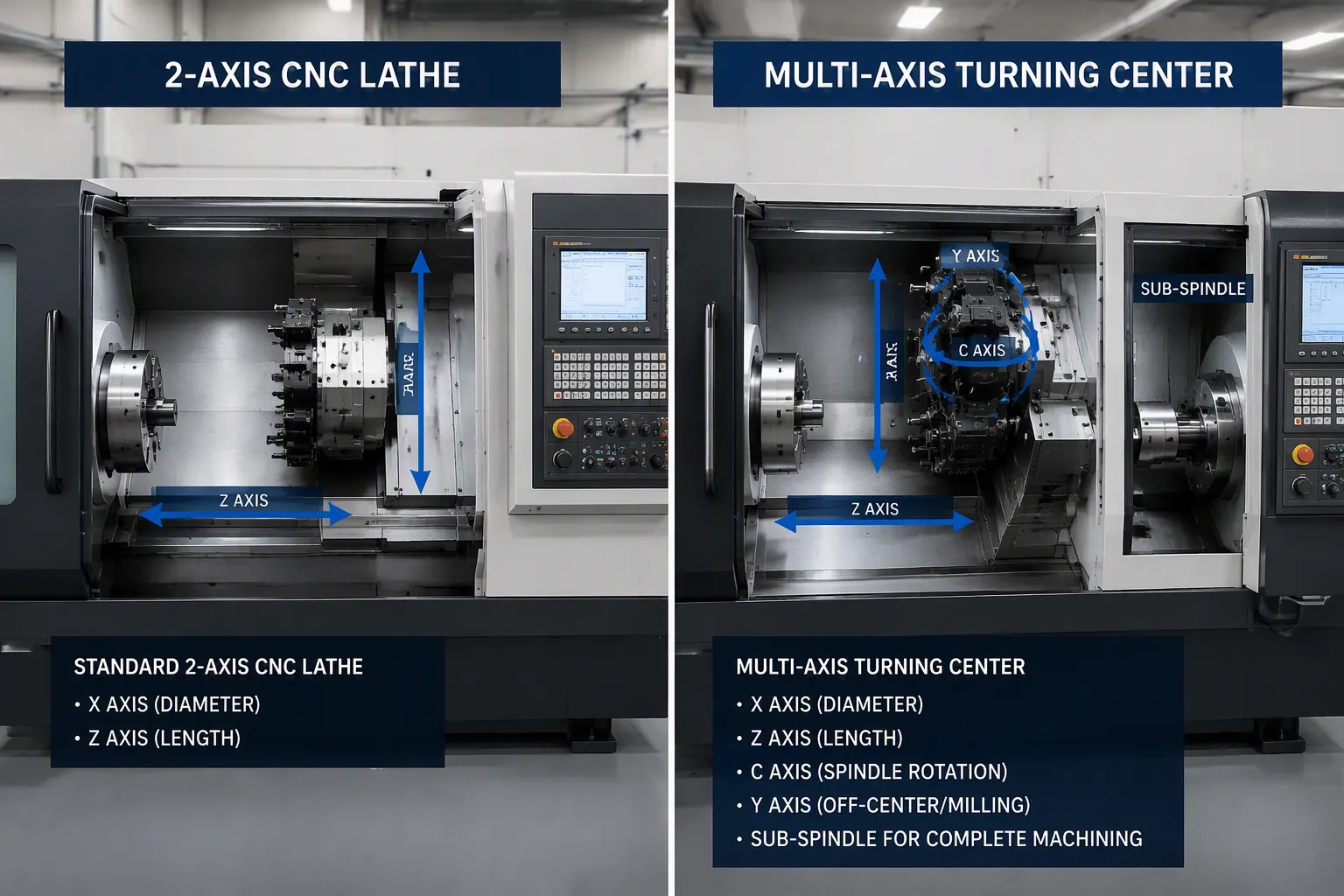
A standard CNC lathe and a turret lathe differ in three key areas. These differences affect the parts you produce, the speed of your changeovers, and your total output per shift. Understanding these gaps helps you choose the right machine for your specific needs.
The number of axes defines what shapes a tool can cut. A basic setup handles only round parts. A multi-axis system creates complex features in one clamping.
Capability | Standard 2-Axis Machine | Multi-Axis Turning Center |
|---|---|---|
Axis Configuration | X and Z only; limited to rotational turning along the longitudinal axis | 3+ axes; adds C-axis rotation, optional Y-axis, and sub-spindle capability |
Movement Capabilities | Basic turning, facing, boring, grooving, and threading | Adds milling, drilling, tapping, and off-center operations without re-fixturing |
Setup Complexity | Single setup for simple cylindrical parts | Multiple features completed in one setup, reducing secondary operations |
A 2-axis machine moves the cutting tool along the X-axis (radial) and Z-axis (longitudinal). You can turn, face, bore, groove, and thread parts. Simple round products like bushings and pins fit this profile well. Any feature off the centerline requires a second machine.
A multi-axis turning center adds C-axis control for spindle rotation and Y-axis for off-center work. Some systems include B-axis tilt or sub-spindle support. You complete complex shapes in one setup. This step removes the need for secondary operations.
The fundamental distinction here is clear. A 2-axis system restricts you to X and Z motion. A multi-axis system expands your movement options with C-axis, Y-axis, and sub-spindle support. You handle more features without reclamping the part.
Feature | Turret-Style Turning Center with Y Axis | Mill-Turn Center with Y Axis |
|---|---|---|
Y Axis Travel | ±10mm to ±50mm | ±50mm to ±150mm or more |
Horsepower | 10 HP to 30 HP | 30 HP to 60+ HP |
Capabilities | Basic milling, turning, and off-center machining | Advanced multi-axis operations with 5-axis capabilities |
Applications | High-volume, simple parts with moderate complexity | Complex parts requiring tight tolerances and multi-axis machining |
The limited Y-axis travel and lower horsepower of a turret-style center restrict it to moderate part complexity. The greater travel and power of a mill-turn machine enable full 5-axis work. You handle far more complex shapes with the larger system.
The numbers show the impact clearly. Moving from a 2-axis to a multi-axis setup brings measurable gains. Setup time drops by 40 to 60 percent. Cycle time for complex parts falls by 40 to 70 percent. Tolerancing errors reduce by 30 to 45 percent. Handling errors drop by about 30 percent. These gains come from finishing the part in one clamping.
Tooling choices affect how fast you switch between jobs and how many tools you use in one cycle.
A standard machine with a single tool post changes tools slowly. You stop the spindle, move the tool out, and swap the holder by hand. Each change takes extra time and attention.
A turret-style machine indexes tools in seconds. The turret rotates to bring the next tool into position. You program this action into the code. The machine performs it automatically while the part stays clamped. This speed difference adds up across a long run. Over hundreds of parts, those seconds become hours of saved time.
Setting up a 2-axis machine for a new job means loading a program, changing tools, and verifying dimensions. You might spend 30 to 60 minutes per changeover.
A multi-axis turning center reduces this time dramatically. You keep tools in the turret from previous jobs. You load a new program and check offsets. The machine indexes to the correct tools on its own. Setup time reduces by 40 to 60 percent compared to a basic machine.
Automation turns a machine into a production cell. You lower labor input and raise output per shift.
A bar feeder attaches to the spindle and pushes material forward automatically. You load a long bar into the collet. The machine cuts a part, cuts it off, and feeds more stock. The process runs without an operator present. Your machine keeps cutting during breaks or overnight.
Robotic loading goes further. A robot arm picks raw parts from a tray and loads them into the chuck. The robot removes finished parts and places them in a bin. One worker oversees several machines instead of tending each one. This setup increases output without adding staff.
Automation reduces cycle time by keeping the lathe cutting. Manual loading means stopping the spindle, opening the door, and unloading parts. Each pause adds 10 to 30 seconds per cycle. Over 1,000 parts, that adds 3 to 8 hours of wasted time.
With automation, the lathe never stops. The bar feeder or robot loads parts while the spindle runs. Cutting continues without interruption. You see cycle time drops of 25 to 35 percent on standard parts. For complex parts, the reduction reaches 40 to 70 percent. Labor drops by 40 to 60 percent. Delivery speed improves by 30 to 50 percent. Profit margins on complex jobs increase by 25 to 50 percent.
Purchase price tells only part of the story. You must examine the total cost of ownership before making a decision. This figure includes tooling, maintenance, energy consumption, and depreciation. A machine with a higher upfront cost may actually save you money over its lifespan if operating costs stay low.
Entry-level CNC lathes offer the lowest barrier to entry. You can acquire a basic model for a modest investment. These machines suit small shops testing the waters of automated turning. Their simpler construction means fewer expensive components. Depreciation slows because the technology remains stable for years.
You should also factor in installation costs. Export packaging, sea freight, insurance, and customs duties add to your initial outlay. Local unloading and foundation preparation require planning. Electrical installation and coolant supplies demand attention. These hidden costs can add substantially to your budget.
Advanced turret lathes command a higher purchase price. Multi-axis capability, live tooling, and sub-spindle options drive up the cost. You pay for engineering that reduces cycle times and expands part complexity. The depreciation curve differs from simpler machines. Advanced features may become outdated faster as technology evolves.
Your investment extends beyond the machine itself. Operator training and commissioning support add value but also cost. A spare parts package protects against unexpected failures. Consider these expenses when comparing quotes from different manufacturers.
Labor costs dominate your per-part calculation. A standard machine requires manual loading, setup, inspection, and tool changes. Each task consumes operator time. A turret-style machine with automation reduces these demands. Bar feeders and robotic loading keep the spindle cutting without human intervention.
Scrap rates affect your bottom line directly. Accuracy stability and process repeatability determine how many parts pass inspection. A machine that holds tight tolerances consistently produces fewer rejects. You save material, labor, and inspection time. This reliability justifies a higher initial investment.
Cost Area | Specific Considerations |
|---|---|
Tooling | Holders, inserts, drills, boring bars, live tools |
Fixtures | Chucks, jaws, collets, special fixtures |
Automation | Bar feeder, parts catcher, robot, automatic door |
Maintenance | Lubrication, filters, seals, electrical parts, spindle service |
Downtime | Service response and spare parts availability |
Operator cost | Manual loading, setup, inspection, tool changes |
Scrap risk | Accuracy stability and process repeatability |
Energy and coolant | Power use, coolant maintenance, oil-water separation |
Future flexibility | Ability to handle new parts and higher volume |
Maintenance costs differ between machine types. A basic CNC lathe has fewer moving parts. Lubrication, filters, and seals need regular attention. Spindle service occurs less frequently. Your maintenance team handles these tasks with standard training.
Advanced turret lathes contain more complex systems. Hydraulic turrets, live tooling drives, and sub-spindles require specialized knowledge. Service response time and spare parts availability become critical. A machine sitting idle costs you money every hour. Choose a manufacturer with strong after-sales support. TAIZHENG offers competitive pricing and responsive service. This support reduces downtime and keeps your production running.
Energy consumption also varies. More axes and automation systems draw more power. Coolant maintenance and oil-water separation add ongoing expenses. Factor these costs into your per-part analysis. A complete picture reveals which machine delivers the best return on investment.
Key Takeaway: Look beyond the sticker price. Tooling, labor, scrap, maintenance, and downtime determine your true cost per part. A turret lathe may cost more upfront but deliver lower per-part costs at high volume.
Choosing between a CNC lathe and a turret lathe depends on your unique situation. No single machine works perfectly for every shop. You need a clear way to weigh your options. This guide walks you through the key factors one by one. Be honest at each step. Your answers will lead you to the right choice.
Start by listing every feature your parts need. Count the operations each part requires. This list forms the base of your decision.
Draw a simple sketch of your typical part. Mark every surface that needs cutting. Note any holes, slots, or flat areas. A basic bushing needs only turning and facing. A valve body might need drilling, milling, and threading on several sides.
Count how many setups each part would need on a standard machine. One setup means a basic CNC lathe can do the job. Two or more setups signal the need for a turret-style machine with live tooling. Each extra setup adds handling time and error risk. A turret lathe finishes multi-feature parts in one clamping. You remove those extra steps completely.
Think about future parts too. Will your product line stay simple? Or will customers ask for more complex pieces? Buying a machine that handles tomorrow's parts saves you from upgrading later.
Check your part drawings for tolerance callouts. Tight tolerances need machines with high rigidity and thermal stability. Both machine types can hold precise sizes. The difference shows in consistency over long runs.
Surface finish requirements matter just as much. A part needing a mirror finish needs stable cutting conditions. Turret-style machines with rigid tool holding produce better finishes on hard materials. They also keep that quality across thousands of parts. A basic CNC lathe might show slight changes as tools wear.
Consider your inspection tools too. Can you measure the tolerances you need to hold? If not, add inspection costs into your decision. Some machines hold tolerances more steadily than others. That steadiness lowers your inspection workload.
Your yearly part volume drives the automation choice more than any other factor. Calculate your realistic production needs before comparing machines.
Look at your order patterns from the past year. Do you run the same part for weeks at a time? That pattern is low-mix, high-volume production. A turret lathe with a bar feeder runs unattended for long stretches. You get maximum output with minimal labor.
Do you switch jobs several times each week? That pattern is high-mix, low-volume production. A standard CNC lathe handles these changes faster. You load new programs and adjust tools quickly. The turret's multi-tool advantage matters less when you change parts often.
Some shops fall in between. They have a few high-volume parts plus many small orders. In that case, consider two machines. A dedicated turret lathe handles the steady work. A smaller CNC lathe takes care of the varied jobs.
Write down your average batch size. Also note how often you repeat each job. A batch of fifty parts repeated monthly suits a CNC lathe perfectly. You spend little setup time and move on to other work.
A batch of five thousand parts repeated weekly demands a turret lathe. The first setup takes longer, but the cycle time savings add up quickly. Calculate your total yearly quantity for each part. Multiply batch size by frequency. This number tells you which machine pays back faster.
Your budget goes beyond the purchase price. Think about your automation path over the next several years. The cheapest machine today might cost more in the long run.
A basic CNC lathe offers the lowest entry cost. You gain CNC accuracy without a large capital outlay. This choice works well if your volume stays low or your parts remain simple. You can upgrade later when demand grows.
A turret lathe with automation represents a larger initial investment. The payoff comes through reduced labor costs and higher output. Calculate your break-even point. Divide the price difference by your monthly labor savings. If that number falls within your planning period, the turret lathe makes financial sense.
Consider resale value too. Advanced machines with automation hold their value better. They stay productive assets longer. A basic machine might become outdated as your needs change.
Look at your current shop floor. Do you already use bar feeders or robotic loading? Does your software track production data? A turret lathe fits smoothly into an automated cell. You connect it to existing material handling and monitoring systems.
A standalone CNC lathe works well as a first automation step. You learn CNC programming and operation without complexity. Later, you can add a bar feeder or robot. Many shops start simple and expand gradually.
Think about your workforce as well. Do your operators have CNC programming skills? Training costs add to your total investment. Turret lathes with modern controls offer conversational programming. This feature shortens the learning curve significantly.
Key Takeaway: Match the machine to your part complexity, production volume, and automation roadmap. A careful review prevents costly mistakes. Talk with TAIZHENG experts to sharpen your analysis and explore smart factory options built for your operation.
Theory helps, but real examples show how these machines perform. Three common situations from 2026 will guide your thinking. Each scenario matches a different production reality.
Picture a shop that serves local manufacturers. Customers send drawings for brackets, fittings, and custom shafts. No two weeks look the same. One week brings fifty parts. The next brings three hundred of something different.
Your shop thrives on quick turnarounds. A customer calls Monday and needs parts by Friday. You load the program, set the tools, and start cutting. The machine's flexibility lets you accept almost any cylindrical job. You change programs in minutes, not hours. This speed wins repeat business.
The lower investment matters too. You keep overhead low while testing new markets. One operator runs two machines simultaneously. The computer controls each cut with precision. You quote competitive prices because your labor costs stay modest. When a rush order arrives, you adjust the schedule without disrupting other work.
Your floor space stays open for other equipment. The compact footprint of a standard CNC machine leaves room for a small mill or grinder. You expand capabilities without moving to a larger building. This agility defines successful job shops in 2026.
Now imagine a supplier that makes steering components. A major automaker sends a contract for fifty thousand units per year. The parts need tight tolerances and consistent quality. Late deliveries cost you thousands in penalties.
This production volume demands speed. A turret lathe indexes between tools in seconds. You combine turning, drilling, and threading in one cycle. The machine runs unattended with a bar feeder. One worker oversees several machines at once. Your cost per part drops dramatically.
TAIZHENG's HMS-550M Automatic Turning Center handles this workload. Its multi-tool turret switches operations without stopping. The machine maintains accuracy across long runs. You inspect the first part, then trust the process. Scrap rates stay near zero because the program never varies.
The real advantage appears during peak demand. Your turret-style machine runs twenty-four hours a day. Automated loading keeps the spindle cutting through breaks and shift changes. You meet delivery deadlines without overtime costs. This reliability builds trust with your automotive customer.
Medical parts present a different challenge. You need surgical precision for implants and instruments. But hospitals order in moderate volumes. You cannot sacrifice quality for speed, nor ignore efficiency for perfection.
Your parts demand tolerances measured in microns. Surface finishes must pass strict inspection. The RA-550MY Automatic Turn-Mill CNC Lathe from TAIZHENG delivers this precision. Its multi-axis control creates complex geometries in one setup. You avoid the errors that come from moving parts between machines.
Volume still matters. A single hospital system might order five hundred units monthly. The turn-mill center processes these efficiently. Live tooling completes milling and drilling without secondary operations. You track every part through the digital system. This traceability satisfies regulatory requirements.
Smart factory integration becomes your competitive edge. Sensors monitor tool wear and vibration. The system alerts you before a tool fails. You schedule maintenance during planned downtime. Production continues without unexpected stops. This predictive approach keeps quality high and costs controlled.
Key Takeaway: Your production reality determines the right machine. Job shops need flexibility. High-volume suppliers need speed. Medical makers need precision with efficiency. Match the equipment to your specific demand pattern.
Your choice between these machines comes down to your production reality. A standard CNC lathe delivers lower cost and simplicity for basic parts. A turret lathe provides speed and versatility for complex, high-volume jobs. Neither option wins universally.
The right decision depends on your specific manufacturing goals, not just machine specifications. 2026 demands forward-thinking automation. Evaluate your current and future part portfolios, production forecasts, and budget constraints carefully.
Assess your needs honestly. Consult with machine tool distributors like TAIZHENG. Request demos to see which technology aligns with your 2026 production strategy. Your next lathe purchase shapes your shop's future success.
A standard CNC lathe takes up a small amount of space. You can fit one in a small workshop without extra gear. A turret-style machine with automation needs more room. Bar feeders and robotic loaders make the machine longer. Measure your open space before you decide to buy.
Yes, you can. Many shops begin with a standalone CNC lathe. Later, you can add a bar feeder or parts catcher. Robotic loading systems also work with basic models. This step-by-step plan spreads out your costs. You learn the basics before adding more complex parts.
Turret-style machines offer more rigidity. Their heavier build handles tough alloys with less shaking. This steadiness gives better surface finishes on hard materials. A standard CNC lathe works fine for softer metals and plastics. Match the machine to the material you usually cut.
Modern turret lathes use conversational programming. The control system asks simple questions about part size. It creates the code on its own. This feature shortens the learning curve a lot. Your current CNC operators can adapt quickly with little training.
Tool wear affects both machine types the same way. The difference shows in how fast you change tools. A turret lathe keeps spare tools ready. The machine moves to a fresh tool by itself. A basic CNC lathe needs manual tool changes. This matters most during long production runs.
A basic CNC lathe has fewer moving parts. Regular lubrication and filter changes keep it running. A turret-style machine needs more care. Hydraulic systems and live tooling drives need special attention. Pick a manufacturer with quick service support to cut downtime.
Retrofitting is possible but rarely worth the cost. Older machines lack the stiffness for modern cutting speeds. New controls cost almost as much as a new machine. You also lose warranty protection. Buying a new turret lathe with built-in CNC gives better value.
Advanced turret lathes with automation keep their value better. Their multi-axis ability stays useful longer. Basic CNC lathes lose value faster as technology changes. Think about your exit plan when buying. A machine that keeps resale value lowers your total ownership cost.


