


A CNC lathe sub-spindle changes the job from single-end turning to a planned handoff between the main spindle and a secondary spindle, so the second side of the part can be machined after transfer. Before selecting this option, confirm the return motion, clearance, feedrate, spindle stop or speed behavior, and dwell requirements that the CAM and machine must support.
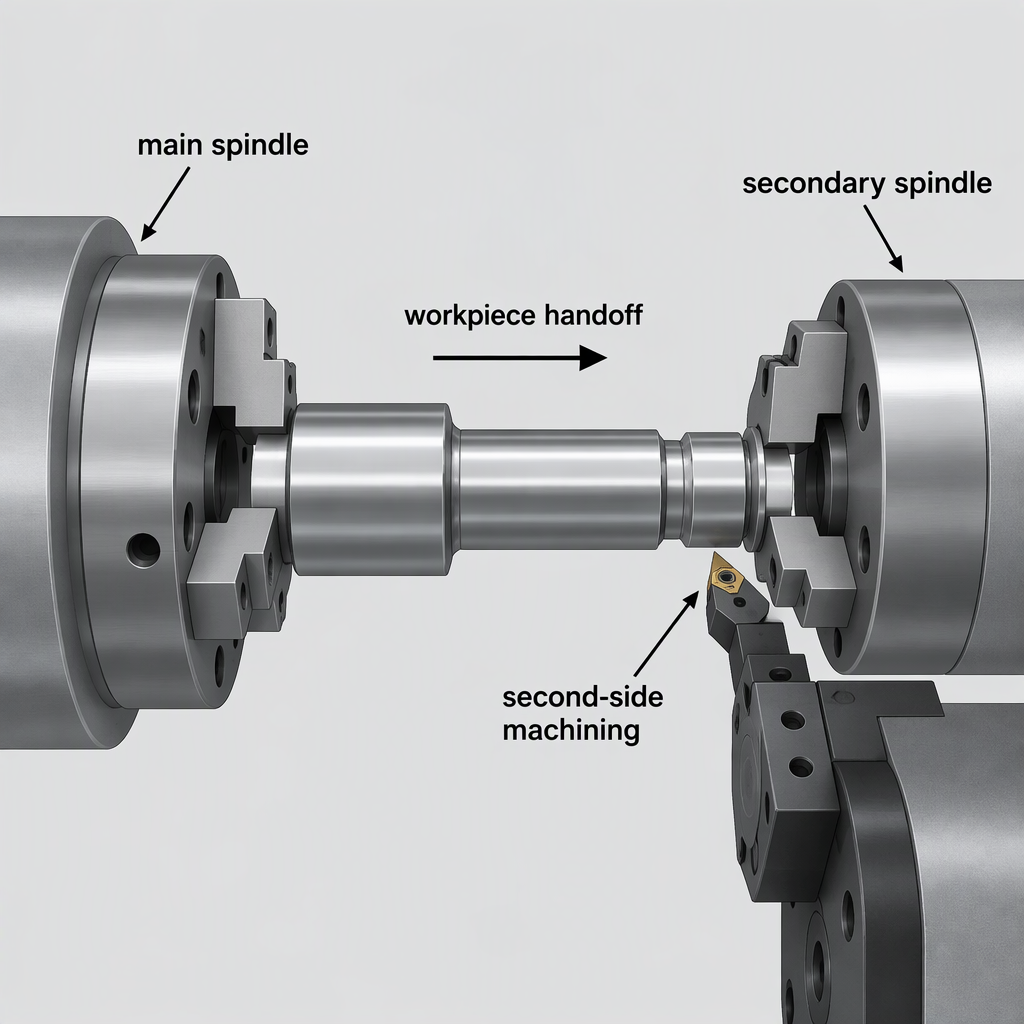
What a sub-spindle changes in part transfer
A sub-spindle adds a controlled second workholding position: the part can move from the main spindle to the secondary spindle, often called a subspindle, before machining continues on the opposite side.
In CAM terminology, Autodesk Part Handling documentation describes part handling as moving the part between the main spindle and secondary spindle, with operations such as Subspindle Grab and Subspindle Return.
For a buyer, the practical change is not just another spindle in the specification sheet. It changes how the part is held, where the datum is maintained, how the first operation leaves material for gripping, and how the second operation removes or finishes the back side.
How the transfer sequence works before backworking
A typical sub-spindle workflow machines the first side, grabs the part with the secondary spindle, releases it from the main spindle, returns or retracts to a safe position, and then prepares the second side for machining.
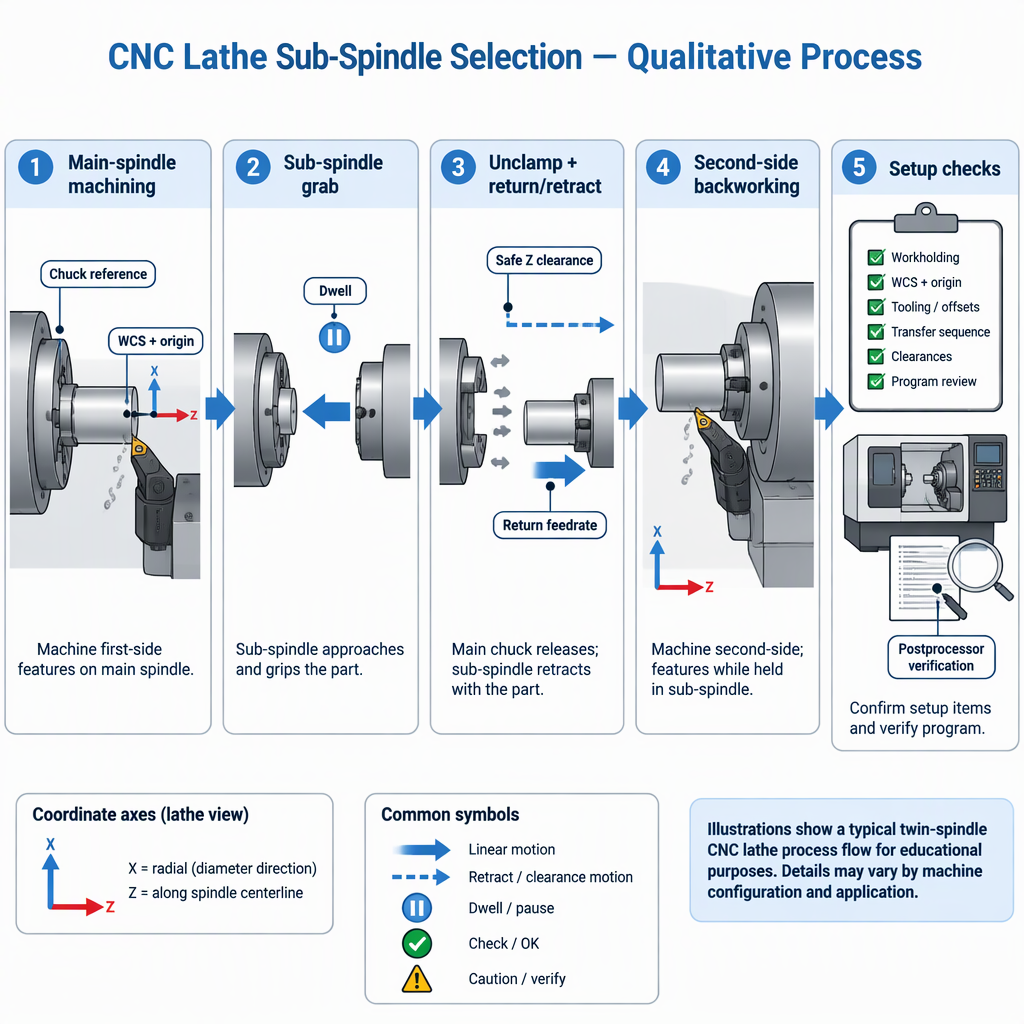
- Machine the first side in the main spindle while leaving a secure transfer condition for the secondary spindle.
- Use a subspindle grab step so the secondary spindle takes the workpiece before the part is released from the first chuck or collet.
- Plan the return or retract move with defined feedrate and feed-plane clearance rather than treating the motion as an afterthought.
- Confirm whether the program should stop the spindle, reduce spindle speed, add dwell, or return the sub-spindle to home after the transfer.
- Machine the other side only after the handoff and workholding condition are suitable for the backworking operation.
The transfer sequence is a programming and machine-integration issue as well as a hardware issue. Return feed, clearance, spindle state, and dwell choices must match the machine, tooling, chucking, and postprocessor used for the job.
What backworking adds to a CNC lathe process
Backworking means machining the second side of the part after transfer, which can reduce the need to remove the part manually for a separate second setup when the part and process are suitable.
The benefit to evaluate is process continuity: the workpiece can be presented for opposite-side turning after the sub-spindle receives it. That can matter for parts with features on both ends, short turned components, and jobs where the second-side datum relationship is important.
Backworking also adds setup requirements. Turning and mill-turn setup data may include spindle-axis orientation, part origin choices, Safe Z clearance, chuck reference and offset, and stock or model reference points. If those are not defined clearly, the second-side operation may be difficult to quote, simulate, or accept.
When a sub-spindle is worth evaluating
Evaluate a CNC lathe sub spindle when the part needs controlled handoff and second-side machining; consider a simpler lathe when the part is one-sided or when transfer, clearance, tooling, and programming add more risk than value.
| Buyer question | Sub-spindle is more relevant when... | Be cautious when... |
|---|---|---|
| Does the part need second-side machining? | The part needs the other side turned after main-spindle work. | The part can be completed from one side or with a simple secondary fixture outside the lathe. |
| Can the transfer motion be planned safely? | Feedrate, clearance, spindle stop or speed reduction, dwell, and return position can be defined for the job. | The handoff path, clearance envelope, or spindle-state behavior is uncertain. |
| Is the setup data clear? | WCS orientation, Z spindle axis, origin, chuck reference, offsets, and Safe Z are known before programming. | The buyer cannot provide datum, stock, chucking, or clearance information for the part family. |
RFQ data to confirm before selecting a sub-spindle lathe
A useful RFQ should describe the part, datum plan, chucking method, transfer clearance, tooling approach, CAM/postprocessor expectations, and acceptance evidence needed for the machine.
- Provide drawings or models that identify the turning axis, origin choice, stock condition, and key second-side features.
- Confirm the WCS orientation, Z spindle-axis direction, Safe Z clearance, chuck reference, and chuck offset assumptions used for programming; Autodesk's turning setup reference shows these as setup considerations.
- Ask how the transfer return feedrate, feed-plane clearance, spindle stop or speed reduction, dwell, and home return are handled in the proposed programming workflow.
- Define which operations are expected before transfer and which features are expected during backworking on the second side.
- Share chuck, collet, bar, receiver, and tooling assumptions early enough for the supplier to check interference and setup feasibility.
How to separate general principles from supplier claims
Use general sub-spindle principles to frame your selection questions, but ask the supplier to document the exact machine configuration, option list, and acceptance method for the model you are considering.
The observed TAIZ CNC lathe page presents categories such as CNC turning center, turn-mill lathe, Swiss type CNC lathe, gang tool lathe, and turret lathe. It also presents configurable items such as bar feeder, workpiece receiver, chip conveyor, direct drive motorized spindle, extended travel, and alternative control systems.
That category and configuration information is useful for starting a buyer conversation, but it should not be treated as proof that every lathe configuration includes a sub-spindle or that a specific transfer diameter, chuck size, stroke, tolerance, delivery time, or cycle result is available. Request the model-specific specification sheet and option confirmation before purchase.
Machine acceptance questions to ask before purchase
Before purchase, ask for acceptance evidence that matches the quoted machine and your part-transfer application, rather than relying on a generic statement that the machine has a secondary spindle.
- Ask which acceptance tests will be performed on the quoted machine configuration and which documents will be delivered with the machine.
- Ask how the supplier verifies the setup references that matter to your program, including origin, spindle-axis orientation, chuck reference, offsets, stock references, and clearances.
- Ask whether sub-spindle return behavior, feedrate, clearance, spindle stop or speed reduction, dwell, and home return are demonstrated in the control and postprocessor workflow.
- Ask for a sample transfer and backworking program review when your part has tight datum relationships or limited gripping length.
- Ask whether acceptance will use your representative part, a supplier test piece, or both, and define the inspection method before the order is placed.
For formal standards or contractual acceptance, use the supplier's current official documents and confirm the applicable edition, local requirements, and test scope before signing the purchase agreement.
Conclusion
A sub-spindle is worth serious evaluation when your parts need reliable transfer from the main spindle to a secondary spindle and meaningful second-side backworking.
The buying decision should focus on transfer motion, clearances, spindle-state control, and return behavior, then connect those items to setup data such as WCS orientation, origin, Safe Z, chuck reference, offsets, and stock references. When discussing TAIZ or any supplier, separate general CNC lathe categories and configurable items from model-specific sub-spindle capability, and require written confirmation for the machine you plan to buy.
FAQ
These buyer questions help turn the sub-spindle concept into a practical RFQ and acceptance discussion.
Is a sub-spindle the same as a secondary spindle?
In the CAM workflow described by Autodesk, the secondary spindle is also called a subspindle, and it is used for moving the part from the main spindle for further machining.
What does backworking mean on a CNC lathe?
Backworking means machining the other side of the part after it has been transferred to the secondary spindle.
Does a CNC lathe sub spindle always reduce cycle time?
Not always. The real result depends on the part, transfer motion, chucking, tooling, program, inspection plan, and machine configuration. Ask the supplier to estimate cycle time using your representative part data instead of assuming a universal reduction.
What should I send before requesting a quote?
Send the part drawing or model, stock condition, origin and datum expectations, turning-axis orientation, chucking method, clearance requirements, second-side features, and any setup references needed for programming.
Why does the postprocessor matter for a sub-spindle lathe?
The postprocessor and machine program must handle practical transfer details such as return feedrate, feed-plane clearance, spindle stop or speed reduction, dwell, and return-to-home behavior.
Can I assume every TAIZ CNC lathe has a sub-spindle?
No. The observed TAIZ page presents CNC lathe categories and configurable items, but buyers should ask for the exact model specification and option confirmation before assuming sub-spindle capability.
What acceptance evidence should I request?
Request the agreed acceptance test scope, inspection method, machine configuration record, sample program review, and any documents that confirm the quoted machine can perform the required transfer and backworking sequence for your application.
